
Bhanu Teja, a 24-year-old from India who created an AI service and achieved $100k in monthly revenue.
Hello! I’m Yuma Ueno(https://twitter.com/stat_biz), from Japan. I’m into AI Industry, and running my own small company about AI.
This article I would like to introduce the person “Bhanu Teja P”!
He is an individual developer and solopreneur from India.

He is one of the most powerful individual developer from India, who is now 24 years old, but has achieved a revenue of $100k in February 2024.
Let’s look at his career and the services he is developing!
Genius Engineer from Indian Institute of Technology
He is a genuine software engineer from Indian Institute of Technology (IIT).
IIT composed of 23 engineering colleges in India, and is famous for its excellent engineers.
Google CEO Sundar Pichai is from IIT.
India still has a strong caste system, and it is difficult to rise from a low status. However, IT professionals are popular because they can transcend caste and earn high salaries.
It is common for graduates to be offered annual salaries of $100k or more from the first year after graduation.
Mr. “Teja” is from Hyderabad, in Indian Institutes of Technology.
He majored in computer science and had internships as an engineer at four startups during his college years.
And after graduating from college successfully, he started working as an engineer full time at a food delivery startup called “Swiggy”.
Founded in 2014, this huge startup is currently already making more than 1 billion dollar in annual sales. It is a huge unicorn company with a valuation of over 10 billion dollar at one point.
After working at Swiggy for about 8 months and gaining experience, “Teja” went independent and started to build his own product.
Coderplex
Soon after becoming independent, he created a tech community called Coderplex. It is unclear what kind of business it was, as it is no longer in operation, but it seems to have been a non-profit organization that taught technology to each other, especially in India.
I suspect that while running the community, Coderplex was also earning money by taking on projects from companies.
Feather
After such a period of time, Feather (originally called MDX.one) was released in 2021.
Feather is a service that allows notions to be easily converted into blogs.
As of February 2024, the service has generated about $7.6k in revenue.
Many people use notion to manage their work and personal tasks and as a notepad, but few use it as a blog.
Although we sometimes see people writing articles on notion itself and publishing them on their corporate website, we do not see people using notion for blogging.
Since notion is not a service for blogging, it does not have an excellent SEO structure and is difficult to appear at the top of Google searches.
Teja has developed a tool that makes it easy to convert notions into SEO-friendly blogs and publish them.
Teja’s blog itself is also built using “notion x Feather”.
The plans are as follows.

The plan is as follows: $39/month for up to 10k PV, and after that the monthly fee increases as the number of PV increases.
To be honest, I think $39/month for 10k PV is a pretty aggressive price, but even so, there are quite a few people actually using this product, and over 175 users are using it.
But to be honest, I personally feel that WordPress, which is free to use, is sufficient for blogging, so this product will only appeal to those who really like notions.
SiteGPT
SiteGPT is a service that was released in April 2023 and has been growing explosively.
SiteGPT is a service that allows users to enter the URL of their own website and scrapes the site’s information, then uses that data as the basis for a GPT model to learn and create a dedicated ChatBot for the site.
It has scaled quickly with the recent wave of AI and has grown to the point where it earned $95k in a single month in February 2024.
Looking at the demo video, it is indeed insanely simple to build your own chatbot, and it is also insanely easy to implement on a website as you just need to copy and paste some Javascript.
The price shows that it is possible to install the service at a lower price than expected.
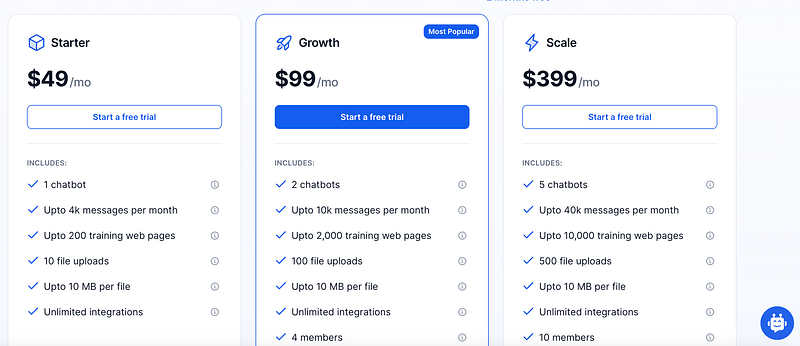

Even the most expensive Enterprise plan costs only $999.
It is not unusual for companies to spend several thousand dollar to implement a chatbot, so it seems much cheaper than a conventional chatbot.
This price structure suggests that the company is likely to receive inquiries from large corporations rather than individuals.
The large increase in sales in February 2024 is probably due to the large increase in contracts with corporations.
However, this type of service requires a considerable API usage fee. First of all, this SiteGPT scrapes information from the site and makes ChatGPT learn a large amount of text information, which costs a certain amount of money at that point.
Then, every time a user uses the chatbot to answer a question, there is an API usage fee.
The business is probably not in a deficit, but I can imagine that the structure is not that profitable.
Let’s do some quick calculations,
The starter plan scrapes a maximum of 200 pages.
Fine Tuning charges about $0.03 for 1000 tokens.
Assuming an average of 3000 tokens per page
200 pages x (3000/1000) x $0.03 = $18
This is a case of learning the maximum number of pages, but it costs this much just for the initial training.
And the maximum number of interactions between the chatbot and the user is 4000.
Assuming that an average of 100 tokens are consumed per round trip, the maximum is 400,000 tokens.
(400,000/1000) * 0.03 = $12.
In the case of max usage, it would cost roughly $30, and since the revenue of the starter plan is $49, the profit would be about $19. Although not in the red, it is clear that the profit margin has been compressed considerably.
Pieter Levels, whom I introduced other article, also said that developing services using AI APIs is quite tough.
Services using APIs are easy to imitate, and the cost is unexpectedly high, making it a tough road for individual developers who are self-funded and cannot compete with startups with strong financial resources raised from VC firms.
However, this is an era in which anyone with an idea can create something.
We should put aside the harshness of the situation and develop products according to our own interests.


