
Beyond the Veil: the Pleiades and the Power of Grief
“Canst thou bind the sweet influences of the Pleiades…?”
It’s a curious question posed to Job in his eponymous Book of the Old Testament. Especially after the last few years, Job is a relatable character: he’s a respected citizen, a devoutly pious man, a caring father, and a hardworking businessman. Yet Job’s story is not a happy one. Over the course of the book, Job sees his livestock stolen, his fields burned, his entire household murdered before he himself is beset with terrible illness. Even when his friends advise him to abandon hope, Job continues to appeal to his faith. He endures months of hardship. When God finally responds to his pleas, it’s with a series of puzzling questions — there are no answers for Job.
But God’s riddles reveal a curious cosmology littered with references to stars and their arrangements. Instead of a causal chain of events to explain his struggles, God grants Job an elevated awareness of the vastness of life. When God asks Job about his ability to command the constellations, it’s a reminder of the influence of these stars on humanity and man’s spiritual ascent beyond. The language of ancient astrology was often a metaphor for moral responsibility and the ability to overcome and expand. In order to understand exactly what these sweet influences represent and why one might wish to bind them, we need to examine the sphere of the Fixed Stars.
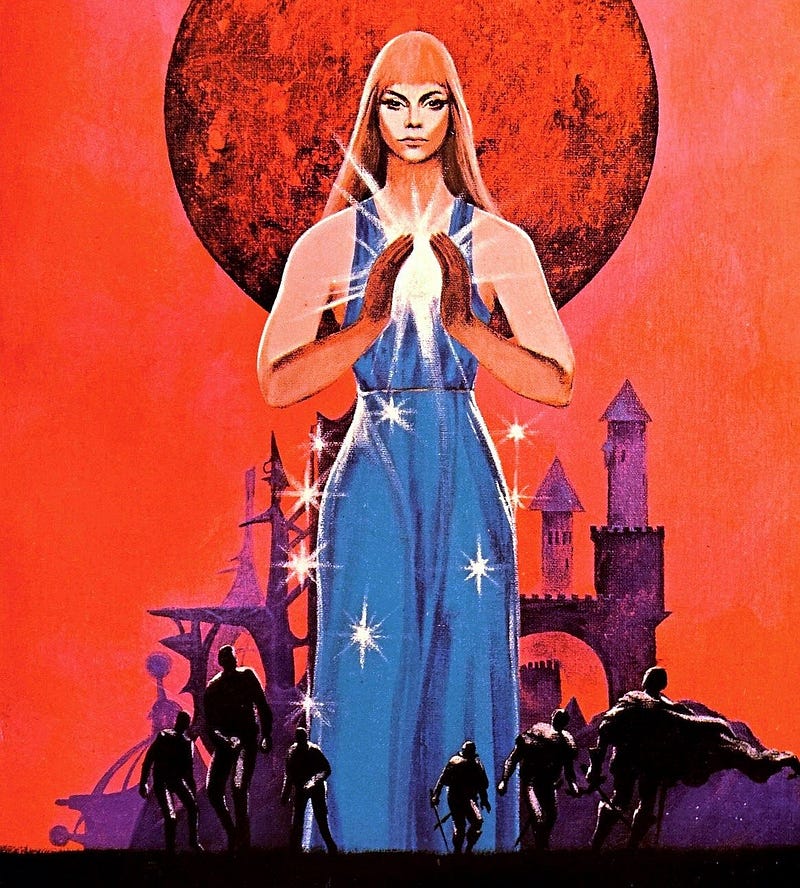
The Pleiades is a system of seven stars located just beneath the shoulder of Taurus. While they’re typically regarded together, Alcyone, the brightest among them, is one of the magical Behenian Stars. Alcyone is fixed at 0 degrees Gemini though Job would have seen it within the final degrees of Taurus as even the fixed stars shift by a minute or so every 72 years. Fixed stars aren’t commonly used in natal astrology, the contemporary bulk of the field, but they were incredibly important to ancient astrologers in their search for information about the passage of time, weather systems, and coming events. They were held in higher esteem than the planets and were considered more noble and resolved than the Wandering Stars. In the Stellar Hierarchy, there was no higher position than the Fixed Stars: they occupied the firmaments themselves, a sphere untouchable by any other power than the angels and God himself.
But a cursory glance at Fixed Star literature will give meanings that seem more Biblical than Divine — even stars considered “fortunate” come with implications of grave injury or misfortune: housefire, flood, death at the hands on one’s enemies. It’s easy to see why their use fell out of favour. But like so many other traditions, we need to look past the literal to see the depth these points bring to a chart.
The Pleiades are associated with blindness and disgrace. Ptolemy, who remains one of the most prolific astrological scholars in history, related each of the fixed stars to the nature of certain planets: the Pleiades, he explained, contained the nature of the Moon and Mars, tying the star system to key words like wantonness, immorality, jealousy, and imprisonment. Before the discovery of the outer planets, the Moon contained all the tumultuous influence of Neptune: it obscured truth and cloaked the world in shadow; it was a false mirror of the Sun’s vital light. The Moon was fickle, fleeting, insubstantial. In the Celestial Hierarchy, the Moon marked the divide between the human world and the heavenly spheres — the Sublunary World was one of logic and reason which were no longer as they seemed beyond. “She is like a mad woman,” Oscar Wilde related in his lunar classic, Salome, “she reels through the clouds like a drunken woman…”
When we look at the Moon as the dark mirror of antiquity, it’s easier to understand how it melts into Mars’ reckless, destructive nature. Pleiadean blindness and disgrace become two words for the same force: sorrow without understanding. Just as Job could not reconcile his suffering and all attempts to ease his pain led to further confusion, the Pleiades represent situations, events, and perhaps even destinies where the cause for our suffering may be too vast to understand. However, like the tribulations of Job, they may lead us into greater power and fortune.
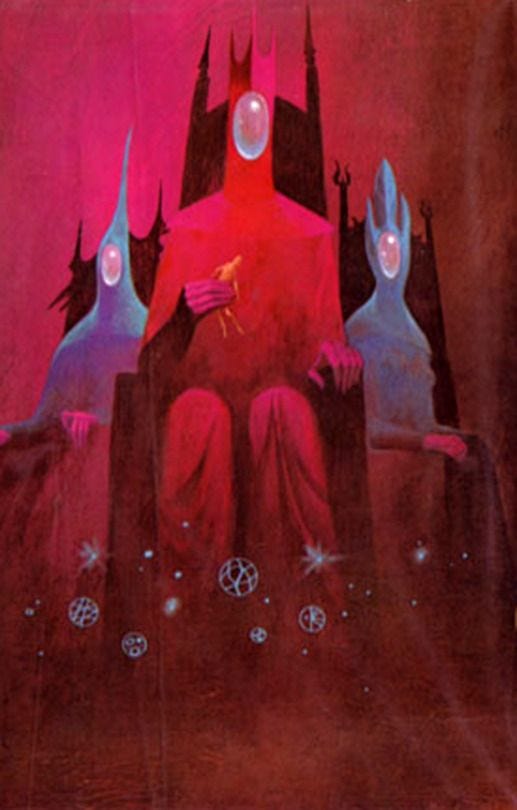
The Pleiades are often called the Weeping Sisters. They were daughters of Atlas, sisters of the Hyades, and their mythology is difficult to pin down. According to some their grief was born from the lonely fate of their father and they were transformed into stars by the pity of the gods so that Atlas may have the company of his children. Others write that without the protective eye of Atlas, the Pleiades were defenseless against the pursuits of Orion who chased them relentlessly into the skies, where they now hide as stars. Still other tales suggest they mourn the death of their sisters the Hyades, or cry for their “lost” sister Merope, the wife of Sisyphus, condemned to a life among mortals. No matter which version of their stories you read, their lives seem necessarily tragic. But it’s exactly this tragedy which immortalizes them in the skies. Like Job, their suffering is rewarded with elevated status and expanded awareness.
It may still feel like a stretch to call the Pleiadean influence “sweet” (and this is likely another example of mistranslation in the infamous King James text) but these stars have long been friends to seekers of the esoteric. Agrippa, Renaissance magic wunderkind, explained that the Pleiades may be evoked to “increase the light of the eyes, to assemble Spirits, to raise Winds, to reveal secret and hidden things.” If we think of the Pleiades as stars of blindness and misfortune it feels unconscionable that we would call on them for anything let alone to remove the very obstacles they represent. But Agrippa drew not only on Ptolemy, but also Hermes Trismegistus, Picatrix, and the Kabbalists and Alchemists of the middle ages: he knew that often, the antidote is part of the poison itself. The sweetness of the Pleiades is not happiness, luck in love or any of life’s other joys, but the understanding that dawns when the veil of darkness is lifted. Grimoires and magical texts refer to rituals of purification preceding work with the Pleiades, fasting, bathing, and suffumigation to cleanse the body and spirit before contact. Magic is a devotional system that seeks to unite the individual with macrocosmic forces and ritual action is often a metaphor for mental processes: just as incense smoke and clean water remove the debris of the material world on our bodies, spiritual crisis strips away the ego, leaving us more receptive to the universe.
The Pleiadean influence recalls the Dark Night of the Soul: we talk about periods of our lives in which suffering pervades, where misfortune and loss seem to fall on us like rain. Even if we can trace its beginning to a singular event — a personal health crisis, the end of a relationship, the death of a loved one — tragedy seems to proliferate, a domino effect of fate. We may retreat into ourselves taking inventory of qualities and behaviors that may have caused our problems, gazing deeply into our own Lunar reflection. Like Job, we can only have faith in a scheme much larger than our perception. If we push past this point, beyond the veil of the Sublunary World, we find an expansive awareness of the universe around us. This is the power of grief: an invitation to remove the blindfold of daily life and install ourselves amongst the stars.
Fairlie Theta is a professional astrologer and lifetime student of the esoteric. You can find more of her work and book a personal consultation through her website, MoonandMajesty.com


