
Beyond the Grind: From Obligation to Enjoyment in Study

I was nearly depressed earlier this year. I was so reluctant to study and nearly dropped out of uni. Since September, I have been improving and working to transform my miserable study experience into an enjoyable journey. Here are five strategies I found really helped.
- Shift your mindset from viewing study as a burden or obstacle to seeing it as an opportunity to learn and grow.
- Set realistic, smaller, and more manageable subtasks.
- Engage in active learning by taking notes, creating summaries, or sharing ideas with friends.
- Incorporating interests, to find connections between your interests and what you’re studying.
- Reward yourself with things like small treats, breaks, or activities you enjoy.
After writing those tips down, I realize most of them are essential for game design. By using these techniques, we essentially turn studying into gameplay!
- By shifting your mindset, you create a top-view storyline where you are an adventurer exploring a world.
- There are clear task logs and progress indicators. The principle is to break down the major challenge into many steps that are easy enough to manage. Easy enough so when you get stuck you can google or learn from others easily. This is similar to getting stuck in a game sometimes.
- Active learning, which involves sharing ideas, clearly applies to gameplay.
- The reward system is key to a game, you intensively get positive feedback! The main drawback of studying is that positive feedback often seems beyond the horizon. It is extremely difficult for you to hold on and try multiple times, and you give up easily because you can’t see what it is the point of doing so.
- There’s no need to incorporate interest when you play a game, as the game itself is the interest. I think this is the most difficult to design when comes to study. Well, if your interest is study then it would be easy for you. but how can I incorporate interest into my current study?
The first and the third strategies are easier. I am studying how to build machine learning models to solve traffic problems. It is a good learning experience, and with it, I can build models to solve other problems in the future. It’s difficult to share these ideas with my close friends since their majors aren’t in IT/CS, but I can share them on platforms like Medium or YouTube.
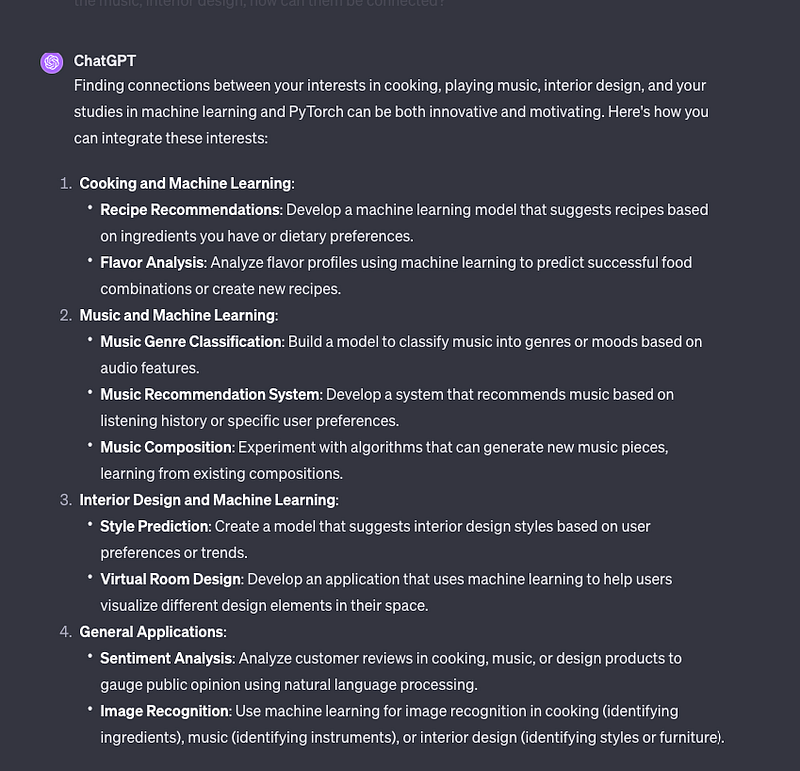
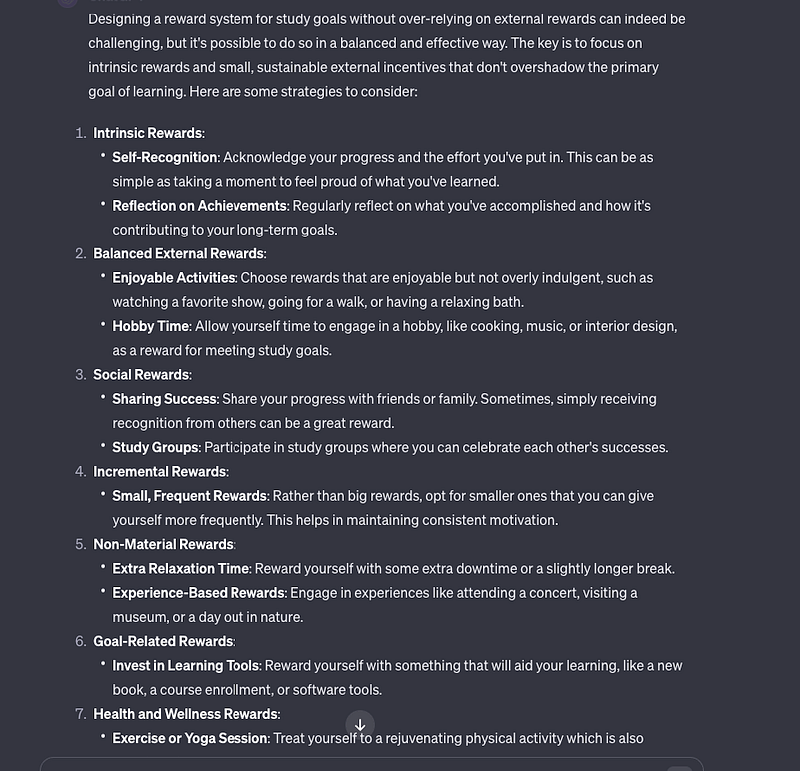
The more complex step involves connecting it to my interests, listing detailed yet straightforward sub-tasks, and setting up a reward system. Designing rewards is complex because we don’t want to overly tie the study experience to external prizes.
GPT gave me some inspiration though.
- Finding connections
2. Reward design
In short, applying techniques used by game designers to make gameplay addictive can be helpful. This isn’t a new idea; I remember watching something about it before. I hope it can help me make significant progress in my studies this month.