
Beyond the Closet: Reflections & Revelations from Two Decades of Queerness
As a teenager I never could have imagined that such a varied community of beautiful LGBTQ+ individuals awaited me later on
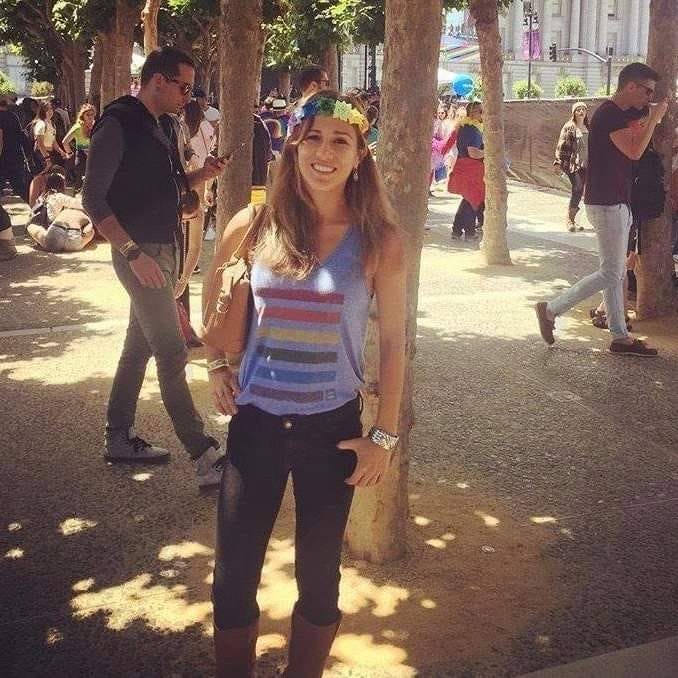
Though I’ve known I was gay since around the age of 12, for years shame kept me from admitting it. I wrote in this story about how I danced around the gay/lesbian label even in the supposed privacy of my own diary. I’d fill its pages with circumlocutory fawning over my crushes (all of it coded as platonic admiration).
After finally taking the plunge by coming out first to my diary at age 15, and then to friends and family at 18, my self-acceptance slowly grew. Firsts and milestones marked a growing comfort with what had once seemed so formidably off limits. From college on, I finally felt connected to larger queer community.
Here’s some of what I’ve learned and experienced in my decade and a half of living outside the closet.
1. Parental support has meant so much.
Mine in large part allowed me to (proudly) own my gay identity, navigate the queer scene freely at a relatively young age, and date and live openly back when queerness wasn’t as accepted or normalized. Without it, I have no doubt things would’ve been far more difficult.
Through the years my dad has frequently saved newspaper articles for me about developments on the LGBT rights front. When Kristen Stewart and her fiancé got engaged, Dad knew before me (and was the first to inform me of it). My mom has welcomed every woman I’ve brought home with warmth and open arms. Over the years both of them have come with me to Frameline Film Festival movies, as well as Pride-themed baseball and soccer matches.
Too many queer friends I’ve met through the years have shared less-than-idyllic stories about coming out to their families. One’s mother cried inconsolably. Another’s, while out to lunch with her, “playfully” tried to set her up with their male waiter immediately after she’d disclosed her orientation. Still another’s parents simply refused to ever speak about it with him.
When a parent doesn’t accept you, it can feel devastating. It creates cognitive dissonance and the need to hide and compartmentalize the full range of who you are. Queer Uruguayan-American author Carolina de Robertis highlights the unique position that LGBTQ+ children of heterosexual parents or caregivers are in:
“Homophobia is in some ways unique among oppressions in that most gay, lesbian, bisexual, transgender, plus people are not raised by people who share that culture with them. So most, not all, but most children of color are raised by people of color. And there can be an enormous amount of hostility and bigotry and racism that that child is going to grow into and learn to deal with in society. And, of course, internalized racism exists. But most of the time, they have at least some mirror or some pathway for how to feel loved within their home culture as they then navigate the greater culture and the ways that it won’t see them.
Whereas queer children are often born to straight parents. It’s very common. And sometimes those people can be embracing, but sometimes those parents are not actually equipped. The culture into which the queer person is born is not equipped to actually recognize that child and then that person’s full humanity.”
2. So has chosen queer family.
Said Robertis in an interview with me last year:
“One of the messages I’d received from my immigrant parents was ‘you can’t be both gay and Uruguayan.’ And I felt that message in my bones, and really wanted to resist it. So I went to Uruguay sort of looking for lesbians. I really wanted to find a way toward being able to fully exist as all of who I was, without having to sacrifice any aspect of my truth or culture. Once there I found this woman who is now one of my best friends, and whom I to this day consider chosen family.”
Her novel Cantoras centers on the relationships between five queer women in a beachside village during Uruguay’s 1970s dictatorship. These women find chosen family in a time when “it was incredibly dangerous to be seen as subversive in any way,” according to de Robertis.
In the early 1970s, the homophile movement emerged to promote the message “Gay is Good” (inspired by the Black Pride Movement). It encouraged gay affirmative therapies whose goal was not to change, but find happiness with one’s orientation, over gay conversion therapies.
Many LGBTQ+ people embrace this ethos as we step into our queer identities. I met my first gay friend in study hall my senior year of high school. There was an almost instant camaraderie. We’d spend hours in the gay section at Borders, thumbing through stories of same-sex love that we both yearned to assume leading roles in. For the time though, we experienced them vicariously, side by side with our backs against those bookshelves.
When we’re younger we lack full agency. Once we’re older though, we can choose environments we thrive in. In college my world began to overflow with queer friends and acquaintances from different walks of life. Years before then, I never could have imagined that such a varied community of beautiful LGBTQ+ individuals awaited me later on. They’ve gradually helped to replace every last ounce of inner shame with pride.
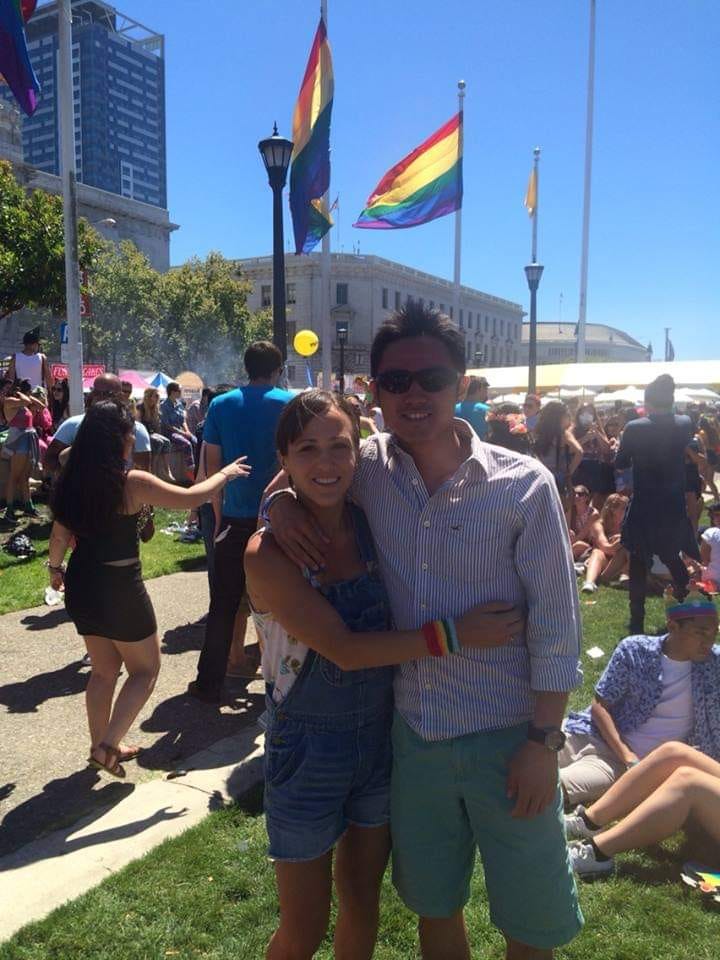
With other queer people there’s often just this unspoken understanding that helps to slowly heal some of the past hurts and traumas.
3. Many people still carry around a rather archaic idea that sexuality looks and sounds a certain way.
Constant assumptions of heterosexuality frustrated and wearied me over the years. Ready for a change, in 2013 I decided to alter my look by chopping off my hair. I was living down in Uruguay at the time.
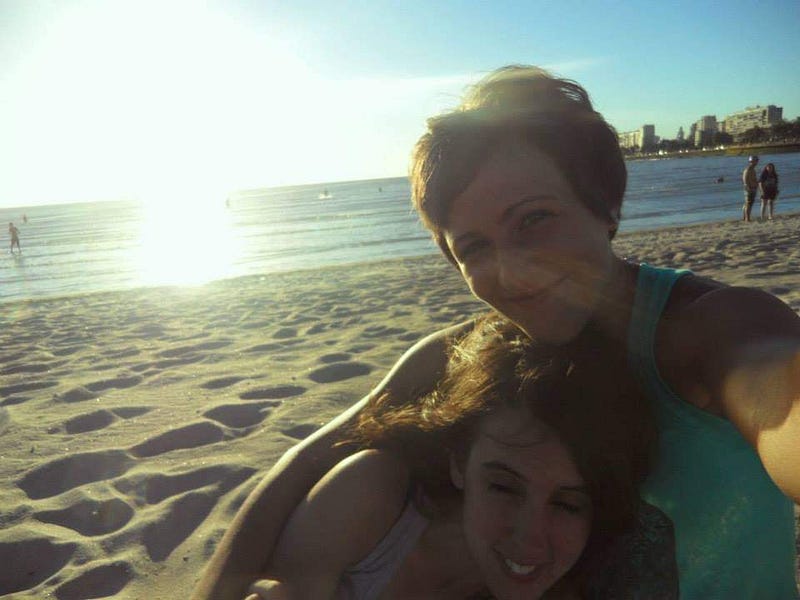
I noticed an immediate difference in the way people perceived me when my appearance no longer channeled conventional femininity. Cat-calling from men toned down. More women approached me than ever before.
Yet super short hair didn’t feel like “me” – so eventually I grew it out again. I do wish for a world wherein appearance-based assumptions cease to be made, especially when they’re wrapped in the packaging of belief in heterosexuality as superior.
I’d like to think we’re slowly getting there.
4. It’s taught me to think about concepts in less black and white ways.
Being queer has made me more aware of many aspects of our society that are socially constructed. It’s led to questioning what we’ve been told, and to tracing the origins of our definitions for “right” and “wrong” as well as the origins of any long-standing societal institution — be it marriage, heterosexuality, subjugation of animals, or individualism over interconnectedness. It’s encouraged me to locate eras, cultures, or groups that did things differently, unto what outcomes.
Gender is one of those things that’s socially constructed, organized into a black and white structure that leaves little space for categorical blending. Binary is the air we breathe. Though I identify as femme and society reads me as such, like many humans a mix of masculine and feminine traits make up my interior. And yet like the vast majority of us do, I’ve merely chosen and settled on the gender I identify most closely with. This doesn’t eliminate the grey area though.
Mary Bem was the first to pioneer an idea that challenged this model. She developed a test that determines a person’s gender on a scale rather than assigning it an absolute value. “People of either sex can be rated as being mostly feminine or masculine, or having equal traits of both sex roles, or not identifying strongly with either role,” writes betterhelp.com’s description of her work.
But her ideas still have yet to be embraced by mainstream society. Transgender individuals often find themselves at a crossroads between bridging the male and female aspects of their identity. In a movie that MTF author Joelle Ryan Ruby wrote about in “Reel Gender,” the character Michael misses opportunities. Jobs turn him down for reasons pertaining to his unclassifiability and overlapping identities. For instance, although he acts his heart out for each audition, ‘he is told he is not the right age, size, doesn’t have the right look for the part, etc” (Ruby 23).
In her article “Butch / Femme Lesbian Space,” scholar Alison Eves writes about how falling between masculine and feminine on the gender spectrum is looked at with confusion. Because “a minority of lesbians self-identify as ‘butch’ or ‘femme’ in contemporary UK lesbian communities,” most lesbians must therefore deal with discomfort at their inability to be categorized.
Encountering these sorts of situations in the community has encouraged me to think of all kinds of concepts— from sexual orientation to mental health conditions to attachment styles — in a generally less binary way. The vast majority of things fall along on a spectrum in my opinion.
5. Determining one’s sexuality isn’t always clear cut for women, due to comp het and other contributors.
As a kid, each month I’d rip open the latest issues of Tiger Beat and J-14 for their latest batch of dreamy celebrity pin-ups. Images of David Gallagher and Jonathan Taylor Thomas plastered my walls (a note to the evangelical Christians: exposure therapy truly does not work as a cure for homosexuality).
In high school I briefly had a boyfriend. We got along well and shared a similar sense of humor. But though I was attracted to his personality, he wasn’t the star of my erotic dreams by any means, and I somewhat knew this from the start (though at times I did experience the faintest flicker of attraction with other boys I dated as a teenager).
The night we became official I even wrote in my diary: I have a boyfriend now. Goofy-looking, random, a talker who doesn’t dominate our conversations but says enough to keep me engaged, an obscure thinker, my date for the spring dance.
Time brought me to the gradual realization that the faint flicker I mentioned earlier wasn’t enough to keep the flame of a long-term relationship burning. More closely it resembled a trick candle on a birthday cake that could never stay lit for the entire song — whereas what I felt for women was strong enough to burn for several lifetimes.
I relate to what author Jill Gutowitz put it, “I wondered…could you date boys, and also be a lesbian? (Yes, and I did that for years — it’s very different from being bi or pansexual).” Glennon Doyle had never been with a woman before meeting her wife Abby Wambach. Though she’d had a relationship with a man for most of her adult life, she now identifies as gay.
Despite the legitimacy and prevalence of bisexuality, not everyone is bi in a dead-even, fifty-fifty sense. And not every woman who initially identifies as fluid or bisexual does so for the uncomplicated reason of simply feeling it in her heart.
So even though I mentioned in my last point that most things fall along a spectrum, for simplicity’s sake it’s also valid to choose a label that we feel best fits us.
Which leads to the next point…
6. We’d ideally live in a label-free world, but at least for now they do serve some purpose.
Unfortunately sexual orientation in many parts of the world isn’t yet a non-issue. After coming out my eyes began opening to all the subtle (and not as subtle) ways that heteronormativity shrouds us all. My repetition of “gay” and “lesbian” as self-identifiers were the engines I used to power against those hetero waves that threaten to engulf.
Labels can be helpful templates. Adopting one can provide belonging, help people feel less alone, and connect us to the resources we need as well as larger community. Power exists in group identification.
As Esmé Weijun Wan wrote in The Collected Schizophrenias, “Some people dislike diagnoses, disagreeably calling them boxes and labels, but I’ve always found comfort in preexisting conditions. I like to know that I’m not pioneering an inexplicable experience.
When I blend in, it doesn’t feel like equality — it can even feel like a form of erasure. And so I wear my label and it doesn’t make me feel boxed in.
Happy Pride month to my fellow LGBTQ+ readers and allies!


