ange-name-ship.htm">why</a> you don’t change a ship’s name, especially if it’s destined for war.</p><h1 id="6c04">How To See Above and Beyond</h1><p id="23b7">The impact of the atmosphere on radar waves has been extensively <a href="https://books.google.com.ar/books?hl=es&lr=&id=Jw9RAAAAMAAJ&oi=fnd&pg=PA1&ots=_Sdlz6IQCl&sig=FMiNowdn1jGqULp9XB8knV8bw48&redir_esc=y#v=onepage&q&f=false">studied</a> for nearly a <a href="https://books.google.com.ar/books?hl=es&lr=&id=5vTp4hfuigYC&oi=fnd&pg=PR7&ots=kxAasdbYD-&sig=msodXpdifhT2bxGj8gzO1rJE1us&redir_esc=y#v=onepage&q&f=false">century</a>. It’s known that radars can see beyond the geometric horizon due to the Refraction Effect. Because of it, radars generally see somewhat beyond the geometric horizon. During the Cold War, powerful radar stations were built to detect objects over 3000 kilometers away using low-frequency radio waves that are refracted in the ionosphere. However, these systems couldn’t accurately pinpoint small targets like ships.</p><p id="2b20">The effective Earth radius model, which assumes a 4/3 Earth radius, is commonly used to <a href="https://ieeexplore.ieee.org/abstract/document/1457400">calculate</a> radar horizon under normal atmospheric conditions. This model extends the horizon about 15% further than the geometric horizon. But the atmosphere doesn’t always conform to this model. Radar waves can be refracted more or less depending on meteorological conditions. During anomalous propagation conditions, low-lying clouds and precipitation could refract echoes back to the radar, similar to a glass lens bending visible light. This allows the radar to detect targets near the Earth’s surface at distances <a href="https://pascal-francis.inist.fr/vibad/index.php?action=getRecordDetail&idt=7739610">far beyond</a> the normal radar horizon.</p><figure id="e136"><img src="https://cdn-images-1.readmedium.com/v2/resize:fit:800/1*vnvhtbVnMvGVKoMktGgBiQ.jpeg"><figcaption><b>Map over the Black Sea showing assumed positions of the Mineral-U radar (blue circle) and the warship <i>Moskva</i> (red star) at the time of the anti-ship missile launch. A gray circle shows the radar horizon, 46 km from the radar. A large red plus sign marks where the <i>Moskva</i> was located by satellite at 1852 LT 13 Apr 2022. Small black plus signs show grid points of the ERA5 reanalysis dataset. Citation: Bulletin of the American Meteorological Society 104, 12; </b>(Source: <a href="https://doi.org/10.1175/BAMS-D-23-0113.1">10.1175/BAMS-D-23–0113.1</a>)</figcaption></figure><p id="bdbc">Norin et. al. used <a href="https://ui.adsabs.harvard.edu/abs/1994STIN...9533231H/abstract">Detvag’s</a> wave propagation model to investigate if a similar phenomenon occurred in the case of the <i>Moskva</i>. At 186 meters long and 20 meters tall, the substantial size of the <i>Moskva</i> provided a significant radar cross-section for radio waves to reflect off. Although the specifications of the Mineral-U radar are not publicly available, estimates were made using open sources about the similar Russian Mineral-ME radar. According to Mineral-ME’s <a href="http://progress.gov.ua/wp-content/uploads/2020/08/radar-radio-communication-and-air-defence-systems.pdf">datasheets</a>, its operating frequency is in the X band (8–12 GHz), used by the Swedish team to calculate that under normal atmospheric conditions and assuming a shoreline position 45 meters above sea level, Mineral-U could detect the <i>Moskva</i> up to 46 kilometers offshore, about 6 kilometers beyond the distance at which the ship would become visible above the horizon. According to Ukrainska Pravda, the <i>Moskva</i> was 120 kilometers away from the coast. The Swedish team assumed the ship’s location at the time of the missile launch to be 45.40°N, 30.75°E, approximately 135 kilometers from the northern shore, three times the radar’s normal range.</p>
<figure id="d41f">
<div>
<div>
<img class="ratio" src="http://placehold.it/16x9">
<iframe class="" src="https://cdn.embedly.com/widgets/media.html?type=text%2Fhtml&key=a19fcc184b9711e1b4764040d3dc5c07&schema=twitter&url=https%3A//twitter.com/Azovsouth/status/1629147499737845761&image=" allowfullscreen="" frameborder="0" height="281" width="500">
</div>
</div>
</figure></iframe></div></div></figure><p id="c166">But could atmospheric conditions bend the radar’s radio waves and the returning echoes <i>that</i> far over the horizon?</p><h1 id="dacb">Defining Meteorological Conditions</h1><p id="6085">Using meteorological reanalysis data from the European Centre for Medium-Range Weather Forecasts (ECMWF), Norin et. al. analyzed the atmospheric conditions at the reported time and location of the Ukrainian anti-ship missile launch.</p><figure id="6672"><img src="https://cdn-images-1.readmedium.com/v2/resize:fit:800/1*6nfrAk2n1wFOyRuOSrC_zA.jpeg"><figcaption>Information on large-scale meteorological conditions can be obtained by studying<b> <a href="https://www.eumetsat.int/media/41623">satellite imagery</a></b> from the Meteosat Second Generation (MSG) satellites for different hours of the day during 13 April 2022. MSG are geostationary meteorological satellites operated by the European Organisation for the Exploitation of Meteorological Satellites (EUMETSAT).</figcaption></figure><p id="9470">The images reveal that in the early hours of April 13, 2022, a Russian low-pressure system, northeast of the Sea of Azov and northwest of the Caspian Sea, geared up. Shifting westward, it planted itself just north of the Sea of Azov in Ukraine by late afternoon. The result? Cyclonic winds slashing northward, aligning almost perfectly with the Ukrainian coast and the potential line of sight between the Mineral-U radar and the <i>Moskva</i>. These winds persisted from early afternoon to late evening, ushering warm continental air over the moisture-laden Black Sea.</p><p id="c817">The capping temperature inversion became the secret ingredient, trapping moisture in the lowermost boundary layer and birthing near-isothermal conditions. Low-level clouds, drawn along the radar and warship line of sight, provided the cover for a tactical advantage. Thick clouds allowed the radar to extend its reach, the pulses and pings riding Earth’s curvature farther than usual. According to Norin’s team, the Detvag model’s parameters indicated the Mineral-U r
Options
adar could <i>“easily have been able to detect the warship in the afternoon and evening on 13 April 2022, but not earlier (or later) in the day.”</i> The scientists assert that the targeting occurred as soon as these conditions allowed for detection, presenting a timeline seamlessly aligned with the atmospheric dynamics at play.</p><h1 id="15a7">The Age of Global Boiling</h1><p id="9ca8">2023 was not an ordinary year. We may now be living in a moment that history will regard as a turning point in the human story. Certainly, not in the right direction. We find ourselves caught in a tide of anger, resentment, and regression, precisely when we should be making better, wiser choices.</p><p id="c2f5"><i>Is this what we human beings are limited to, an endless wheel of suffering? Aren’t we capable of more?</i></p><p id="8865">The arrival of climate change’s mega-catastrophic impacts was nothing short of shocking. Temperatures soared on land, at sea, and in the air. Devastating wildfires broke out, crops failed, and droughts spread. We now stand on the brink of unknown and potentially severe consequences.</p><p id="1788">And it wasn’t just the environment that suffered. The very systems that support us began to crumble. The world plunged into a bitter and brutal “cost of living” crisis. Predatory capitalism pushed people in the Global North to the brink of financial trauma. But even they are considered lucky.</p><p id="2811">The world — the mess we’ve made of it — watched Israel explicitly <a href="https://casebook.icrc.org/case-study/water-and-armed-conflicts">committing war crimes</a>, cutting off essential resources to the two million people trapped in the world’s biggest open-air prison, a.k.a. Gaza, were the most unfortunate souls watched their kids die in their arms and trying to live another day with 3 liters of water. All for a <a href="https://www.planetcritical.com/p/everybody-wants-gazas-gas">network of pipelines</a> in the Middle East to feed the “free world”.</p><p id="9630">Meanwhile, Russia is spending so much on its war in Ukraine (one that has now almost 2 years since February 24, 2022, bringing only death and destruction) that it is draining resources from the rest of the economy, <a href="https://www.foreignaffairs.com/russian-federation/putins-unsustainable-spending-spree">according</a> to Alexandra Prokopenko, a former Russian central bank official. Military spending, comprising more than a third of the <a href="https://www.reuters.com/world/europe/everything-front-russia-allots-third-2024-spending-defence-2023-10-02/">2024 budget</a>, has overshadowed social expenditures for the first time since the fall of the Soviet Union.</p><blockquote id="1f86"><p><i>Because, as my financial adviser <a href="undefined">Denis Gorbunov</a> <a href="https://denisgorbunov.substack.com/p/ive-made-these-3-investing-principles">says</a>:</i> “It’s not that war motivates people to work more. Far from it. People get depressed even if your country (inevitably) protects its interests. The military sector receives a financial stimulus to boost R&D, optimize costs, and hike manufacturing. It’s the most obvious winner from soldiers shooting each other. The German company <a href="https://www.rheinmetall.com/en">Rheinmetall</a> has made a killing (it produces tanks for Ukraine). <b>We’d have fewer wars (or they’d end more quickly) if there weren’t so much money involved.</b> For the military, this means producing more stuff that kills people.”</p></blockquote><p id="ac49">But it’s not just about money. The military sector is <i>“siphoning off”</i> talent from the <a href="https://www.businessinsider.com/russia-lacks-workers-ukraine-war-labor-crisis-worker-shortage-2023-12">civilian workforce</a>, resulting in an abnormally low unemployment rate of 2.9% — down from 4% to 5% before the war, Prokopenko <a href="https://www.foreignaffairs.com/russian-federation/putins-unsustainable-spending-spree">wrote</a>. The backlash? A <a href="https://www.businessinsider.com/russian-economy-brain-drain-labor-shortage-workforce-exodus-capital-flight-2023-9">massive brain drain</a>, threatening social and developmental needs.</p><p id="a4bd">And then you add the incomprehensible number of <a href="https://war.ukraine.ua/faq/what-are-the-russian-death-toll-and-other-losses-in-ukraine/"><b>360,000+ Russian soldiers lost</b></a><b> in Ukraine as of January 1, 2024, according to</b> <a href="https://www.facebook.com/GeneralStaff.ua">daily reports</a> about the situation on the frontline kept by the General Staff of the Armed Forces of Ukraine, and the situation is just dystopian. These casualties would have <a href="https://www.economist.com/europe/2023/11/01/ukraines-commander-in-chief-on-the-breakthrough-he-needs-to-beat-russia">ended</a> the war in any other country, but Russia seems to operate by its own rules.</p><figure id="d7ad"><img src="https://cdn-images-1.readmedium.com/v2/resize:fit:800/1*VOXFykH-vu-TI2EK59de4A.png"><figcaption>Source: <a href="https://war.ukraine.ua/faq/what-are-the-russian-death-toll-and-other-losses-in-ukraine/">War.Ukraine</a></figcaption></figure><p id="713b">History will judge us for embracing this destructive spiral. It may sound harsh, but the evidence speaks for itself. They’re all Darwinian mechanisms, essentially, whether applied to economics, geopolitics, society, or culture. Hurt people, and the strong will rise, and the weak will fall, leading to a better world is the thought process.</p><p id="df9a">But nobody’s better off this way.</p><p id="e4ae">Sure, suffering is also part of life, but hurting people only corrodes trust, replacing it with brutality and hate, leaving broken-spirited individuals consumed by tension, panic, and anger. The UN Secretary-General António Guterres <a href="https://www.un.org/sg/en/content/sg/speeches/2023-07-27/secretary-generals-opening-remarks-press-conference-climate">called it</a> the <b>“age of global boiling.”</b></p><p id="cc11"><i>What’s that going to cost us? How much freedom will we have in a world where essential resources like air, water, and food are scarce?</i></p><p id="0216">Be loud.</p><p id="43e6"><i>Thank you for your thorough reading and support!
<a href="https://rickylanusse.medium.com/subscribe"><b>Subscribe</b></a><b> </b>for immediate insights and join the 400+ <a href="https://rickylanusse.substack.com/?utm_source=navbar&utm_medium=web&r=271e6q"><b>Antarctic Sapiens</b></a> community for weekly thought-provoking content.</i></p></article></body>
Ukraine’s “Lucky Break” in the Downfall of a Russian Warship
Beyond Radar Limits: Decoding the Military Enigma Amidst the Age of Global Boiling
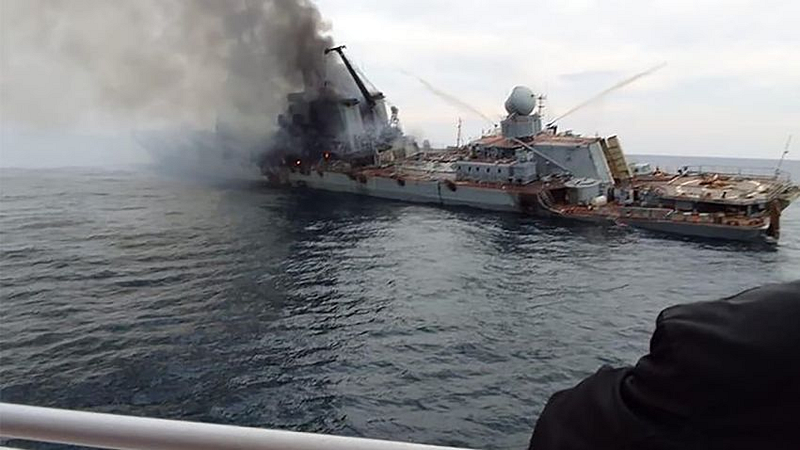
In a scene ripped from the pages of a geopolitical thriller, the Russian-guided missile cruiser Moskva was sailing with stoic resolve, its imposing silhouette dominating the horizon more than 100 kilometers south of the Ukrainian city of Odesa.
But as the winds slashed through the Black Sea, they brought with them a strange alliance of conditions: an ominous backdrop for the events that followed. Explosions, sudden and violent, shook the very core of the Moskva, and the vessel, defiant in its power, succumbed to the depths.
Hours later, Ukraine would claim responsibility for the attack with two Neptune anti-ship missiles. The sinking of the Black Sea fleet flagship was the biggest wartime loss of a naval ship in 40 years — and a huge embarrassment for Russia.
Yet, in the murky depths of this maritime warfare, a puzzle emerged that baffled even the most seasoned analysts. Before a missile is launched, a target must be detected, typically by radar. The Russian guided missile cruiser was far beyond the reach of 50 km of conventional radar, comfortably nestled beyond the watchful eyes of ground-based detection systems some 135 km from the coast. Under normal circumstances, she should have been navigating undetectable, a phantom on the vast expanse of the Black Sea.
So, how does one target the untouchable? How did Ukrainian forces breach the veil of invisibility, cloaking the Moskva? Did they receive collaboration from their allies?
This is how the mystery of oddities and military precision unfolded on the night of April 13, 2022.
Don’t Change a Ship’s Name
The warship Moskva (originally named Slava) was commissioned into the Soviet Union Navy in 1983. At the time of construction, not much effort was put into making the ship stealthy. With a length of around 186 m and a height of more than 20 m above sea level, the ship’s radar cross-section (RCS) was substantial.
When the world woke on 14 April 2022, news media were already reporting the explosions on the Russian vessel, and a few days later, brought the news of its definitive shipwreck as a result of the damage she sustained. It became clear that the explosions were the result of the warship being hit by two Ukrainian R-360 Neptune anti-ship missiles.
But, as stated before, the Ukrainian R-360 Neptune anti-ship missile launch was far beyond the normal radar horizon of any ground-based radar system, even the Neptune’s accompanying search-and-track radar, Mineral-U, which detects surface targets and provides the targets’ coordinates to the missile launcher. Immediate speculation pointed out that Moskva’s coordinates were provided by U.S. aircraft, which at that time, would have been quite a big step for the U.S. to have shared that information. This was later denied, and the circumstances of such a military feat remained unexplained.
Until eight months later, in December 2022, an article published in the newspaper Ukrainska Pravda pointed to a yet uncharted explanation: the weather conditions.
Could the atmospheric characteristics on 13 April 2022 enable the Mineral-U radar to extend its range to detect the Moskva?
Multiple interviews with military personnel involved in the missile launch revealed that the crew operating the R-360 Neptune anti-ship missile system detected a large target on their radar at approximately 1600 local time. Concluding that it was likely the Russian warship Moskva, they fired two missiles within minutes.
New modeling, published a year later in December 2023 in the Bulletin of the American Meteorological Society, supports the theory: anomalous atmospheric conditions may have greatly extended the range of the Ukranian missile radar. They caught a lucky weather break.
That’s why you don’t change a ship’s name, especially if it’s destined for war.
How To See Above and Beyond
The impact of the atmosphere on radar waves has been extensively studied for nearly a century. It’s known that radars can see beyond the geometric horizon due to the Refraction Effect. Because of it, radars generally see somewhat beyond the geometric horizon. During the Cold War, powerful radar stations were built to detect objects over 3000 kilometers away using low-frequency radio waves that are refracted in the ionosphere. However, these systems couldn’t accurately pinpoint small targets like ships.
The effective Earth radius model, which assumes a 4/3 Earth radius, is commonly used to calculate radar horizon under normal atmospheric conditions. This model extends the horizon about 15% further than the geometric horizon. But the atmosphere doesn’t always conform to this model. Radar waves can be refracted more or less depending on meteorological conditions. During anomalous propagation conditions, low-lying clouds and precipitation could refract echoes back to the radar, similar to a glass lens bending visible light. This allows the radar to detect targets near the Earth’s surface at distances far beyond the normal radar horizon.
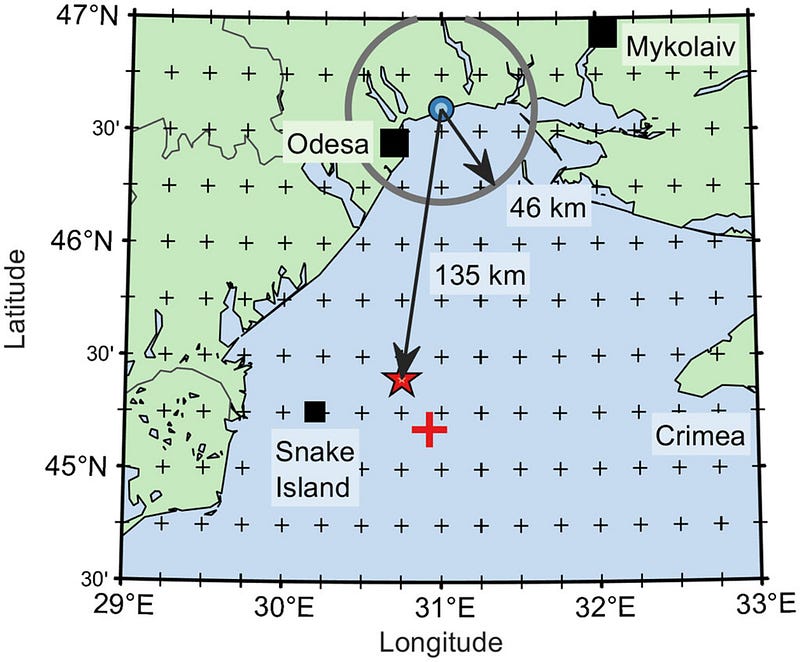
Map over the Black Sea showing assumed positions of the Mineral-U radar (blue circle) and the warship Moskva (red star) at the time of the anti-ship missile launch. A gray circle shows the radar horizon, 46 km from the radar. A large red plus sign marks where the Moskva was located by satellite at 1852 LT 13 Apr 2022. Small black plus signs show grid points of the ERA5 reanalysis dataset. Citation: Bulletin of the American Meteorological Society 104, 12; (Source: 10.1175/BAMS-D-23–0113.1)
Norin et. al. used Detvag’s wave propagation model to investigate if a similar phenomenon occurred in the case of the Moskva. At 186 meters long and 20 meters tall, the substantial size of the Moskva provided a significant radar cross-section for radio waves to reflect off. Although the specifications of the Mineral-U radar are not publicly available, estimates were made using open sources about the similar Russian Mineral-ME radar. According to Mineral-ME’s datasheets, its operating frequency is in the X band (8–12 GHz), used by the Swedish team to calculate that under normal atmospheric conditions and assuming a shoreline position 45 meters above sea level, Mineral-U could detect the Moskva up to 46 kilometers offshore, about 6 kilometers beyond the distance at which the ship would become visible above the horizon. According to Ukrainska Pravda, the Moskva was 120 kilometers away from the coast. The Swedish team assumed the ship’s location at the time of the missile launch to be 45.40°N, 30.75°E, approximately 135 kilometers from the northern shore, three times the radar’s normal range.
But could atmospheric conditions bend the radar’s radio waves and the returning echoes that far over the horizon?
Defining Meteorological Conditions
Using meteorological reanalysis data from the European Centre for Medium-Range Weather Forecasts (ECMWF), Norin et. al. analyzed the atmospheric conditions at the reported time and location of the Ukrainian anti-ship missile launch.
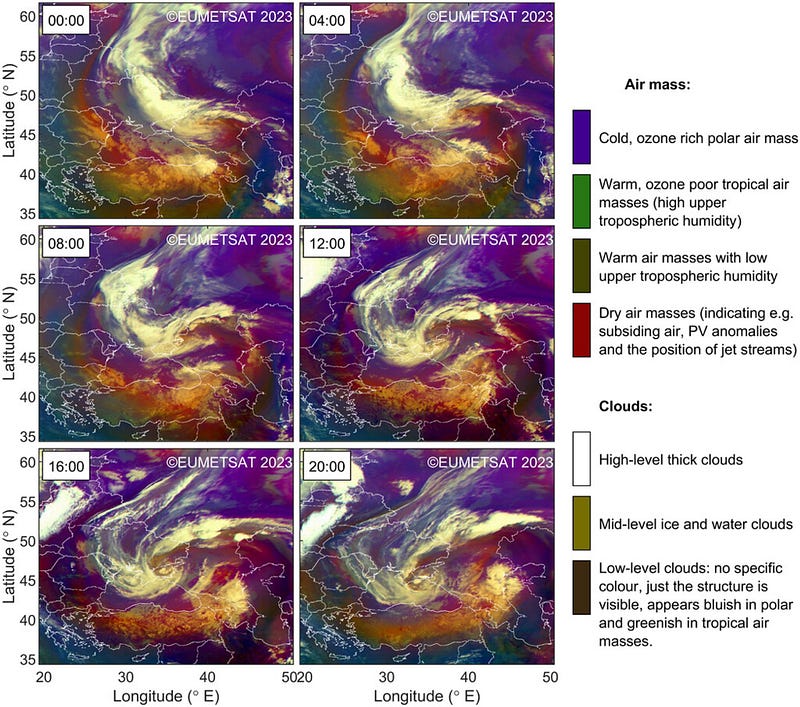
Information on large-scale meteorological conditions can be obtained by studyingsatellite imagery from the Meteosat Second Generation (MSG) satellites for different hours of the day during 13 April 2022. MSG are geostationary meteorological satellites operated by the European Organisation for the Exploitation of Meteorological Satellites (EUMETSAT).
The images reveal that in the early hours of April 13, 2022, a Russian low-pressure system, northeast of the Sea of Azov and northwest of the Caspian Sea, geared up. Shifting westward, it planted itself just north of the Sea of Azov in Ukraine by late afternoon. The result? Cyclonic winds slashing northward, aligning almost perfectly with the Ukrainian coast and the potential line of sight between the Mineral-U radar and the Moskva. These winds persisted from early afternoon to late evening, ushering warm continental air over the moisture-laden Black Sea.
The capping temperature inversion became the secret ingredient, trapping moisture in the lowermost boundary layer and birthing near-isothermal conditions. Low-level clouds, drawn along the radar and warship line of sight, provided the cover for a tactical advantage. Thick clouds allowed the radar to extend its reach, the pulses and pings riding Earth’s curvature farther than usual. According to Norin’s team, the Detvag model’s parameters indicated the Mineral-U radar could “easily have been able to detect the warship in the afternoon and evening on 13 April 2022, but not earlier (or later) in the day.” The scientists assert that the targeting occurred as soon as these conditions allowed for detection, presenting a timeline seamlessly aligned with the atmospheric dynamics at play.
The Age of Global Boiling
2023 was not an ordinary year. We may now be living in a moment that history will regard as a turning point in the human story. Certainly, not in the right direction. We find ourselves caught in a tide of anger, resentment, and regression, precisely when we should be making better, wiser choices.
Is this what we human beings are limited to, an endless wheel of suffering? Aren’t we capable of more?
The arrival of climate change’s mega-catastrophic impacts was nothing short of shocking. Temperatures soared on land, at sea, and in the air. Devastating wildfires broke out, crops failed, and droughts spread. We now stand on the brink of unknown and potentially severe consequences.
And it wasn’t just the environment that suffered. The very systems that support us began to crumble. The world plunged into a bitter and brutal “cost of living” crisis. Predatory capitalism pushed people in the Global North to the brink of financial trauma. But even they are considered lucky.
The world — the mess we’ve made of it — watched Israel explicitly committing war crimes, cutting off essential resources to the two million people trapped in the world’s biggest open-air prison, a.k.a. Gaza, were the most unfortunate souls watched their kids die in their arms and trying to live another day with 3 liters of water. All for a network of pipelines in the Middle East to feed the “free world”.
Meanwhile, Russia is spending so much on its war in Ukraine (one that has now almost 2 years since February 24, 2022, bringing only death and destruction) that it is draining resources from the rest of the economy, according to Alexandra Prokopenko, a former Russian central bank official. Military spending, comprising more than a third of the 2024 budget, has overshadowed social expenditures for the first time since the fall of the Soviet Union.
Because, as my financial adviser Denis Gorbunovsays: “It’s not that war motivates people to work more. Far from it. People get depressed even if your country (inevitably) protects its interests. The military sector receives a financial stimulus to boost R&D, optimize costs, and hike manufacturing. It’s the most obvious winner from soldiers shooting each other. The German company Rheinmetall has made a killing (it produces tanks for Ukraine). We’d have fewer wars (or they’d end more quickly) if there weren’t so much money involved. For the military, this means producing more stuff that kills people.”
But it’s not just about money. The military sector is “siphoning off” talent from the civilian workforce, resulting in an abnormally low unemployment rate of 2.9% — down from 4% to 5% before the war, Prokopenko wrote. The backlash? A massive brain drain, threatening social and developmental needs.
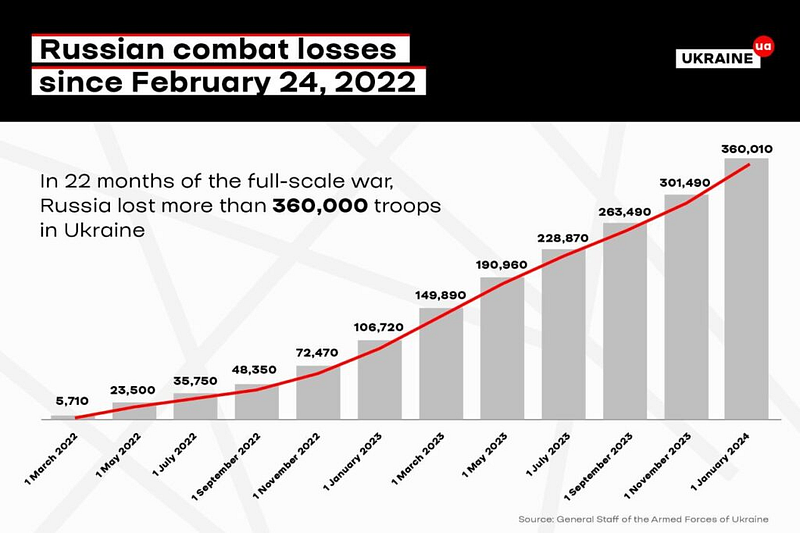
And then you add the incomprehensible number of 360,000+ Russian soldiers lost in Ukraine as of January 1, 2024, according todaily reports about the situation on the frontline kept by the General Staff of the Armed Forces of Ukraine, and the situation is just dystopian. These casualties would have ended the war in any other country, but Russia seems to operate by its own rules.
History will judge us for embracing this destructive spiral. It may sound harsh, but the evidence speaks for itself. They’re all Darwinian mechanisms, essentially, whether applied to economics, geopolitics, society, or culture. Hurt people, and the strong will rise, and the weak will fall, leading to a better world is the thought process.
But nobody’s better off this way.
Sure, suffering is also part of life, but hurting people only corrodes trust, replacing it with brutality and hate, leaving broken-spirited individuals consumed by tension, panic, and anger. The UN Secretary-General António Guterres called it the “age of global boiling.”
What’s that going to cost us? How much freedom will we have in a world where essential resources like air, water, and food are scarce?
Be loud.
Thank you for your thorough reading and support!
Subscribefor immediate insights and join the 400+ Antarctic Sapiens community for weekly thought-provoking content.