
Beyond Meta-Modernism Part 1: Human Development from the Perspective of Complex, Evolving, Living Systems
I tuned in this morning to a Stoa interview with Dave Snowden which I found stimulating. At the same time, it also highlighted several gaps and the occasional yawning chasm between a variety of philosophies, movements, and perspectives. The fundamental question at hand which popped up at several different points was: what drives beneficial change in humans? And as a rider to that: out of the many approaches to making beneficial change happen, is the most scientific, evidence-based perspective communitarian or individualistic? Or both?
Dave and I have known each other since the late 1990s, when he was down the road from my e-business lab at EY in London, working at IBM in a knowledge management role. If memory serves, I believe that at the time he, like me, was a Fellow at NECSI (the New England Complex Systems Institute based at MIT), though there is a certain fog accompanying my recollection of 25 years of history. We certainly had a number of mentors and colleagues in common, including Max Boisot, Michael Lissack, Hugo Letiche and, in particular, Stuart Kauffman of the Santa Fe Institute. I’ve always enjoyed Dave’s combination of story-telling peppered with complexity science, and his direct style as a critic of sloppy thinking.
In Part 1 of this article, we will begin by examining some of the critiques and confusions surrounding terms such as “Meta-Modernism”, “Integral” and the vertical development movement in general, including the love/hate relationship many have with Spiral Dynamics. This includes my critique of “altitude sickness” and “the danger of unintegrated polarities”.
In Part 2, we’ll get into how viewing human development from the perspective of complex, evolving, living systems can get us out of this mess, and provide some clarity about what works and what we need to move on so that we can address the polycrisis we find ourselves in.
Of Stages, Modulators & Assemblages- Clearing Up Some Misunderstandings about Human & Social Evolution
So it was that I tuned in this morning to update myself on David Snowden’s latest thinking and his critique of metamodernism, or as he termed it, “meta-mugglism”, presumably in honor of Harry Potter and the elitism of the wizards versus humble muggles i.e. ordinary people without the special powers granted to the elite wizards.
If I understand him correctly, his principal critique of the 3 versions of meta-modernism was that, in varying degrees, they encouraged an elitist view based on the superiority of higher stages of development, (variously known as yellow, teal or meta-modern), relying on the progression implied by a shift from modernism to post-modernism and, you guessed it, meta-modernism.
Although I’m less concerned about certain forms of meta-modernism being “dangerous”, there is definitely a whiff of smugness and occasionally even a hint of a superiority complex in some of the purveyors of what seems to vary between being a new way of thinking/perceiving, and at the other extreme, a cult or even a new religion. I appreciate that Dave had a painful experience with a certain Don Beck at a conference many years ago, much like many of us have had over years of interacting with him then avoiding him as he seemed to become more cantankerous, opinionated and right-wing with age. But let’s not throw the baby out with the bathwater just yet.
Where I am fundamentally in agreement with Dave, is that our western enlightenment narrative is an overly individualistic, idealistic, and even ideological perspective on a world that is much more complex and unpredictable than this perspective is capable of understanding. Having grown up in Africa and Canada and then lived and worked in 37 countries on four continents, I take it for granted that context is almost everything and that different cultures condition us to think and behave in very different ways.
And it does seem to me that our American and Northern European cousins tend to view themselves as exceptional cultures and places with unique insights into life the universe and everything, whether they live on the left, in the middle or the right politically and economically. This kind of universalistic individualism definitely requires some rebalancing with more relativistic, pluralistic thinking, values and practices if it is ever to emerge as a healthy next step for humanity’s evolution.
In addition, I share with him a great deal of concern that much of what passes for advanced levels of thinking and being can actually be a distraction from dealing with the polycrisis we are facing as a global civilization. Yes, there may be a bazillion surveys showing that everything is amazing but nobody is happy, that there is a “meaning-crisis”, and yes, there is an avalanche of quality research showing that suicides, violent crime, aggression, depression, and much more are being visited upon the denizens of the western world.
But as Dave puts it so well: ”Giving up on hope is in itself a mortal sin”. And retreating into a warm ideological or religious jacuzzi to address deficiencies of meaning and belonging only works if one can then get out, dry oneself off and get ready to engage with whatever aspect of the polycrisis is showing up near you.
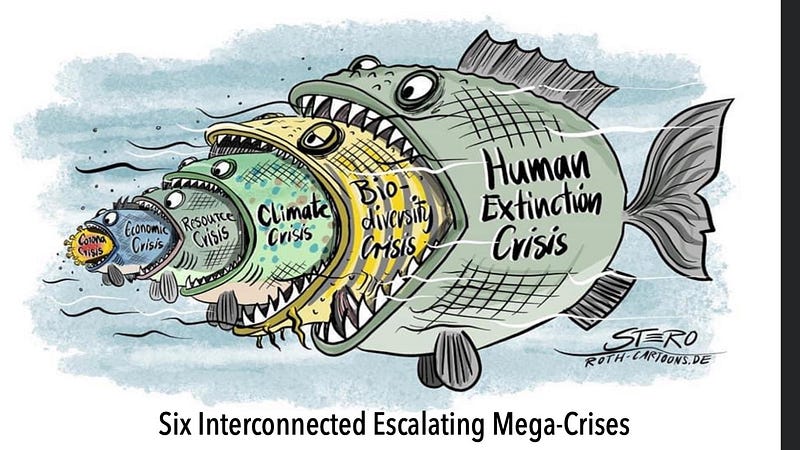
My personal critique of the integral and meta-modern movements is comprised of two parts- the first is what I call “altitude sickness”, and the second is “the danger of unintegrated polarities”. Both of these show up with a slightly obsessive focus on theory, oblique references to long-dead thinkers, intellectual posturing, dialogue, and podcasts, sitting in circles, and a minimal engagement with the scientific and social challenges we are facing, what I call in my work the six interconnected, escalating mega-crises.
Altitude Sickness
Throughout animal, primate, and human history, there have been alpha males (and sometimes alpha females/LGBTQ), who vie for dominance in their tribe/pack/pick your collective noun. And there have also been more exceptional examples of collaborative, more equal social arrangements- it all depends on whether we are looking at chimpanzees or bonobos, libertarianism or socialism, or reading Ayn Rand or Karl Marx. In evolutionary terms, in a beneficent environment collaboration and sharing are easier, while under resource scarcity competition emerges more easily, and majority voting and hierarchies become different ways of resolving competitive conflicts in primates and humans.
So, to some extent, “elites” have always existed in some form or other, and unless there is some magic potion that can change human nature, will probably always exist somehow, somewhere. And some elites are capable of benevolence and wisdom, and some aren't. Some say we get the government and leaders we deserve, but I’m not so sure that the Chinese tortured and killed in the cultural revolution or the Russians tortured and killed in the various Russian revolutions, or the hundreds of millions who died in wars between elites throughout history, would agree.
In peacetime, however, where billions of people have now had the advantage of a high school or university education, we find collaboration and competition taking a different form. The tools of collaboration and weapons of competition are no longer what they were. The swords, guns, tanks, and fighter jets of old-fashioned competition are replaced by sharp words, dramatic symbols and images, dogmatic narratives, superior degrees, “bullet” points, aggressive news channels, career politics, political careers, and dominant platforms, dominant market shares and geopolitical posturing. And of course, a great deal of testosterone, which means the occasional real war breaks out now and then, here and there, when elites miscalculate.
The tools of collaboration have also advanced dramatically- from the reading, writing, and printing revolutions to the telecommunications, transport, mass media, and internet revolutions, even as those tools can also be a double-edged sword when competition inevitably breaks out from time to time between people, ideas, interests, ideologies and more.
So, how does altitude sickness arise in a world uneasily at peace, for the most part? Let me share with you parts of an interview I did with one of the wiser men in the developmental space: Otto Laske, published in the Integral Leadership Review a while ago.
“Otto Laske: So Kegan’s theory and the whole social-emotional universe do not really provide us with any tools to develop people. And the bad thing, in my view, is that kind of thinking and research has taken over the cognitive training that people urgently need, both individually and in organizations and so I have come to speak of the whole integral movement as being on a “social emotional triumphal train”.
Robin Wood: Yeah, that’s a very powerful phrase; a social-emotional triumphal train. And I can resonate completely with that because my biggest critique, and I’ve met … I know Ken Wilber quite well and I know Suzanne Cooke-Greuter and Don Beck quite well, and a number of the figures in this for 20 years or more and-
Otto Laske: Yes, and-
Robin Wood: My critique has been this statement that it takes five years to go from one developmental stage to another as if there’s some kind of holy grail that you are aiming at. I call it altitude sickness when you get to the integral or the second tier and suddenly you’ve “made it”. It’s a triumphal arrival of the enlightened. And I’m very delighted to hear you say that because my own experience has been that my own cognitive development has always pulled the rest of me forward and helped pull other people forward well before I was even emotionally or socially able to even comprehend what I was doing.”
There is a great deal more to be said about altitude sickness, and it is not just limited to the adult developmental space or the integral/spiral movements (think WEF and other elitist gatherings), but I will put this marker down here and now, to be followed up with a more detailed analysis of my experience of bringing about beneficial change, even transformation, in organizations of all sizes around the world for 40 years.
I’ll leave you with a final excerpt to give you a flavor of my frustration with those suffering from altitude sickness, while to truly heal ourselves we need to heal our world and each other at the same time.
“Robin Wood: … I find parts of the Teal organization movement, slightly naïve and a little irritating in their hyped-up claims and over-simplification of what are much deeper and more complex issues that need to be carefully considered when exploring the world of organizations, especially at a developmental level. This is as much to do with the simplistic application of Fred Laloux’s research by many, as it is to do with some of the conclusions he jumps to from a very small sample of firms.
I believe this movement is over-generalizing and over-simplifying a complex, evolving field that requires many more dimensions to understand and operate in than their model recognizes. From the evidence I have been gathering, I believe this may cause a degree of confusion and even harm where developmental considerations are overridden, especially in technologies like Holacracy.
Otto Laske: Uh huh.
Robin Wood: Have you read, “Reinventing Organizations” by Fred Laloux? Or heard of it?
Otto Laske: I have, yes I have. I think Laloux’s work is inspiring and challenging but it’s not effective in terms of teaching people to change their way of thinking. And one reason for that is that you cannot be successful, I think, in transforming people’s thinking if you are operating in a universal space in which there is no distinction between development and leverage.”
And a final snippet:
“Robin Wood: Well I want to link what you just said to a frustration that I’ve had in my own experience with dialogue, which was initially in the early ’90s. I was still doing my doctorate at London Business School part-time, while I began working with a small consulting firm that facilitated systems thinking, simulations, organizational dialogue, and learning. And we were lucky enough to be brought into the Shell Group Planning to try to help Shell become a learning organization, which was not the easiest thing! But the work of David Bohm and of course, Peter Senge had a strong influence on all the methods and the cognitive science we were using to map the mental models of people with software and show the group a mirror if you like. And then we would let the group mind emerge and have something that could help deal with the issues of power. Separating the people from the problem, as it were.
Now, my frustration after more than a decade in this work at the top level of many global corporations, the World Bank, and top executives was that at the end of the day we could trigger a momentary shift in the system, it opened up, more and better thinking was happening, some of it was transformational but at the end of the day, it regressed to the mean in almost every case after a couple of years or so.
Looking back over 28 years now, which is when I began this work, is a feeling that we didn’t address the issue of power enough. This may enable us to go directly to the question about structuration theory and the sociological and political applications of your deep thinking framework. Because while structuration theory itself was developed at the London School of Economics by brilliant people such as Anthony Giddens and others, it is, I think a little static. Yeah? I think you would probably agree with that. And while your deep thinking framework is excitingly dynamic and in the moment, the question is, how do I lock in, as they say in evolution and complexity science, how do I lock in the changes that we make so that they cannot be unraveled by the next Chief Executive, for example?
Otto Laske: Yes, thank you, Robin. I do not know structuration theory. But I’m very interested in sociological and political applications of course, as you know. And I have a keen sense of what our abstractions are compared to what is happening in the real world. And of course, as conceptual thinkers, or as thinkers, we use concepts and so we are using abstractions. And when I read your text on structuration theory and the focus on power, I think I thought that power is a total abstraction. And so to start with such an abstraction may not be as effective as reflecting in the moment on the thought form structure of what one is saying about power.
So dialectical thinking the way I have conceived of it, as a dialogical model of communication, is basically an attempt to become aware of abstractions and use knowledge of the four modes of dialectic, which I will explain shortly, to expand what is presently being said. I follow Roy Baskhar, whom the integral movement claims to have integrated and certainly has not. In that, I’m saying there are four fundamental perspectives in which we can address the world that Roy called Moments of Dialectic.
One is context, where we see the world as a static entity that has a certain structure, which we can analyze to the last. Then, there is the process perspective, where we are asking, where does the situation we are in come from? Where is it going? What is dynamically happening to us as we are in this situation? And some of the consulting is beginning to go in that direction but not very often.
The third perspective has to do with what Baskhar calls relationship, which means not just external relationships between me and you but relationships that are codifying. In the sense that I couldn’t be the person I am without being presently in a relationship with you and vice versa. So, we are mutually enabling each other and that’s an intrinsic relationship, which is very different from the logical, external relationship that we are familiar with.
Robin Wood: Yeah exactly. The network diagram or the business card exchange level of “relationship” at the conference.
Otto Laske: Yes, yes. Yes, and to finish this up, in order to think transformationally in my experience teaching, I have found that you already have to know how to think in terms of context, process, and relationship in order to be able to think about transformation but there’s a huge distinction to be made between change and transformation. Change is just moving something from A to B, whereas transformation is what we constantly experience in our own lives, that when you wake up tomorrow, we are basically a different person. And while other people don’t know that, we should know that.”
One of the challenges with developmental theories is that anyone learning any developmental theory begins by labeling individuals and collectives in the early stages of the learning process. And sometimes, this is where any further learning stops, excluding the dynamic evolving interaction between contexts, situations, processes, and relationships.
For example, one of the disadvantages of both spiral dynamics and Wilberian color schemes is that they make it easier to learn about developmental stages, very often leading to people using colors to label others, organizations, and societies with colors very superficially, well before they are able to demonstrate any sophistication in understanding the complex dynamics inherent in the ever-evolving interaction between contexts, situations, processes, and relationships.
I like the way Dave Snowden differentiates between stages of development and what he calls “Modulators”. While we can both agree that from birth to adulthood in our early twenties, that we definitely progress through several developmental stages, we agree to differ on the extent to which adult development from our early twenties to our seventies and beyond can be said to exhibit further stages of development.
As I understand it from the Cynefin website, behavioral modulators influence the emergent patterns in a system but cannot predict future system behavior:
“Imagine that you have a round flat table and around that table are a series of electromagnets. They can vary in strength and also polarity. Some you control, some are controlled by people you know and some appear to change at random. In the middle of the table are a lot of iron filings. Now as long as the magnets don’t change, the iron filings will form a complex stable pattern. However, as the magnets fluctuate in strength the pattern changes. If some of them change polarity then change is sudden and drastic before a new stability emerges. At the same time, some of the iron filings get magnetized in turn as they pass through electric currents, making the situation even more complex. I may not even be aware of some modulators until they suddenly come into play and their impact is seen.
The magnets in this case modulate the system. They interact with each other and with the system as a whole, they make it inherently unpredictable. Understanding what modulators are in play will help us understand the emergent behavior of the system, but not to predict its future state. Attributing cause to a limited number of dominant modulators (that is what I think people mean by drivers) is a mistake as the level of interaction is too much. I can build models to simulate the behavior of the system, however, simulation does not lead to prediction.”
In my own experience of using developmental models and maps as part of a toolkit that includes the complexity, cognitive, and evolutionary sciences, the idea of modulators comes in handy. The simplistic application of developmental thinking without taking into consideration context/life conditions, lines of development/multiple intelligences, culture, and systems living and non-living, is a real barrier to making a beneficial difference in the world. It will be interesting to see how Snowden’s work on deconstructing Kegan’s work into modulator theory develops.

The Danger of Unintegrated Polarities
While altitude sickness addresses the “vertical” dimension of development, the danger of unintegrated polarities addresses the “horizontal” dimension. Both of these play a role in shaping the outcomes in any situation or context of various patterns of behavior.
Think of two politicians: Nelson Mandela and Donald Trump. Then let’s compare them on a spectrum of integrity. On the right, we have one of the most revered leaders the world has ever seen, in a league of his own along with Gandhi and other peaceful liberators of their people: Nelson Mandela. Humble, and honest to a fault, he spent 28 years in jail and forgave his captors to create a rainbow nation. On the left, we have Donald Trump, who is estimated to have lied 40 000 times during the four years of his Presidency, almost succeeded in destroying American democracy, and hopefully will discover the inside of a prison cell before he dies.
Our western way of thinking tends to lend itself to seeing things in binary opposition- such as “black or white,” “good or bad,” and “all or nothing.” This style of thought may be useful for quick decision-making, but it is also known as a cognitive problem of borderline personality disorder. In a Japanese study of 152 undergraduates, the Dichotomous Thinking Inventory was found to have significant positive correlations with borderline personality and narcissism.
Given the significant influence of what Max Weber called “the Protestant Ethic” and the control exerted by the Catholic Church for two millennia on the western mind, is it any wonder that good and evil, right and wrong, and heaven and hell are deeply embedded in our psyche?
On the other side of the world, meanwhile, ancient philosophies and religions tend to focus on the integration of opposites. Unlike our adversarial, individualistic western approach, eastern religions and philosophies such as Confucianism and Taoism prioritize harmony and humanistic values.
Confucianism deals with social matters, while Taoism concerns itself with the search for meaning. They share common beliefs about man, society, and the universe, although these notions were around long before either philosophy. Both began as philosophies, each later taking on religious overtones.
The yin-yang symbol shows a balance between two opposites with a portion of the opposite element in each section. In Taoist metaphysics, distinctions between good and bad, along with other dichotomous moral judgments, are perceptual, not real; so, the duality of yin and yang is an indivisible whole. Good luck is Tao, bad luck is Tao. Rather than rigidly choosing one side against the other, we are urged to perceive the two sides in their relatedness, to experience how one creates the other.
Buddhists share a belief in the goal of overcoming suffering and rebirth by attaining enlightenment, known as Nirvana. In contrast, Taoists worship deities, even if Tao itself is not a god but rather the natural order of the universe that guides everything impersonally. Confucianism revolves around 3 principles- Jen, Li, and Xin. The concept of Jen is based on human nature and benevolence. Li is a principle of respect and propriety. Xin refers to faithfulness and being honest towards oneself and others and helps individuals earn admiration.
My own application of developmental assessments over three decades on four continents, as part of a much more comprehensive approach to strategy, culture, change, and transformation has revealed some interesting insights. The most important insight is that in defining a well-functioning human being or system, what matters most is the balance between opposites in the developmental profile of an individual, group, or organization. The developmental “altitude” is the least important. This balancing of opposites is largely lost in the current world of developmental psychology and explains much of the altitude sickness described above.
This is why I have developed a non-judgemental, componentised, non-linear approach to both horizontal and vertical development, that takes into account many more variables and dimensions than are recognized in the classic vertical and horizontal cultural developmental models. Most importantly, this model recognizes that there are almost an infinite number of ways for people to grow and develop, in interaction with the contexts, processes, relationships, and capabilities they need to survive and thrive. And yet there are also some recognizable common patterns in human development and evolution.
In Part 2, we will explore this new approach I call “Plexus” in greater detail, in order to be able to discern the outlines of what might be some adjacent possible spaces for humanity to evolve into without frying ourselves and our biosphere as a result of our Anthropocene ways of thinking, being and doing.


