
Beyond Digital: Orchestrating Business Change

There’s no doubt, we’re amid a “digital” craze. Everyone is in a race to use advanced technology to create new types of customer value. For years now, we’ve obsessed over IoT, and it’s been the focus for many organizations of what it means to “go digital”. But soon we’ll get used to everything being connected and IoT will fade from our vocabulary — it’ll just be “things”. In fact, the real opportunity goes beyond digitizing products and services, where we’ve historically focused on integrating sensors into hardware components, building “connected” monitoring software, and pumping customer data through analytics engines. That’s all well and good, but the opportunity at hand is bigger than that. Way bigger.
Digital is a means, not an end. It’s a fantastic enabler; one of many available to an organization. As Paul Boag said, “Digital doesn’t differentiate in the market place. Providing an outstanding customer experience does. Digital just provides us with new opportunities to do things better. Things like doing a better job of customer service. That is where the value of digital transformation really lies.”
The real trick is getting your business model right…constantly.
Your business can’t afford to stand still, at least for long. Products and services can be quickly usurped. The competition landscape could shift in an instant. Long-proven channels could be made irrelevant (think traditional retail). Customer segments can morph. “Today” talent doesn’t necessarily equate to the talent needs of tomorrow. This all means that tuning and periodically re-imagining how you do business is now a vital survival skill. Using tools like Business Model Canvas, design thinking, and journey mapping are useful methods for continually articulating would “better” looks like, but actually executing on that change is hard. So that leaves us with the most important capability that a modern organization can possess: change orchestration.
Letting go of change management, embracing orchestration
“No man ever steps in the same river twice, for it’s not the same river and he’s not the same man.”
– Heraclitus
Change is the only constant in life. And coaxing the right change to occur (per your vision and at speed) is getting increasingly difficult. We’re reaching a point where linear change management is hitting its limits, and change orchestration needs to be embraced as the new model.
In the case of digital transformation, a recent survey shows that just 5% of businesses are meeting their envisioned expectations. This is alarming, and we can imagine the waste at hand. One reason for failure is that organizations generally take a linear, traditional approach to change management.
While models like Kotter’s 8-Step Process for Leading Change can world well for smaller-scale and less complex change endeavors, major moves like digital transformation and business model reinvention require true change orchestration capability. Traditional change models run into roadblocks given the dynamic and web-like nature of modern businesses. With all this movement and necessary pivoting, linear and long-duration approaches designed to uplift culture, create new customer value, and refresh “how we work” are becoming increasingly futile. “Agile” isn’t just a buzzword with legs beyond software development. It’s the predominant way that successful businesses must now operate.
In contrast to change management, orchestration is the active and constant coordination and harmonization of situational elements to produce a desired effect. In business, it’s about steering — not micromanaging — collective resources in a direction that delivers a positive outcome. Here, you’re seeking network effects amongst all the nodes in your network. You want the autonomy of their siloed specializations, while also having active mash-ups take place to deliver on your key needs. Attributes of a well-orchestrated business include:
- A clearly mapped network of nodes (e.g., organizations, teams, assets) and connections (process workflows, data exchanges)
- Existence of both strong (heavily nurtured) and soft (weakly held) connections
- Avoidance of linear logic (e.g., traditional supply chain architectures that operate purely like a pipeline)
- Select situations where decisionmakers overlap (thereby bringing healthy tension and bias reduction to the decision)
- Operating in ways that consider other stakeholders’ points of view, thereby producing the right impact for the collective system
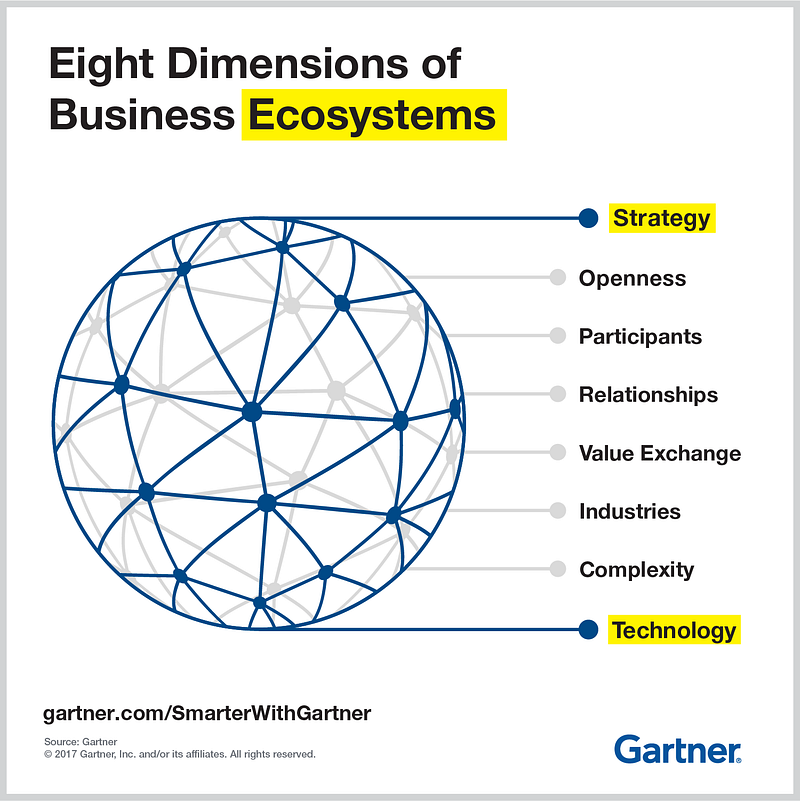
We can think of a modern business as an individual ecosystem — one that’s living and fluid, and highly networked with many other ecosystems. All the piece parts (people, data, infrastructure) can prove individually useful, but it’s when they connect under the right context and work in harmony that valuable business outcomes manifest. Your ability to orchestrate change across this complex and ever-evolving beast is your challenge.
Bringing orchestration to life
Again, the overall need today is constant business model adjustment — continually making micro and macro tweaks based on a swirling set of dynamic market factors. As a “big change” example, take Netflix: they foresaw the potential of high-bandwidth internet, and they made the early and bold move from physical product (DVD) to streaming delivery and in-house content development. A company’s ability to continually adjust business trajectory depends on its change orchestration capability, which enables a complex decision to turn into reality. And just like any good capability, someone should own it, and there are various ways to bring it online.
In the last five years alone, we’ve seen both the quick rise and potential diminishing of the Chief Digital Officer role. Given that digital now just needs to be part of a company’s DNA, the latest thinking is pointing to the need for a Chief Transformation Officer. Local context will drive what makes the most sense for a given company. Regardless of the chosen C-suite role type, someone needs to own change orchestration for the company. And in most cases, that leader and unit need to be separate from — yet connected to — the rest of the business.
It’s a careful balance of giving executive authority and autonomy to a part of the organization to live above and across the lines of business to ensure they can stitch together and orchestrate resources to accomplish particular change initiatives. Whether that initiative is onboarding and infusing a new breed of talent into the business, developing a new digital platform for two-way customer engagement, or something else, it requires a leader and team outside of the core day-to-day business to ensure the right change is happening at the desired pace. Business model changes can’t happen within a siloed part of the enterprise.
As an underpinning need, change orchestration also requires a continually fresh view of the business ecosystem. By definition, an ecosystem only serves its purpose with all parts participate. Take a lesson from the field of system dynamics: every element of this system either reinforces or balances another part of the system. Just like you need customer demand insights to fuel R&D (reinforcing processes), you need internal business units and external business partners aligned (balancing processes) on the strategic goals of your business model to ensure you’re delivering desired outcomes. It’s important to have a function in your organization that’s continually mapping an ecosystem view of what the business looks like and how it works. That’s your gameboard for orchestrating change.
Structurally, much like we’re seeing in climate governance, where there’s a diverse and complex set of actors involved in driving towards an outcome for the collective good, we can lean on polycentric governance as a way to better enable change orchestration. Here, collaboration across units enhances connectivity, learning, and productive output across an institution. Structuring enterprise governance in a similar way will better enable change orchestration to work. Having a highly-networked governance construct helps organizations be antifragile when disturbances arise in a business ecosystem and changes need to take place.
Finally, we can lean on a real “maestro” for some tips on orchestration. In his book, Maestro: A Surprising Story About Leading by Listening, orchestral conductor Roger Nierenberg articulates how orchestration works in music and how it translates to business. Some key principles for an orchestrator include:
- Listen to the instruments first before proceeding with any conducting
- The conductor should grasp reality from the chairs
- The more the musicians in the orchestra understand themselves, the better they play as a unit
- It’s not that people dislike change; they often can’t visualize it
- Cultivate an environment where artists create and thrive together (1 + 1 = 3)
In conclusion, your ability to transform major elements of your business is now your most important need. It’s about more than going digital. Change orchestration is the enduring capability that’ll allow you to constantly shape-shift and remain competitive as the world turns.
Want to stay in touch? Follow me on matthewdoan.com, LinkedIn, Twitter, and Medium.