
Money Management
Beware — Terms and Conditions
They started out simple - disclaimers and don’t copy the site. Then the lawyers got involved, automatic renewals were added, and limits set.
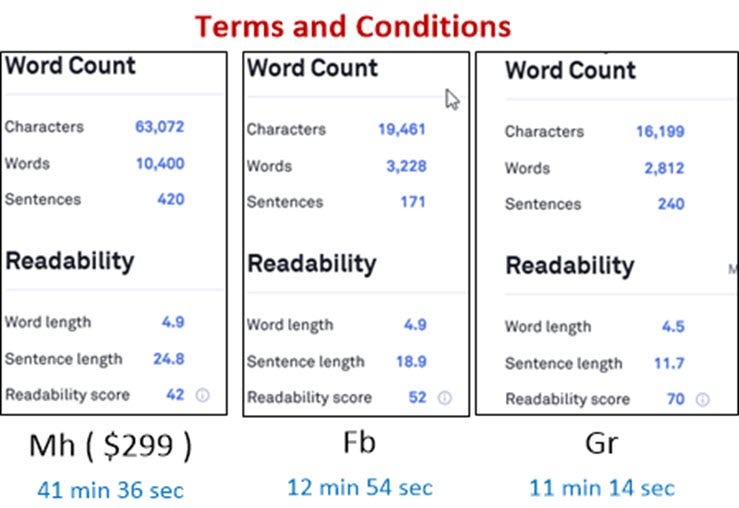
Every site you sign up for has a “Terms and Conditions” requirement that you must agree to if you want to use that site.
Once upon a time, they were pretty simple and fairly short, then they slowly expanded and became more detailed than The Constitution! Most people just agree without reading them and continue with what they were doing. Usually, it doesn’t make much difference, but it could.
Unexpected charges I didn’t think much about them until I had an unexpected $299 charge show up on my credit card for a service that we were no longer using. I immediately canceled the service and got my $299 back.
Once, we received a charge on my credit card from a strip club in Jamaica when we were in Houston, TX that day. I caught it the next day.
So, I check my credit card every day. I saw the $299 the day after it was posted. If I had waited until I received the bill, it would have been too late to get the entire fee back.
The investigation After that, I started reading the Terms and Conditions on every site that I used. The conditions for my banks were somewhat lengthy, but they talked mostly about their products, my responsibilities, and their liability. Nothing too surprising or difficult to follow.
Then I looked at the $299 site, as shown on the left in the picture at the top. Reading time of 41 minutes and a low 42 reading score. The lower the score, the higher education required to read it. You had to read a long time to find the automatic renewal clause.
I went to two other frequently used sites with much shorter conditions, but close to the same length to each other. Their reading time was much better. However, the middle one was harder to read than the right one, based on reading scores.
All three were very long text strings. This article would be much harder to read on a computer or cell phone if it didn’t have any blank lines. Those three didn’t have any, either. I suspect that none would be curated just because of formatting.
The easiest - Medium Unlike the others, Medium does not present the reader with a long string of text. It may have as much content, but it sure did not feel like it! On the internet, look/feel is crucial.
Medium's Terms and Conditions are built around a whole web site with a table of contents linked to individual pages. Each page covers one subject, and navigation is easy.
The privacy policy is the longest, is well formatted, and is still shorter than any of the examples.
Of course, I would expect a beautiful and easy to read set of Terms and Conditions from a publisher.
Conclusion I don’t expect people, or me, to start reading the Terms and Conditions for every site. I wish that sites would notify me whenever an automatic charge is about to hit my credit card, but don’t expect it to happen.
Now, instead of worrying about automatic charges, I get a temporary credit card with a short expiration date from Bank of America for the cost. That way, an automatic renewal can’t go through. I have to get a new temporary card if I want to renew. Other banks may also provide temporary credit cards.
Finally, here are three other articles providing a slightly different insight to Terms and Conditions.
Automatic Renewals of Consumer Contracts: Everything You Ever Wanted to Know But Were Afraid to Ask By Michael P. Daly, Marshall L. Baker and Antoinette Snodgrass July 27, 2018
Terms and Conditions, The Graphic Novel
Reading the Privacy Policies You Encounter in a Year Would Take 76 Work Days


