
Journalism and Media
New Hampshire’s Betty & Barney Hill UFO Historical Marker Needs a Rewrite
It’s only 92 words long, but contains two fact errors. On the 60th anniversary of the Hill UFO abduction, it’s time to set the record straight.
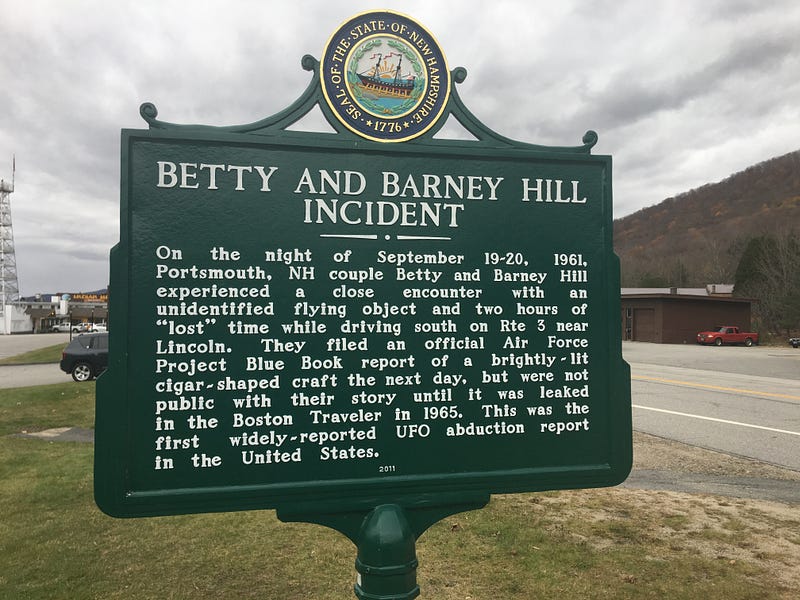
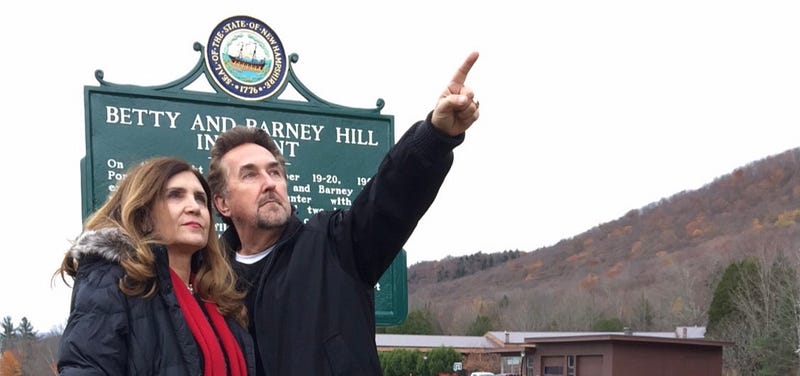
If you happen to take a vacation to New Hampshire and end up driving through the White Mountains on Route 3, you may come across this historical marker in Lincoln, near the northern end of the area’s quaint Indian Head Resort. It commemorates the famous alien abduction case of Betty and Barney Hill that allegedly took place nearby. The sign itself has become a tourist destination, and this is what it says:
Betty and Barney Hill Incident. On the night of September 19–20, 1961, Portsmouth, NH couple Betty and Barney Hill experienced a close encounter with an unidentified flying object and two hours of “lost” time while driving south on Rt. 3 near Lincoln. They filed an official Air Force Project Blue Book report of a brightly-lit cigar-shaped craft the next day, but were not public with their story until it was leaked in the Boston Traveler in 1965. This was the first widely-reported UFO abduction report in the United States.
It’s a fine sign, something long overdue, and it was placed there by the state of New Hampshire in 2011 for the 50th anniversary of the historical (and controversial) event. It is not, however, entirely accurate. Here’s the part that is problematic —
“…but were not public with their story until it was leaked in the Boston Traveler in 1965.”

This false statement should be revised on a new replacement sign that could hopefully go up in this 60th anniversary year. There are two key misrepresentations made in its copy.
- The idea that Betty and Barney Hill “were not public with their story” is inaccurate. While not actively seeking publicity, the Hills did tell their story to numerous individuals — friends, family and co-workers — plus, they filed two official reports that were certainly discussed within their respective organizations. They also spoke openly in several well-attended public forums.
- The Boston Traveler did not “leak” the story of Betty and Barney Hill, the newspaper reported it. Leak is an incorrect, pejorative way to describe journalism, which is taught in universities and practiced widely by reporters worldwide. Award-winning investigative reporter John Luttrell broke the story in a legitimate, responsible, and ethical manner. If any leaks occurred, they came from people offering information and reports to Luttrell.
While the roadside sign is well-intentioned, it’s important to respect the role of a free press on the subject of UFO/UAP reality. It reminds us how it is possible for newspapers, including the maligned mainstream media, and other emerging sources to bring valuable information to the public.
In that spirit then, on the 60th anniversary of the abduction report of Betty and Barney Hill, let’s set the record straight.
October 25, 1965
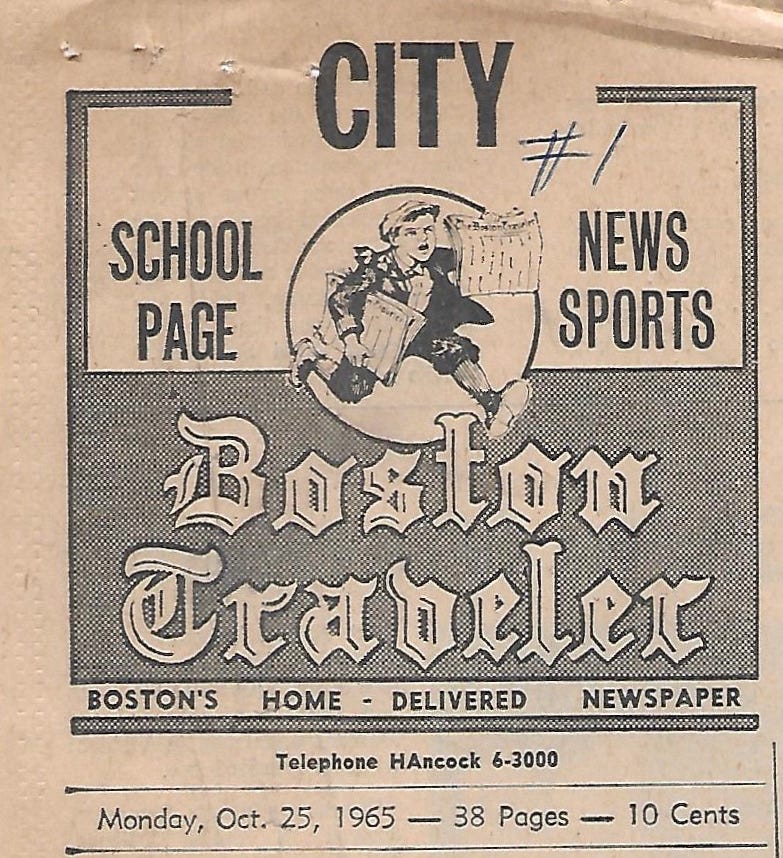
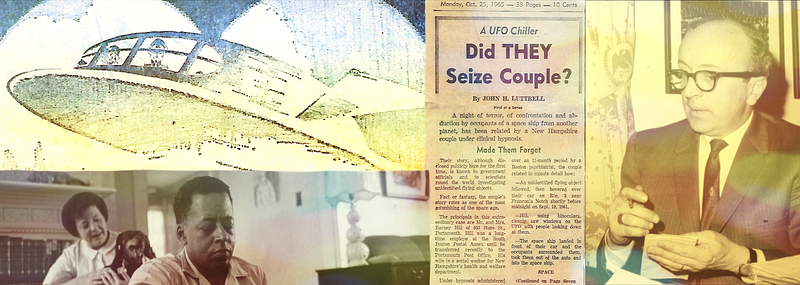
On October 25, 1965, the first of five articles appeared in the Boston Traveler newspaper with the headline, in big bold letters: “A UFO Chiller: Did THEY Seize Couple?” In a story credited to John H. Luttrell as the “First of a Series,” it began:
“A night of terror, of confrontation and abduction by occupants of a space ship from another planet, has been related by a New Hampshire couple under clinical hypnosis… Their story, although disclosed publicly here for the first time, is known to government officials and to scientists round the world investigating unidentified flying objects. Fact or fantasy, the couple’s story rates as one of the most astonishing of the space age.”
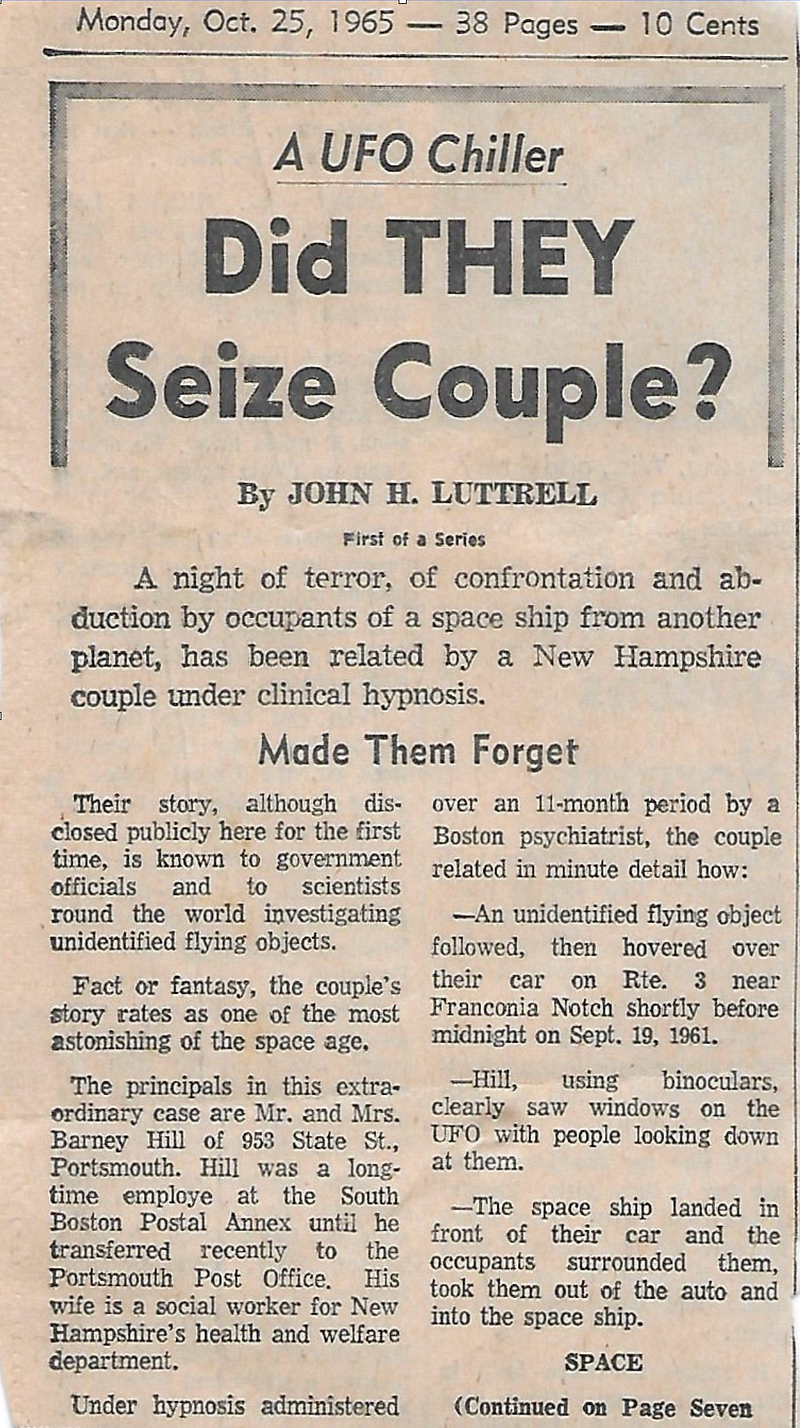
Because of the interest in this series, the Boston Traveler sold the greatest number of newspaper copies in more than eight decades of its publication, and had more than 3,000 requests for reprints.
United Press International (UPI) picked it up and reprinted it across the country in numerous local papers, and it spread out internationally as well.
Instantly, Betty and Barney Hill received phone calls from ufologists and journalists from every corner of the Earth. Letters poured in from the old and the young, students, and witnesses to other sightings. The Hills’ story was electrifying and it caught fire first in the 1965 holiday season, four years after the events in the White Mountains of New Hampshire took place.
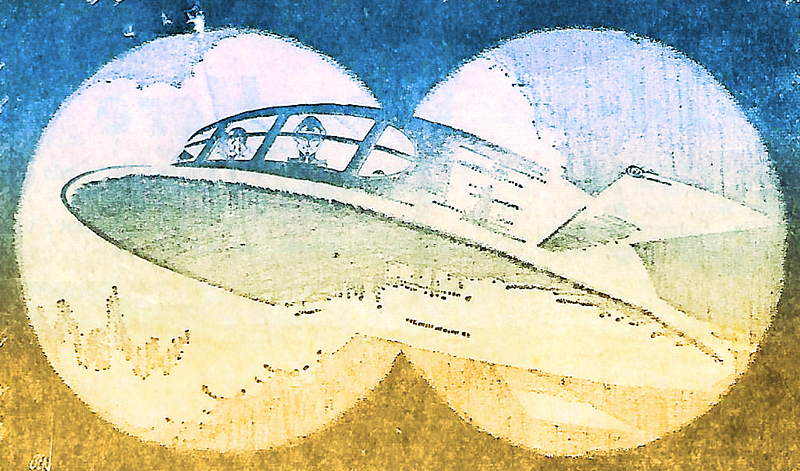
Luttrell’s reporting got all the basics right. The Hills were coming home from a honeymoon through the White Mountains. They both saw an object that followed them from a distance and then closer. Frightened, they stopped to get a better look, and Barney, first with his own eyes and then with binoculars, saw it as a craft with beings on board. He raced back to Betty and said he thought they were going to be “captured.” The next thing they knew it was two hours later and they were thirty miles from where they saw it up close. Plagued by Barney’s fear and Betty’s nightmares, they eventually sought the help of a hypnotist whose regressions revealed that they believed they were taken aboard the craft and subjected to medical examinations.
A key point, however, is that it wasn’t until a year after Luttrell and the Boston Traveler published that account that author John Fuller would have his book The Interrupted Journey published by Dial Press, and have those excerpts published to massive acclaim by Look magazine. All of that brought the Hill case to global attention, again.
So, rather than think of Fuller’s book as the starter’s gun to the worldwide analysis the Hill case would cause, it was Luttrell’s local newspaper series that came out twelve months earlier that really got things rolling.
In addition to that error by omission, over the years, John Luttrell’s right to report and the Boston Traveler’s right to print the Hills’ story have been called into question as somehow being unethical, and a brazen violation of Betty and Barney’s personal privacy. The truth is that at the time of publication Luttrell was already an award-winning reporter with a distinguished resume. He found the story the old fashioned way — shoe leather and keeping an ear to the ground.
Fact Error #1 — The Hills Actually Were Public with Their Story
Despite protests over the years that the Hills were extremely tight-lipped about their story, the truth of the matter is it’s a miracle some enterprising reporter didn’t beat Luttrell to it in the first place. Here’s an incomplete rundown —
- The day Betty and Barney Hill returned, they told the upstairs renters. Betty then told her sister, Janet Miller, who also told her husband, two sons, and a daughter. Janet immediately told one of her neighbors who was a physicist. She also spoke with the former Newton, New Hampshire Chief of Police. How many people did the physicist and the retired police chief talk to? Her family members? And who did those people talk to? And who did those people talk to? Janet’s involvement alone shows just how sensational stories of seeing a flying saucer up close travel fast.
- Betty called the United States Air Force at Pease AFB in nearby Newington the day after their return, and she and Barney told their story to an officer on the phone. The next day Major Paul Henderson at Pease AFB took a second full accounting from the Hills and soon filed a report with Project Blue Book. Importantly, Luttrell also reported the fact that after landing at Blue Book “the Hills’ case is getting top priority attention of the Foreign Technology Division of the Air Force Command at Wright-Patterson Field in Dayton, Ohio.” His article pointed out that the division was run by the Central Intelligence Agency, and that it “takes over and investigates UFO reports the Air Force cannot explain.”
- On September 26, 1961, Betty wrote a lengthy letter to the National Investigations Committee on Aerial Phenomenon (NICAP) director Donald Keyhoe who passed it along to assistant director Richard Hall who sent a copy to Hayden Planetarium astronomer and investigator Walter Webb. On October 21, 1961 the Hills met at their house for over six hours with Webb who write a six-page typed report. Also present was Webb’s friend Cheryl Wellock. On November 25, 1961, Betty and Barney met at their home with two more NICAP members, IBM senior engineer C.D. Jackson and staff writer Robert Hohman. Also present was the Hills’ longtime friend, Major James McDonald, a recently retired Air Force intelligence officer.
- About a week and a half after the event, Betty told her co-worker and friend Gail Peabody at the Department of Public Welfare about the sighting and the dreams she was having. She may also have spoken to her boss, George E. Murphy.
- There were also a number of medical professionals the Hills consulted — from their private physicians to a series of psychiatrists/therapists that include Dr. Patrick Quirke (spring 1962); Dr. Duncan Stephens of Exeter, New Hampshire (summer 1962); and finally Dr. Benjamin Simon of Boston (fall 1963), the man who ended up conducting the hypnotic regressions that have become so famous.
- On November 23, 1962, just a year after the event, the Hills spoke to a discussion group at the home of their Unitarian-Universalist Church pastor, Reverend John Stewart McPhee. They stayed to answer questions. On March 3, 1963, the Hills led a discussion at the Unitarian-Universalist Church about life in the Universe before their church’s “Couple’s Club,” and again related their UFO experience. On September 7, 1963, Captain Ben Swett gave a formal lecture on hypnosis to a meeting at the same church. Afterward, the Hills told him more about their story and discussed hypnosis therapy for themselves.
- On November 3, 1963, the Hills told their story in public before 200 people.
This isn’t even an exhaustive list, nor does it take into account the sheer number of others who heard the story from someone who heard it from the Hills in a giant game of UFO sighting telephone tag. With the exception of medical doctors, none of these people had any established obligation to treat the information “confidentially” (as the Hills later claimed) given that they were not the Hills’ attorneys or physicians. NICAP, for example, did not have, nor could it have enforced, any oath of secrecy. Even wilder, however, is the often repeated claim that John Luttrell “violated confidentiality” when he wrote about the Hills. They never spoke to him on the record, and he had zero confidentiality agreement with them. This is an absolutely ludicrous charge that should not be taken seriously.
All of this, however, is prologue to the big mistake that the Hills made that opened the door for Luttrell, given their later protests that all they wanted was to keep what happened to them quiet.
They Spoke to a Public Forum of Over 200 People
“Through the months and years since Sept. 19–20, 1961,” states the article, “Barney and Betty Hill have drawn strength from the friends upon whom they rely for mature judgment.”
One of those friends was Lorraine D’Allessandro of Weymouth, MA, a woman who had become friends with the Hills after reading about their case in the NICAP Bulletin in 1963. Over time, she had welcomed Betty and Barney into her home as weekend guests, visited them in Portsmouth, and even accompanied them into the mountains look for the actual site of their abduction. It appears she invited the Hills to attend the Two State (Massachusetts and Rhode Island) UFO Study Group. She became one of the key sources for Luttrell when he was preparing his reporting.
On November 3, 1963, the Hills spoke before over 200 people at an open-to-the-public meeting before the UFO study group in Quincy, Massachusetts. At this meeting, Barney laid out the saucer sighting in full detail, including the missing time component, and the physical effects on their car, etc. Betty followed his remarks and laid out, again in full detail, the content of her dreams, including being taken aboard the craft and having experiments performed on them.
Both Hills fielded questions from the audience at the end of the presentation. It was such a complete job that a week later, Jeanne Weller, the secretary/treasurer of the group, wrote to praise the Hills on their “excellent dissertation on their experience” and state she had “received many calls from members and guests complimenting” their presentation.
There are two key points to be made here.
- First, the Hills’ attempts to call these remarks “confidential” and somehow protected from being the subject of news coverage is simply naive. They told their story before hundreds of people in an open forum. If anyone let the cat out of the bag here, it was them.
- Second, it appears that Luttrell was one of those guests who attended that public meeting at the invitation of a neighbor down the street, a Mr. Sorenson, who was a group member.
Luttrell’s article makes it clear that “a tape recording was made available to the Traveler” of the public session. Whether he made it available or someone else did, he never revealed his sources or methods. Betty Hill always thought he recorded it himself. Even if true, many reporters record public meetings they attend so they can transcribe them and get accurate quotes from them. This is hardly the same behavior as unethically and/or illegally recording a private phone call and not telling the other person you’re doing it.
In any case, it would be almost exactly two years later before Luttrell’s story broke in the Boston Traveler. This suggests that rather than leap to exploit what he learned, the reporter was methodical.
Still, it is critical to understand, that the sign completely distorts the truth by saying “the Hills were not public with their story.” If speaking to your renters, friends, family, co-workers, a UFO investigation organization, the U.S. Air Force and Project Blue Book, two large church groups, and a UFO study group with 200 people in it is not being public with their story, one has to wonder what it would take to be public.
Fact Error #2 — The Boston Traveler “Leaked” the Story
The Boston Traveler did no such thing. Like any newspaper with investigative reporters, they reported it. This is how journalism works. More on that in a moment. First, a short bio on the man who has been attacked as an unethical journalist who violated the Hills’ privacy in an unscrupulous manner. As you read it, ask yourself, does this sound like an accurate description to you?
Who Was John H. Luttrell Sr.?
John Luttrell was a veteran of World War II where he served as an intelligence specialist with the 9th Army Air Corps in the European Theater. Assigned to the 410th Fighter-Bomber Squadron, Luttrell received six campaign battle stars.
After the war, he went to work for the Woonsocket Call where he had worked before the war as a copy boy. As a full-fledged journalist then, he broke tough stories exposing police and municipal corruption. He received the Heywood Broun Award from The Newspaper Guild in 1951.
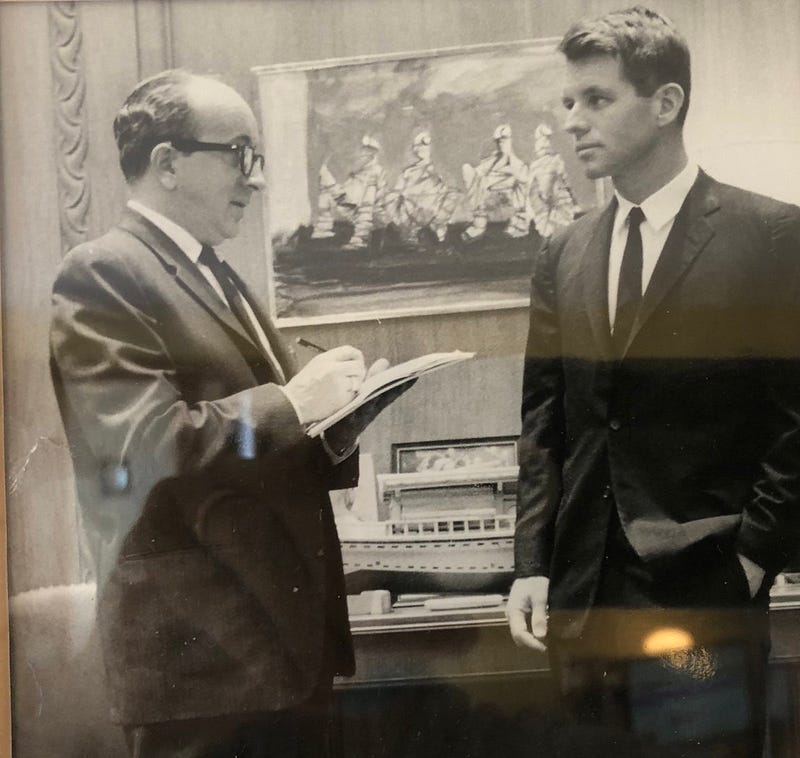
He was recruited to the Boston Daily Record as a court and investigative crime reporter where his story about rampant illegal drug use and prostitution by inmates at the state women’s reformatory won the 1957 Boston Press Club’s Amasa Howe Award. He also worked as news writer at WBZ in Boston and helped refine the “Eyewitness News” concept. All of this before he went to work as a columnist and feature reporter for what was initially known as the Boston Traveler-Herald.
According to his son Marty Luttrell, who was 15 when the Hill story broke, his dad worked two jobs, at the paper and the TV station, “Most days he was gone before I got up, returning home after the 11 o’clock news had aired.” John Luttrell had to be a hard worker. In addition to his wife and seven children, his mother also lived with the family.
Working the Story
During the time after the Hills so publicly blew up their own confidentiality and before publication in October 1965, Luttrell worked the story (a period of two years), slowly at first, then by his admission, in a rapid coming together over a three month period at the end. A lot of that work involved chasing down friends of the Hills to see who could confirm and add to the details of their story.
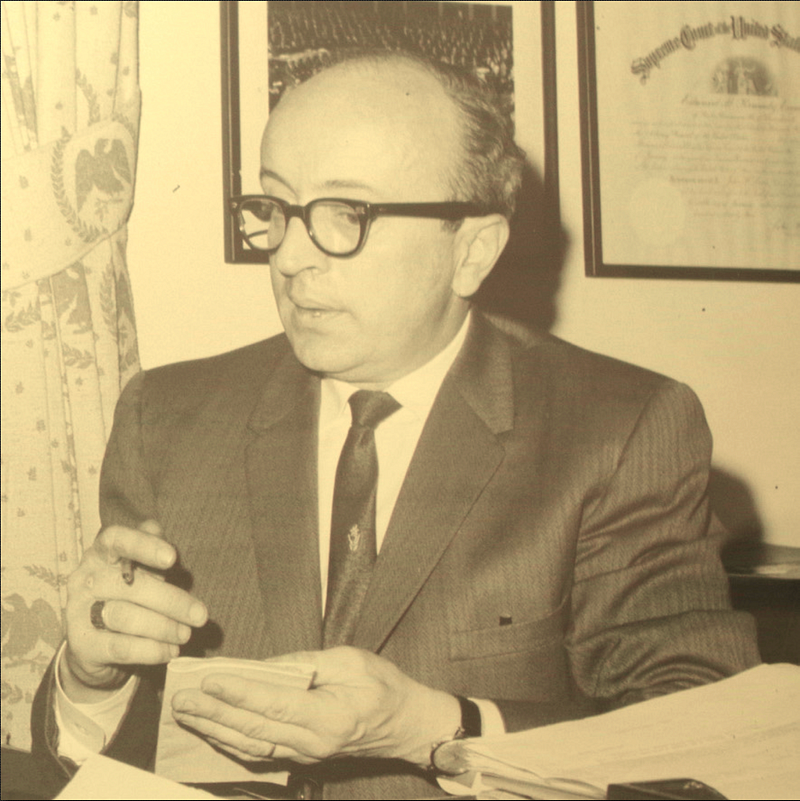
This is how that process went according to Luttrell in a (condensed) interview with radio host Alan Dary in 1965:
“Certainly these people (the Hills) deserved every single consideration. But then where do you draw the line? Between maintaining a certain degree of personal privacy or the public’s right to know? If you were to have heard this story first hand from a couple to whom this is supposed to happen, how long could you keep quiet about it? How long could anybody keep quiet about it? It’s so exciting. So fascinating. It’s a thing that you want to tell other people. And ultimately, this is how I got it. And it took some doing to find out who these people (their friends) were, and then to try to persuade them that the best interest of the general public would be served by them coming forward.”
So, for those who argue the Hills were victims of a sleazy journalist who violated their confidentiality and “leaked” their story, it would seem that the violators were their friends and others, and if anybody leaked anything, it was the psychiatrist, the Air Force, NICAP, church members, UFO working group members, etc. Luttrell reported what was told him, cross-checked these facts, and broke a big story.
Reporting on the Reports
There were two other key sources of detailed information that Luttrell hunted down with the same doggedness as he did those who had heard the Hills tell their story.
- The report filed by the Hills with Pease Air Force Base that went to Project Blue Book and then, apparently, to Wright-Patterson and the CIA.
- The report they filed with the National Investigations Committee on Aerial Phenomena or NICAP.
Both reports, particularly the NICAP one, were assembled from multiple conversations with the Hills and in-person, quite lengthy, interviews.
Luttrell states in the articles that he had access to both reports in his own investigation. “The Traveler, at its request, and after a month-long delay,” wrote Luttrell, “was provided with what purported to be an actual copy of Air Force Information Report 100–1–61, originally prepared by Maj. Paul W. Henderson of the 100th Bomb Wing at Pease Air Force Base.” Additionally, he references the NICAP investigation report, including actual interview quotes from its author Walter Webb as well as Hill psychiatrist Dr. Benjamin Simon.
It’s inconceivable that the story stayed completely siloed off at either the Air Force or NICAP. It was compelling and many people at both organizations were attempting to judge its accuracy. They clearly reached out to a wider group for thoughts and analysis and to judge its accuracy. The reports were both open secrets waiting for someone to track them down.
As it turned out, Luttrell caught another lucky break in his investigation. Two months before his articles were published, on August 30, 1965, Walter Webb turned in an exhaustive 60 page version of his “Final Report” for NICAP (ten times longer than his original filed in 1961) that referenced the hypnotic regressions, and it received circulation within the organization’s leadership. It’s a barn-burner of a read and it is absolutely unfathomable to think that no one talked about it with their friends. Luttrell had said that he spent two months on his final research phase and one month writing. This would mean this report might have dropped into his lap at the midway point of his investigation, allowing him to cross-check facts and to flesh out his story. You can read the full report here.
Importantly, it appears that Luttrell also may have gained actual access to some of the tapes and/or transcripts of Dr. Benjamin Simon’s hypnotic sessions with the Hills. Someone who had them probably gave them to him — and there can’t be many suspects (i.e. Dr. Simon, his secretary). We’ll never know because Luttrell never revealed his sources. This is often exactly how journalism works.
Bottom line, between the Air Force and NICAP reports, the many friends of the Hills, and the hypnosis sessions, Luttrell likely had access to a great deal of detailed information, all of it originating from the story told by Barney and Betty Hill themselves, the primary sources. All of it also appears to have been obtained through established and ethical journalistic methods.
No one is blaming Betty and Barney Hill for needing to talk to people about what happened. They wanted answers, and the event was so traumatic that talk therapy was a necessary way to start healing. Still, given the givens, it was inevitable that some journalist would hear about the case. John Luttrell Sr. just happened to be that man.
The Public’s Right to Know
There is nothing surreptitious about obtaining reports that have been made by public (Air Force) or private (NICAP) institutions that interact with the public. Sometimes those documents are given openly. Sometimes, as in the Pentagon Papers that went from Daniel Ellsberg to the New York Times, they are given by whistleblowers inside the institution. That is a “leak.” What the Boston Traveler did is report.
The way a journalist comes into possession of such documents does not determine if they can be reported on, only if they consider them legitimate. Additionally, the sources of such reports (i.e. Betty and Barney Hill) do not maintain exclusive rights as to their distribution once they have told their story.
The hypnosis tapes and/or transcripts are another story, of course. Dr. Simon had an obligation of patient confidentiality, and it’s clear that the Hills felt betrayed to see details of those sessions in print. Again, however, if confidentiality was broken it was through Simon and his office or by someone giving out the NICAP report. Also, presumably, the Hills agreed to share the details of the hypnotic sessions with Webb for that report. Confidentiality does not transfer as an obligation to the reporter, nor is it controlled by the patient, no matter how sensitive the information.
As it was, Luttrell contacted the Hills repeatedly, asking for an interview. He spoke to Barney on the phone. He went to their house and waited for them in order to speak to them in person. He wrote them polite letters asking them to reconsider speaking to him.
At no time did he ever pledge to hold back the story if they wouldn’t grant an interview. Instead, he followed the common journalistic practice where the subject of the story is told that the reporter is doing the story under any circumstances but wants to include their input and comments as part of the report to guarantee the greatest accuracy.
Nonetheless, Betty and Barney Hill were both angry and scared about what they considered a violation of their privacy and they needed someone to blame. During Luttrell’s research phase, knowing he was investigating their story, they had consulted two lawyers seeking to force the Boston Traveler to not publish their story. The couple feared that Betty might lose her job as a child welfare worker with the State of New Hampshire, and that Barney could lose out on a potential appointment to the State’s Human Rights Commission.
While one can be sympathetic to their fears, both lawyers told them the truth about the law — the Hills could not bar publication of a news story in advance and, after it was published, their only recourse would be suing for libel if it was false.
In other words, there is no prior restraint as interpreted by the courts, and truth is a defense when it comes to journalism. What John Luttrell Sr. wrote in the Boston Traveler was as true as could be ascertained at the time, coming almost 100 percent from the statements of Betty and Barney Hill themselves as told to others.
And, in actual fact, if anyone has privilege, it is the reporter who is protected by the First Amendment. According to the First Amendment Encyclopedia:
The idea behind reporter’s privilege is that journalists have a limited First Amendment right not to be forced to reveal information or confidential news sources in court. Journalists rely on confidential sources to write stories that deal with matters of legitimate public importance. Many reporters… prize their role as “neutral watchdogs and objective observers.”
Was the Hill case a matter of legitimate public importance? Well, if you think that abductions carry the potential for threat, as researchers like Dr. David Jacobs have maintained, then reporting their experience could possibly be one of the most important stories ever reported in the history of humanity.
This is bold stuff, coming from a local newspaper in the mid-1960s. If it does nothing else, it solidifies the case that John Luttrell was acting in the public’s interest in writing about it, and that he was willing to speak truthfully about the Washington power structure.
The bottom line is that Luttrell’s reporting was solid, he had every right to follow this story, people either told him what they knew or gave him access to reports. Further, the public response to the articles was overwhelmingly positive, demonstrating credibly that the issue of alleged alien abduction was a matter of legitimate public importance, and easily cleared any First Amendment criteria.
Missing Files
As an example of how thorough Luttrell’s work was, when he was doing his research for his Boston Traveler articles, he located additional witnesses who saw a strange object in the sky during the same time the Hills were having their encounter. The articles state, “…the object encountered by the Hills also was seen by a half-dozen other New Hampshire residents.” In a July 7, 1976 letter to researcher Stanton Friedman, Luttrell stated:
“I can recall interviewing between 12 and 14 different people from different communities surrounding Franconia Notch, NH, none of whom knew one another but all of whom remembered experiencing the same siting (sic) at the same time the Hills did in the same location. This was basically established by drawing comparable lines of sitings (sic) on an area map and all intersected at precisely the same location reported by Mr. and Mrs. Hill.”
Luttrell’s editors apparently did not want to take time and space away from the main story about the abduction of Betty and Barney Hill. Those witnesses were not named or quoted, and did not become part of the story as published in late October 1965.
Unfortunately, when Luttrell left his job at the Traveler, he handed all his files over to his editor. Over the years, those files have simply disappeared. They are presumed missing and maybe destroyed in one of the greatest acts of journalistic short-sightedness on record.
Friedman’s Captured! co-author, Kathleen Marden (Betty Hill’s niece) has turned up several people in her New Hampshire area speeches who claimed to be witnesses but all of them fell short of being able to clearly state that they were in the same area at the same time and saw the same thing as the Hills.
A Tale of Two Reporters
As it turned out, just about two weeks after Luttrell’s story broke, on November 7, 1965, the Hills turned up the heat on their case voluntarily, again, when they spoke at the Pierce Memorial Unitarian-Universalist Church in Dover, New Hampshire. It was cold and rainy but it was a standing room only crowd with all 400 seats filled and a loudspeaker playing to the overflow in both the basement and hallways. They were rock stars of UFOlogy at this point whether they wanted to be or not.
As John Luttrell had been two years earlier at the Two-State UFO meeting, in this audience was John Fuller, the columnist for The Saturday Review, who would go on to write and publish The Interrupted Journey a year later in 1966.
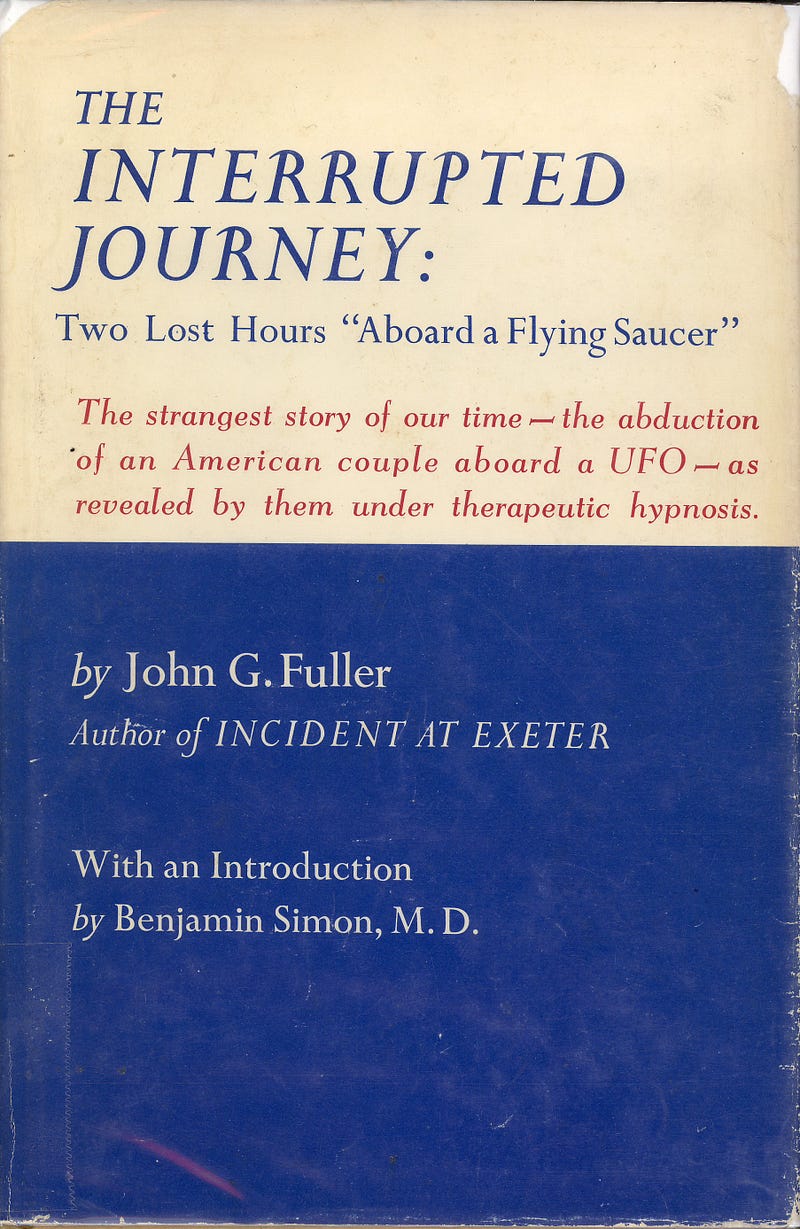
Fuller was in the area interviewing witnesses for what would become his first UFO book, The Incident at Exeter. He knew he had a tiger by the tail by the wild reception the Hills’ night had elicited and, of course, he had read the Traveler articles the year before as had most people. He and NICAP’s Walter Webb met Betty and Barney for coffee following their presentation, and they had dinner the next night. Fuller hit them up with the idea for a book about their experience and even had contracts drawn up to show them. Eventually, after back and forth negotiations, he put together a deal for the Hills, Dr. Benjamin Simon and himself to split the profits. That book came out in late 1966, sold over 300,000 copies, and went to the top of the New York Times bestseller list. It was a sensation.
The truth is that Fuller’s book is not the paragon of journalism it has been portrayed as. For starters, he changed facts to suit his narrative.
- He didn’t like the idea of Barney getting a gun from the trunk the night of the abduction so he changed it to a tire iron.
- He didn’t like the idea that Barney had a semen sample taken from him and a rectal exam so he simply left those crucial parts out. It’s possible it was Barney who pushed him on this matter.
- He didn’t want a letter Betty wrote to NICAP’s retired Major Donald Keyhoe mentioning psychiatric help to have that reference so he cut it with no comment.
Fuller took out facts from the true narrative, obviously bowing to pressure from his publisher, Dr. Simon, the Hills, and his own sensibilities.
In stark contrast, Luttrell tried to get as many facts as possible into his work, seeing himself as working for the public alone, and if anyone pushed him it was his editors arguing for more details. Any errors he may have made were through being the first to write about the case and facing the active non-cooperation of the Hills and many of their friends.
John Fuller was the person who commercialized the Hill abduction with his book. He knew from the beginning that it was a topic with huge public interest and his contract with the Hills and Simon shows that he was thinking about film and/or TV exploitation from the beginning of their relationship.
John Luttrell received only the salary he was being paid as a reporter and nothing more. He made no deals and was an independent voice.
His Place in History
John Luttrell might have written the first draft of the story of the century. Yet his contribution has been diminished and most of the credit has been given to another writer who simply stood on his shoulders. Hopefully, this article begins the historical process to set the record straight.
If there was any justice in the world, there would be a John H. Luttrell Sr. Journalism Award for Excellence in UFO Reporting.
The Rewrite Desk
Here is a suggested rewrite to replace the existing sign with a more accurate one during this year of commemoration of the 60th anniversary of the incident.
Betty and Barney Hill UFO Encounter. On the night of September 19–20, 1961, Portsmouth, NH couple Barney and Betty Hill had a close encounter with an unidentified flying object and experienced two hours of “missing time” while driving south on Rt. 3 near Lincoln. The next day, they filed an official Air Force Project Blue Book report describing a brightly-lit cigar-shaped craft. Their story was first reported by John Luttrell Sr. in The Boston Traveler in 1965. Theirs was the first publicized UFO abduction case in the United States.
The original is 92 words. This is also exactly 92 words. But three of the words are John Luttrell Sr. It’s better this way.
Bryce Zabel first dramatized the Hill case in his NBC drama series Dark Skies. He and his wife, writer/producer Jackie Zabel, currently have developed a TV series inspired by the book Captured! by Kathleen Marden and Stanton Friedman. Bryce (and Kathleen) will appear as on-camera historians on a premium streaming service documentary about the Hill case set for this fall. For Trail of the Saucers, he also wrote a 60th anniversary appreciation, “The Lost Honeymoon of Betty and Barney Hill.”