avatarNikolaos Skordilis

Free AI web copilot to create summaries, insights and extended knowledge, download it at here

2802

Abstract

l being <i>is far superior to his God.</i><a href="https://en.wikipedia.org/wiki/William_Blake">William Blake</a>, who drew several illustrations in the early 19th century for Paradise Lost, remarked that “The reason Milton wrote in fetters when he wrote of Angels & God, and at liberty when of Devils & Hell, is because he was a true Poet and of the Devil’s party without knowing it”.</p><p id="682f"><b>What do I think?</b> I think Paradise Lost is, at least in part, a product of the era Milton was born and bred in. It was the era when, for a while, <a href="https://en.wikipedia.org/wiki/Oliver_Cromwell">Oliver Cromwell</a> reigned supreme. You know, the guy who managed to have King Charles I tried and executed and subsequently for 11 years a Republic ruled Britain.</p><p id="bdae"><b>John Milton was a staunch anti-Roya</b>l and Republic believer. It is clear that, at least to an extent, his Lucifer is based on Oliver Cromwell and his God on Charles I or the <i>Crown by and large</i>. At the same time though the poem is a socioreligious comment on the importance of free will and freedom in general, incl. freedom of speech and expression.</p><p id="583b"><b>But above all else, it is high poetry at its finest.</b> It is the first ever well-known poem written in blank verse with iambic pentameter. Milton ditched rhyming to write more freely but he retained a scheme of 10 syllables per verse with iambic 5-meter, so the poem does not feel like it’s all over the place like.. some of my own free verse poems.</p><figure id="f5ab"><img src="https://cdn-images-1.readmedium.com/v2/resize:fit:800/1*WQowNUZa3AJP10X26mReFA.jpeg"><figcaption>John Milton’s portrait (cropped) in <a href="https://www.npg.org.uk/">NPG London</a> | Public Domain</figcaption></figure><p id="8dbb"><b>It is widely considered the greatest poem of the English language,</b> with Milton’s influence on English literature second only to Shakespeare. According to British author <a href="https://www.philip-pullman.com/">Philip Pullman</a>, the writer of His Dark Materials trilogy (titled after a verse of PL), “No one, not even Shakespeare, surpasses Milton in his command of the sound, the music, the weight, taste and texture of English words.”</p><p id="2e97"><b>To answer my question at the beginning,</b> Paradise Lost is <i>not</i> an indoctrinating poem. It is a poem with a religious theme. Indoctrination would go squarely against Milton’s freedom loving ideology. His Lucifer is a rebel spirit. It does not matter whether who he rebelled against was good or evil. Milton does not focus on that, and as a Puritan of the 17th century I doubt he thought God was evil — unlike the Pope I guess.</p><p id="1aa0"><b>Nevertheless he gives Lucifer the moral high ground</b> for choosing to suffer free i

Options

n hell over being comfortable but obedient in Heaven. My title is a famous verse from the poem, spoken by Lucifer. His Lucifer, more accurately, wants the<i> choice</i> of freedom rather than freedom itself.</p><p id="6908"><b>I think Milton suggests that if God had given Lucifer the choice</b> to forge his own path -like any father with any son- Lucifer would have probably chosen to stay in Heaven. But God never gave him a choice. Hence Lucifer’s only path was to rebel. <i>Per</i> <i>God’s plan?</i> No comment..</p><p id="0b8b"><b>That will be all ladies, gents, non binaries,</b> and potential angels and demons who might be peeking. According to Philip Pullman PL should be <i>listened</i>, not read. I linked the poem’s Book 1 at the first paragraph, but here is a free audio version (a mere.. ~10 hours) of it for anyone who wants to know if the poem stands up to its reputation.</p><p id="eec8"><b>I read the poem in my early 20s</b>, in Greek, but I think I’ll spend a couple of hours each day to listen to the original. I think the guys who worked on this did a very good job:</p> <figure id="91fb"> <div> <div> <img class="ratio" src="http://placehold.it/16x9"> <iframe class="" src="https://cdn.embedly.com/widgets/media.html?src=https%3A%2F%2Fwww.youtube.com%2Fembed%2F0hu8p-NYSkE%3Ffeature%3Doembed&amp;display_name=YouTube&amp;url=https%3A%2F%2Fwww.youtube.com%2Fwatch%3Fv%3D0hu8p-NYSkE&amp;image=https%3A%2F%2Fi.ytimg.com%2Fvi%2F0hu8p-NYSkE%2Fhqdefault.jpg&amp;key=a19fcc184b9711e1b4764040d3dc5c07&amp;type=text%2Fhtml&amp;schema=youtube" allowfullscreen="" frameborder="0" height="480" width="854"> </div> </div> </figure></iframe></div></div></figure><p id="86e5">Sources:</p><p id="8c0b"><a href="https://www.bbc.com/culture/article/20170419-why-paradise-lost-is-one-of-the-worlds-most-important-poems">Why you should re-read Paradise Lost</a> (BBC Culture) <a href="https://en.wikipedia.org/wiki/Oliver_Cromwell">Oliver Cromwell</a> (Wikipedia)</p><p id="42d0">All my non fiction:</p><div id="e38f" class="link-block"> <a href="https://skordilis.medium.com/list/27a59e44316b"> <div> <div> <h2>My Non Fiction</h2> <div><h3>All my non fictional articles and essays</h3></div> <div><p>skordilis.medium.com</p></div> </div> <div> <div style="background-image: url(https://miro.readmedium.com/v2/resize:fit:320/0*e841ccf3e7dcf87876fa72879746808f0a03d5f1.jpeg)"></div> </div> </div> </a> </div><p id="175f"><a href="https://skordilis.medium.com/subscribe">Get my stories in your inbox 📬</a></p></article></body>

CULTURE | PARADISE LOST | JOHN MILTON

Better to Reign in Hell, than Serve in Heaven

The beauty and genius of John Milton’s Paradise Lost
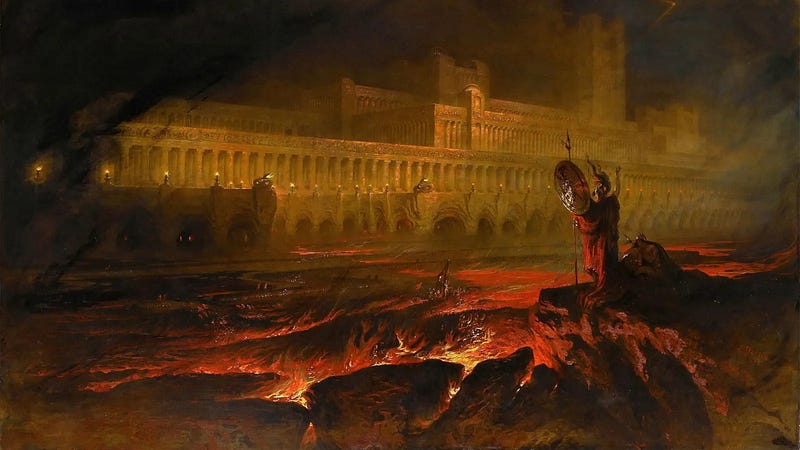
Pandemonium, Hell’s capital (1825), by John Martin | Public Domain

As I wrote here poetry -and art by and large- should not copulate with religion (or politics). And yet John Milton did just that with his epic poem Paradise Lost. So? Well, every rule has exceptions, and Paradise Lost is one of them.

Wait. Is it? Paradise Lost is religious in nature, certainly, but does it try to push a religious agenda? Does it try to convert or proselytize anyone? And, since the poem’s MC is Lucifer himself, toward which side such a religious agenda, should one be at play, would gravitate? In this article we will try to address these questions.

Milton’s poem has been a major influence on anyone from the poet Percy Shelley and the poet/painter William Blake to metal bands like the namesake Brits Paradise Lost, and the most well-known Greek band worldwide, the metal band Rotting Christ. They are the only musicians I know who compose songs with ancient Greek lyrics:

Percy Shelley, an anti-establishment poet, wrote that “Milton’s Devil as a moral being is far superior to his God.William Blake, who drew several illustrations in the early 19th century for Paradise Lost, remarked that “The reason Milton wrote in fetters when he wrote of Angels & God, and at liberty when of Devils & Hell, is because he was a true Poet and of the Devil’s party without knowing it”.

What do I think? I think Paradise Lost is, at least in part, a product of the era Milton was born and bred in. It was the era when, for a while, Oliver Cromwell reigned supreme. You know, the guy who managed to have King Charles I tried and executed and subsequently for 11 years a Republic ruled Britain.

John Milton was a staunch anti-Royal and Republic believer. It is clear that, at least to an extent, his Lucifer is based on Oliver Cromwell and his God on Charles I or the Crown by and large. At the same time though the poem is a socioreligious comment on the importance of free will and freedom in general, incl. freedom of speech and expression.

But above all else, it is high poetry at its finest. It is the first ever well-known poem written in blank verse with iambic pentameter. Milton ditched rhyming to write more freely but he retained a scheme of 10 syllables per verse with iambic 5-meter, so the poem does not feel like it’s all over the place like.. some of my own free verse poems.
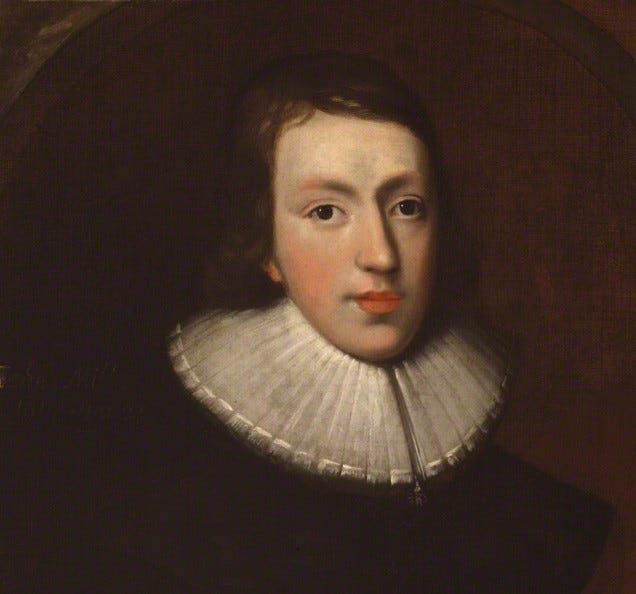
John Milton’s portrait (cropped) in NPG London | Public Domain

It is widely considered the greatest poem of the English language, with Milton’s influence on English literature second only to Shakespeare. According to British author Philip Pullman, the writer of His Dark Materials trilogy (titled after a verse of PL), “No one, not even Shakespeare, surpasses Milton in his command of the sound, the music, the weight, taste and texture of English words.”

To answer my question at the beginning, Paradise Lost is not an indoctrinating poem. It is a poem with a religious theme. Indoctrination would go squarely against Milton’s freedom loving ideology. His Lucifer is a rebel spirit. It does not matter whether who he rebelled against was good or evil. Milton does not focus on that, and as a Puritan of the 17th century I doubt he thought God was evil — unlike the Pope I guess.

Nevertheless he gives Lucifer the moral high ground for choosing to suffer free in hell over being comfortable but obedient in Heaven. My title is a famous verse from the poem, spoken by Lucifer. His Lucifer, more accurately, wants the choice of freedom rather than freedom itself.

I think Milton suggests that if God had given Lucifer the choice to forge his own path -like any father with any son- Lucifer would have probably chosen to stay in Heaven. But God never gave him a choice. Hence Lucifer’s only path was to rebel. Per God’s plan? No comment..

That will be all ladies, gents, non binaries, and potential angels and demons who might be peeking. According to Philip Pullman PL should be listened, not read. I linked the poem’s Book 1 at the first paragraph, but here is a free audio version (a mere.. ~10 hours) of it for anyone who wants to know if the poem stands up to its reputation.

I read the poem in my early 20s, in Greek, but I think I’ll spend a couple of hours each day to listen to the original. I think the guys who worked on this did a very good job:

Sources:

Why you should re-read Paradise Lost (BBC Culture) Oliver Cromwell (Wikipedia)

All my non fiction:

Get my stories in your inbox 📬

Culture
Poetry
John Milton
Paradise Lost
English Literature
Recommended from ReadMedium
avatarNevena Pascaleva
Atlántida

The calling

5 min read