
10 Best Solana API Providers
Discovering the Top API Providers for Solana Development
Solana is an open source blockchain that is designed to have a high transaction speed. It uses a consensus mechanism called “Proof of History” (PoH) which allows the network to process thousands of transactions per second, making it one of the fastest blockchain networks available today.
How does Solana Work?
Solana’s high transaction speed is achieved by using a combination of techniques, including parallel processing, sharding, and a unique data structure called a “gossip protocol” which allows for efficient data transfer between nodes. This makes Solana well-suited for use in decentralized applications that require fast and efficient data transfer, such as decentralized exchanges, gaming, and prediction markets.
Solana’s native token is called SOL. It is used to pay transaction fees on the Solana network and is also used as a form of collateral to secure the network. There is no upper limit to the number of SOLs that can be generated by the network. The total supply of SOL is determined by the number of tokens that are mined over time.
What are Solana APIs?
Solana nodes accept HTTP requests using the JSON-RPC 2.0 allowing developers to interact with the Solana network and perform various functions, such as sending transactions, querying the state of the ledger, and managing validator nodes.
To interact with a Solana node inside a JavaScript application, developers can use the solana-web3.js library. This library provides a convenient interface for the JSON-RPC methods and makes it easy to perform various actions on the Solana network.
There are also third-party API providers like Bitquery that offer APIs for interacting with the Solana network. These providers typically offer a wider range of features and higher rate limits compared to using the JSON-RPC methods directly. Bitquery, for example, provides a suite of Solana blockchain APIs to query the blockchain, retrieve historical data, and perform analytics on the Solana network.
Additionally, third-party API providers like Bitquery can also provide extra features such as support for multiple programming languages, built-in caching, and more advanced analytics. This can make it easier for developers to build and scale their applications on top of the Solana network.
In this article, we will look at some of the best Solana API providers and their features, so that you can choose the right one for your project.
Best Solana API providers
1.Bitquery
Bitquery is a blockchain data company that provides a suite of APIs for interacting with the Solana blockchain. These APIs allow developers to easily access the data and functionality of the Solana network, facilitating the creation of decentralized applications (dApps) and other tools that use the Solana blockchain.
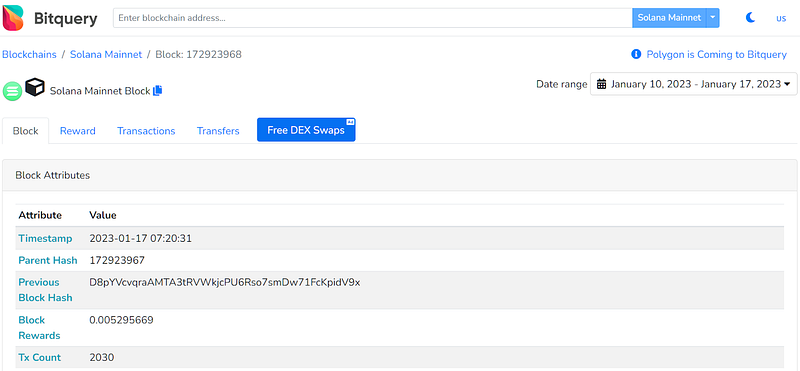
Solana Explorer provides detailed information about the network. Bitquery’s inbuilt GraphQL IDE supports custom queries including the balance of an address on the Solana network. It also gives you the ability to visualize the transfer count over a period of time.
You can view daily statistics about the Solana network, including:
Daily Active Users (DAU): Solana does not have the concept of “users” in the traditional sense. You can check the number of unique addresses that have signed transactions on the Solana network.
Programs: You can check the number of programs that have been deployed on the Solana network.
Transactions: You can check the number of transactions that have been processed on the Solana network. Solana transactions contain an array of signatures and the actual message that is signed by the sender, this array of signatures called the “compact-array of signatures” is a mechanism to prove the authenticity of a transaction.
Support for multiple blockchains: In addition to Solana, Bitquery also supports 30+ other blockchain networks, such as Ethereum, Bitcoin, and Binance Chain. This may be useful for developers who want to build dApps that can query data from multiple blockchains.
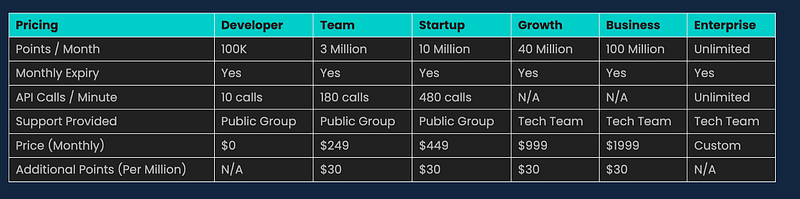
By using the points system to charge you for what you request, we save you millions of dollars in business costs. Sign up for a developer account for free.
2.Chainstack
With ChainStack, users can access Elastic Solana RPC nodes, which provide dedicated and protected API endpoints for interaction with Solana networks. These nodes use up-to-date snapshots of the ledger, allowing them to be ready for use immediately, rather than having to wait for long synchronization times when starting from the genesis block. With SolanaFM, Chainstack provides full data indexing services.
It provides a collection of JSON-RPC API call examples for the Solana API using different programming languages and tools such as Solana web3.js, Solana.py, curl and Solana Tool Suite. Chainstack offers a free developer plan that provides Elastic full nodes and allows for unlimited users and projects.
3.Blockdaemon
Blockdaemon’s Ubiquity API Suite provides developers with access to a variety of blockchain protocols, including Solana, through a single API. This streamlines developer efforts by reducing the need to write separate code for each protocol and returns consistent results across all protocols. The API supports various Solana method types, including protocols, accounts, blocks, transactions, and transaction broadcasting, as well as providing access to both universal and native historical data. Blockdaemon also provides dedicated Nodes-as-a-service to get RPC access to the Solana network. The Starter pack is ideal for individuals who would like to test Ubiquity suite and it comes with a limit of 25 requests per second.
4. Quicknode
QuickNode is a blockchain development platform that provides Solana RPC endpoints, which can be used to interact with a Solana blockchain network. These endpoints can be called using various libraries such as Python, Ruby, JavaScript, and cURL. This allows developers to easily build and integrate Solana-based applications in a wide range of programming languages.
QuickNode supports custom methods like the “Fetch NFTs By Creator” that allows developers to query the Solana blockchain for NFTs (non-fungible tokens) that have been created by a specific address. Quicknode’s free plan offers all APIs for free with a limit of 25 Requests/sec.
5. Moralis
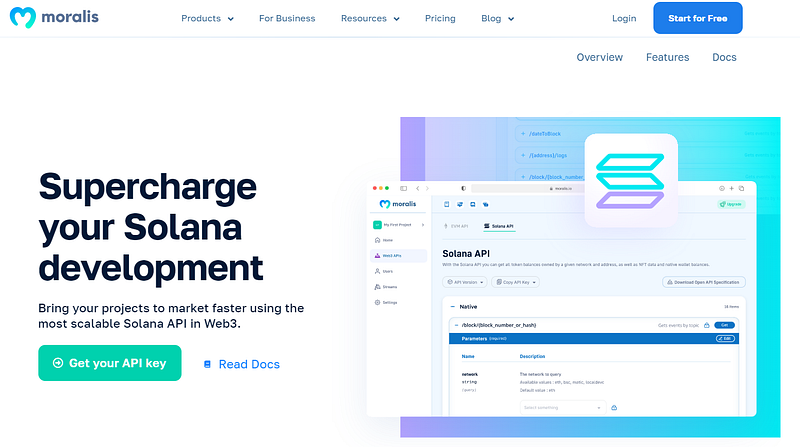
Moralis is a Web3 API platform that provides APIs for working with data on NFTs (non-fungible tokens), and wallet portfolios on the Solana blockchain. Their REST APIs allow developers to easily integrate real-time token data, such as prices and exchange data, into their applications. They also provide an Account API that can be used to interact with user accounts on the Solana blockchain. NFT marketplaces can use the Moralis API to access real-time data on NFT prices, token data, and exchange data. Users can get up-to-date information on NFTs they are interested in buying or selling. The Free plan comes with access to all Moralis APIs and Moralis Streams.
6. Alchemy
Alchemy is a blockchain developer platform with an uptime of 9.9%. The AccountsDB Infrastructure built by Alchemy is a key component of its Solana API ecosystem that enables fast and scalable access to data stored on the Solana blockchain. By paginating the response and using a pageKey, it allows for more efficient data retrieval and reduces the load on the network. It can be used for different use cases like decentralized exchanges, games, and other dApps. The free plan includes access to enhanced APIs and multichain mainnets and testnets.
7. Getblock
GetBlock’s Solana API allows developers to easily access and interact with the Solana blockchain using a JSON RPC method. The API provides access to SOL nodes through a single API key, enabling users to move their blockchain-based applications. This can help to simplify the process of building and deploying decentralized applications on the Solana network. GetBlock’s Dedicated Nodes as a Service (DNaaS) provides access to dedicated SOL nodes, which can help to ensure a stable and reliable connection to the network.
The shared node option is an entry-level solution offered by GetBlock. In this mode, users share the infrastructure of the nodes with their peers. This can be a cost-effective solution for small or medium-sized projects and can help to reduce the barriers to entry for developers who are new to the Solana blockchain.
8. Tatum
Tatum is a platform for building Web3 applications with Javascript or C#. The Tatum Solana API is currently in BETA and there is a rate limitation applied for all projects for Solana to 40 req/s on the platform. This rate limitation ensures that the network remains stable and secure, while still allowing developers to create powerful applications. The API includes methods to get account balances and Solana transactions. It also provides a CLI to interact with the blockchain.
Tatum’s free plan includes unlimited API calls and a limit of 5 requests/second.
New to trading? Try crypto trading bots or copy trading on best crypto exchanges


