
Best Python Resources Available On The Internet in 2022
Python is an interpreted, high-level and general-purpose programming language. Python’s design philosophy emphasizes code readability with its notable use of significant whitespace. Its language constructs and object-oriented approach help programmers write clear, logical code for small and large-scale projects. Wikipedia
Python is dynamically typed and garbage-collected. It supports multiple programming paradigms, including structured (mainly procedural), object-oriented, and functional programming. Python is often described as a “batteries included” language due to its comprehensive standard library.
In today’s article, we will talk about 6 of the best open-source Python Resources available online to get you started with this fantastic tool.
Note: In this article, we are going to talk about some of the not-so-famous but really good PythonResources which you can use to make your next projects. To read more about each of them I recommend following the link given along the project.

Having good theoretical knowledge is amazing but implementing them in code in a real-time machine learning project is completely different. You might get different and unexpected results based on other problems and datasets.
As a bonus, I am also adding the links to the various courses, which have helped me a lot in my journey to learn Data science and ML. I am personally a fan of DataCamp, I started from it, and I am still learning through DataCamp and doing new courses. They seriously have some exciting classes. Do check them out.
Coming back to the topic -
1. TheAlgorithms — Python
Github Link | Official Documentation
Stars: 94700 | Forks: 27600
TheAlgorithms is Github’s most extensive open-source algorithm library to build new things, writing complex encryption programs or simple ciphers. An algorithm is a set of rules that takes in inputs, performs inner calculations and data manipulations and returns an output or a group of works.
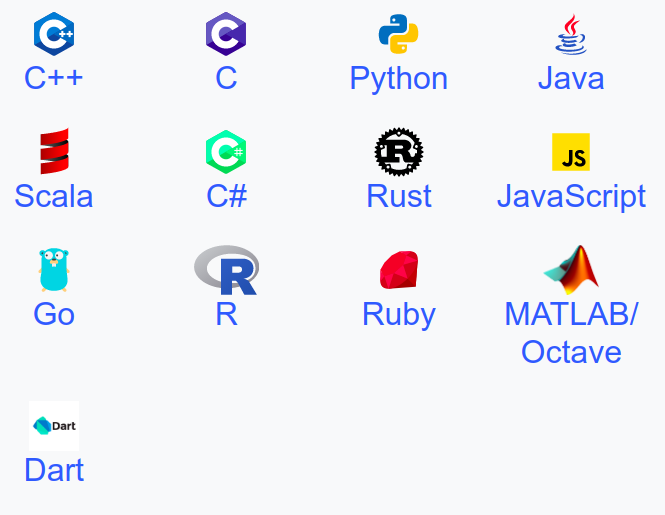
They support many programming languages and have more than 500 algorithms. Each language has its own GitHub repository where all the code for the algorithms is stored.
Here is a list of the current programming languages:
2. Awesome Python
Github Link | Official Documentation
Stars: 91200 | Forks: 17900
Awesome Python is a curated list of all the excellent Python frameworks, libraries, software and resources available on the internet.
It contains resources for more than 50 Computer Science topics, including:
- Caching
- Code Analysis
- Computer Vision
- Cryptography
- Data Analysis
- Data Visualization
- DataBase Drivers
- Deep Learning
- DevOps Tools
- Distributed Computing
- E-commerce
- Email Services
- Functional Programming
- Package management and repositories
- Image Processing
- Machine Learning
- HTTP Clients
- HTML Manipulation
- RESTful API
- Robotics
- and the list goes on. Check it here.

3. Project-Based Learning
Github Link
Stars: 41900 | Forks: 6900
Project-Based Learning is a list of programming tutorials in which learners build an application from scratch.
These tutorials are divided into different primary programming languages. Some have intermixed technologies and languages.
Topics included in the Python programming language are:
- Web Scraping
- Web Applications
- Bots
- Data Science
- Machine Learning
- OpenCV
- Deep Learning
- and some miscellaneous topics
4. Python-Patterns
Github Link
Stars: 26600 | Forks: 5500
Python Patterns repository is a collection of design patterns and idioms in Python.
Design patterns are used to represent the pattern used by developers to create software or web application. These patterns are selected based on the requirement analysis. The practices describe the solution to the problem, when and where to apply the key and the consequences. tutorialspoint
Python-Patterns repository contains:
- Creational Patterns
- Structural Patterns
- Behavioural Patterns
- Design for Testability Patterns
- Fundamental Patterns
- and many other patterns
5. WTFPython
Github Link
Stars: 22900 | Forks: 2000
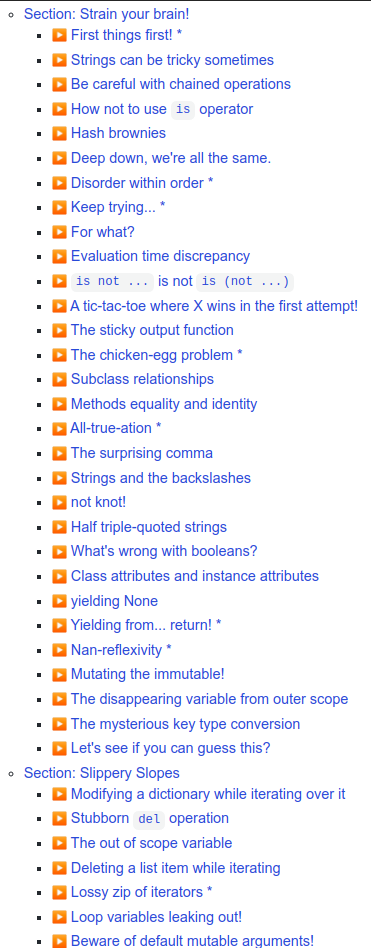
WTFPython, also called What the f*CK Python, may not be WTFs in the truest sense, but they’ll reveal some of the exciting Python parts that you might be unaware of. I find it an excellent way to learn the internals of a programming language.
If you’re an experienced Python programmer, you can take it as a challenge to get most of them right in the first attempt. You may have already experienced some of them before, and I might be able to revive sweet old memories of yours!
Table of contents:
6. Python Guide
Github Link | Official Documentation
Stars: 22200 | Forks: 5500
Python guide is the hitchhiker's guide to Python. This handcrafted guide exists to provide both novice and expert Python developers a best practice handbook for the installation, configuration, and usage of Python daily.

Topics included:
- Platform and version-specific installations
- Py2app, Py2exe, Biofreeze, pyInstaller
- Pip
- Numpy, scipy, statpy, pyplot, matplotlib
- Virtualenv
- Fabric
- Exhaustive module recommendations, grouped by topic/purpose
- Which libraries to use for what
- Server configurations & tools for various web frameworks
- Documentation: writing it
- Testing: Jenkins & tox guides
- How to easily interface
hgfromgit
PS: You won’t find a list of every Python web framework available here. Rather, you’ll find a nice concise list of highly recommended options.
If you enjoyed reading this article, I am sure that we share similar interests and are/will be in similar industries. So let’s connect via LinkedIn and Github. Please do not hesitate to send a contact request!