Best Practices For Creating a Successful Data Strategy for Your Business

Creating a Successful Data Strategy (Part 2)
Develop a Data Strategy
In Part 1 of this series, we looked at the reasons to build a data strategy in the first place. We also outlined the key data infrastructure considerations and the overall role that data analytics can play in your organization. In this article, we’ll take a deeper look at how to use analytics to add value to your decision-making process.
Understanding Your Customer: Create A Data-Driven Customer Persona
To craft an effective data strategy, it is essential for startups to understand their customers. One way of doing this is by leveraging data to create customer personas. A customer persona is a characterization of a typical or ideal customer that represents the needs, behaviors, and preferences of a particular target audience. Startups can use these personas as a guide when designing products, services, and marketing campaigns tailored to their customers’ unique characteristics. To construct accurate and insightful customer personas, startups should analyze various types of data such as demographic information, online behavior patterns, social media interactions and purchase histories. They can then segment this data into meaningful clusters to identify specific groups with similar needs or interests. With this information in hand, they can build detailed profiles that include personal attributes such as age range, profession, income level as well as information on what motivates them to purchase goods or services. Once you have this basic data about your customers, you can feed it into chatGPT to craft detailed customer personas for you.

ChatGPT is a powerful tool for creating customer personas when you use the following prompt:
“Create a buyer persona for my company and identify the pain points, main areas of interest, etc. Ask me follow up questions that you need to create the buyer persona”
The “ask me follow up questions” part of the prompt will trigger chatGPT to ask you to supply the following information:
- Age range and demographic profile of the target audience
- Job roles and industries they are working in
- Level of experience and expertise in AI and automation
- Geographic location (are they primarily from a specific region or country?)
- Goals and objectives they want to achieve through joining this community
- Communication preferences (online forums, webinars, in-person events, etc.)
Once you’ve used this prompt to create a customer persona, you can continue asking chatGPT to generate content ideas, product suggestions, etc.
Best Practices for Data Collection, Storage, Cleaning and Preparation For Analysis
Collecting and storing data are essential components of any successful data strategy for any business. It’s important to collect the right type of data and store it in a reliable and secure manner; only collect necessary information that will help you achieve your business goals rather than collecting irrelevant or excessive amounts of data just because you can. Startups also need to comply with privacy laws and regulations when collecting personal or sensitive information. If you work for a larger corporation, you will always need to conduct a digital privacy impact assessment (DPIA) when dealing with any that could directly, or indirectly, identify a real person. Cloud storage solutions are often preferable to on-premise data stores given their scalability, reliability, security, accessibility to remote teams and cost-effectiveness. Cloud-based storage also gives you peace-of-mind knowing your data is backed up in multiple locations across several geographic regions, which should protect it from fires, natural disasters or cyber attacks.
Once you’ve collected and stored the data, your analytics team will need to clean and prepare it for analysis. This is a crucial step in any data strategy and will probably consume the majority of your analytics’ team working hours. Reliable analytics depend on accurate, complete, and consistent datasets but raw data often comes with errors, missing values, duplicates, or irrelevant information. If these errors are not corrected, any insights will be flawed or simply incorrect. At this point, your analytics team will conduct exploratory data analysis (EDA) to get a “feel” for the dataset in terms of how much data there is to analyze, the quality of the data (missing values, obvious errors), the variety of data to work with (a few columns or dozens)and the type of data (numeric, categorical, mixed). Exploratory Data Analysis can be as much art as science. However, there are several powerful automated EDA tools including SweetViz and Pandas Profiling that can be used to automate much of the tedious data exploration phase.
Data cleaning requires removing inconsistencies and inaccuracies from the dataset by using imputation (filling in missing values with the mean, median or some other logical value), de-duplication (removing identical records), normalization (transforming variables into a standard range so variables with different numeric scales can be used in the same machine learning models), or outlier detection (identifying observations that seem too large or too small). Once the data is cleaned, data preparation can be done to transform the raw data into a format suitable for analysis by selecting relevant features, creating new variables (such as ratios consisting of two or more other variables), encoding categorical variables (e.g. one-hot encoding is a popular technique) and scaling numeric attributes.
Data Visualization: Communicating Insights and Results Effectively
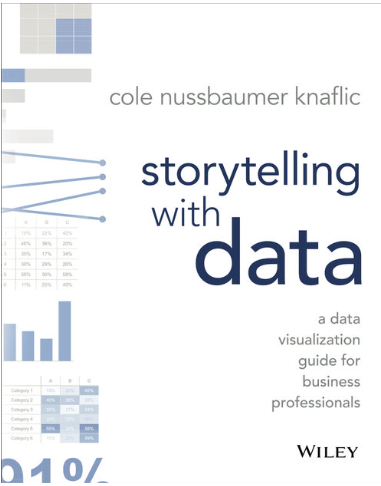
Data visualization is an essential aspect of any successful data strategy for startups. Startups must present their data insights and results in a clear, concise, and understandable manner to stakeholders. Data visualization tools help transform large amounts of data into easy-to-comprehend dashboards, charts, and graphs. Effective data visualization enables audiences to quickly grasp the key message and meaning that would otherwise be hidden in the data. A great resource for learning more about this subject is the book, Storytelling with Data.
Measuring Success: Setting KPIs and Metrics for An Effective Data Strategy
Measuring success is an important component of any business strategy and setting Key Performance Indicators (KPIs) is important for tracking progress against your goals and objectives. When setting KPIs and metrics, it’s important to consider the objectives that matter most to your startup. Define what success looks like in measurable terms and tailor your approach based on these objectives. For example, if increasing website traffic is a goal for your startup, you could set KPIs focused on organic search rankings or click-through rates from social media channels.
It is also important to select relevant data sources when crafting a data strategy plan. Decide which information you need to calculate / track your KPIs and consider how accurate and timely that data is. If the data is difficult or expensive to obtain, or if the data quality is low and open to dispute, don’t use it. If your staff don’t trust the inputs to the KPIs they are being measured with, they will either find a way to game the system or ignore it all together.
The Power of Predictive Analytics: Using Data to Forecast Trends and Behavior
So far, we have been discussing descriptive analytics (what happened), i.e., analysis that describes and summarizes historical results. There are several higher levels of analysis, including diagnostic analytics (why did something happen), predictive analytics (what is going to happen in the future) and prescriptive analytics (what can we do about it and how should we respond). This graphic from Gartner summarizes what each type of analytics tries to accomplish.
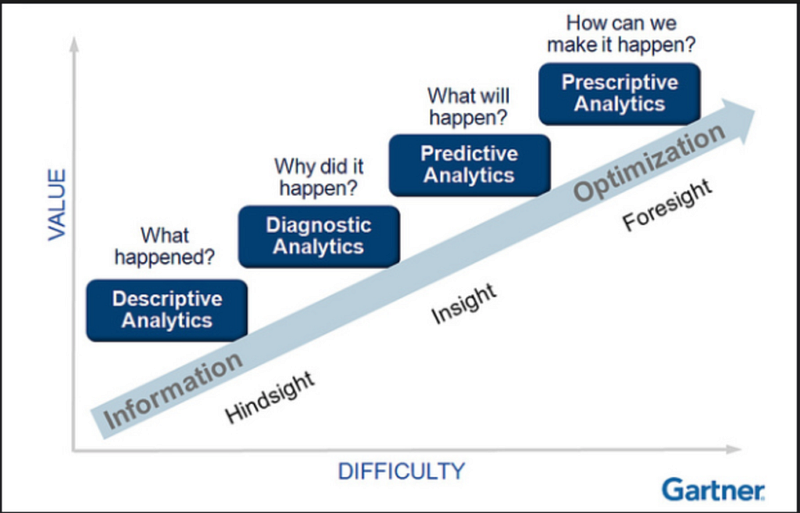
Predictive analytics helps businesses forecast trends and consumer behavior. By analyzing large amounts of data, predictive models can provide insights into future customer needs, preferences and habits. Time Series Forecasting is one popular technique that attempts to use past information about a business process, e.g. sales, to predict what future sales might be while taking into consideration probable growth rates, seasonality, inflection points, etc. This is a complex topic for a future article.
Key Takeaways To Create A Data Strategy
Here are five key takeaways to consider:
- Leverage data to create customer personas with chatGPT, using demographic information, online behavior patterns, social media interactions, and purchase histories to better understand customers and tailor products, services, and marketing campaigns.
- Be sure to comply with privacy laws and consider cloud storage solutions for scalability, reliability, security, and cost-effectiveness when collecting and storing data.
- Explore, clean and prepare data for analysis by removing inconsistencies, filling in missing values, normalizing variables, and transforming raw data into a format suitable for analysis.
- Utilize data visualization techniques to communicate insights and results in a clear and concise manner to stakeholders.
- Set measurable KPIs and metrics based on relevant and reliable data sources. Consider using predictive analytics to forecast trends and behavior for informed decision-making and business growth.
If you liked this article, make sure to follow me on Medium for more ideas how to apply data science to solve real business challenge
Here are some other articles you may like:
- Customer Review Analysis Using ChatGPT
- Practical Examples of AI and Machine Learning in Business
- 5 Reasons Why Business Data Science Projects Fail
I’m happy to answer any questions you have in the comments section.
Disclosure Per Medium’s Policy: AI-assistive technology was used to help create this article, particularly for brainstorming and SEO optimization. All images in the article are original and were created with generative AI by me with full commercial rights.