
Benjamin Franklin used data to show that variolation with smallpox was safer than smallpox infection “the natural way”
One of the Founding Fathers used reason and numbers to convince people about variolation’s safety.

I’ve told you before that you shouldn’t put all the weight of your evidence on the p-value of your statistical analysis. Statistics help confirm the certainty of your findings, but they’re not the end-all, be-all of the truth of your observations. So what did you do to convince people that a medical intervention was safer than the alternative? You used a lot of reasoning with words and numbers, like Benjamin Franklin did.
Variolation is the precursor to vaccination. In variolation, you take fluid from the vesicles of a person with smallpox, and inject that fluid into a healthy person. The hope is that you’ve taken just enough material to not make the recipient too sick, and that you’ve used Variola minor instead of Variola major. One causes more severe symptoms than the other… I’ll let you guess which one.
Ben Franklin Makes His Case For Variolation
Between 1753 and 1754, smallpox visited Boston, causing a severe epidemic. Having heard of Mather and Boylston’s experience with variolation (after Onesimus told them all about it), Benjamin Franklin paid close attention to the outcomes of people who got smallpox “in the common way” and those who got it by “inoculation.” Writing the preface to a pamphlet on variolation by Dr. William Heberden, Benjamin Franklin reported the results thus:
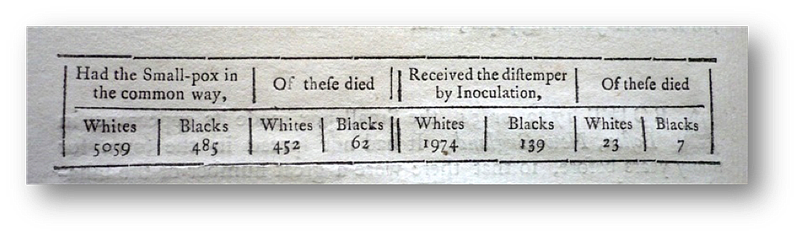
Here are some findings from Franklin’s data:
- Franklin had results for 7,657 people.
- A total of 5,544 people got smallpox.
- 514 of them, or about 9.3%, died.
- A total of 2,113 people got variolated (inoculated).
- 30 of them, or about 1.42%, died.
- The risk of death was about 6.5 times higher in those who contracted smallpox “in the common way” than those who were variolated.
That by itself should be enough to convince us, right? If we use modern vaccine effectiveness calculations, we could say that variolation was 85% effective in preventing death. But we can only compare those infected and those variolated. We would need to know how many were not infected nor variolated to see the full picture. Nevertheless, Benjamin Franklin continues to reason through his observations:
“It appeared by this account that the deaths of persons inoculated, were more in proportion at this time than had been formerly observed, being something more than one in a hundred. The favourers of Inoculation however would not allow that this was owing to any error in the former accounts, but rather to the Inoculating at this time many unfit subjects, partly through the impatience of people who would not wait the necessary preparation, lest they should take it in the common way; and partly from the importunity of parents prevailing with the Surgeons against their judgment and advice to inoculate weak children, labouring under other disorders; because the parents could not immediately remove them out of the way of the distemper, and thought they would at least stand a better chance by being inoculated, than in taking the infection, as they would probably do, in the common way. The Surgeons and Physicians were also suddenly oppress’d with the great hurry of business, which so hasty and general an Inoculation and spreading of the distemper in the common way must occasion, and probably could not so particularly attend to the circumstances of the patients offered for Inoculation.”
He then adds more numbers to the evidence for variolation:
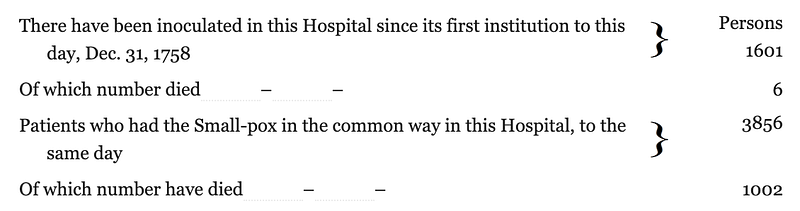
Again, just by looking at the numbers, you can tell that inoculation kills less people than the natural infection. And, again, I have to warn you to take these numbers with a grain of salt. These numbers are from an era before Germ Theory, before modern medicine. We have no way to confirm if the smallpox patients had it, though I would trust physicians of that era to readily recognize it. Physicians today have not seen a case for over 40 years.
Did you catch the inequity?
By the way, did you catch the inequity in how smallpox affected people based on race? If we look at the numbers by race, you can see that those patients identified as “Blacks” were more likely to die from smallpox than their “Whites” counterparts, 12% vs. 8.9%. And “Blacks” were more likely to die from variolation, 5.1% vs 1.2%. Some things never change, I guess?
“All Others Must Bring Data”
In my experience, a well-reasoned argument with many examples and simple numbers can help convince people to take action to protect their health. You can see it in how Benjamin Franklin presented his support for variolation. He lost a son to smallpox, so I’m sure that horrifying event contributed to his passion for preventatives like variolation. He investigated the evidence, collected the numbers, and presented them to the public.
It wouldn’t be until the end of the 1700s that Edward Jenner would write his observations on inoculation with cowpox to prevent smallpox. In the meantime, people had to rely on the more dangerous variolation procedure to hopefully prevent smallpox. Many were weary, they had heard stories. But it was people like Benjamin Franklin, Lady Mary Wortley Montagu, and even Catherine The Great who pushed through the fear and probably saved millions of lives in the era before vaccines.
Hey, if you liked what you read just now, and what you read on Medium in general, why not get a membership and support our work? Click here for more information: https://medium.com/membership Thanks!
René F. Najera, MPH, DrPH, is a doctor of public health, an epidemiologist, amateur photographer, running/cycling/swimming enthusiast, husband, father, and “all-around great guy.” You can find him working as the director of a center for public health, grabbing tacos at your local taquería, teaching at a university in northern Virginia where he is an adjunct in the Department of Global and Community Health, or teaching at the best school of public health in the world where he is an associate in the Department of Epidemiology. All opinions in this blog post are those of Dr. Najera, and do not necessarily represent the opinions of his employers, friends, family, or acquaintances.


