
“Beneath a Scarlet Sky” by Mark Sullivan
A review
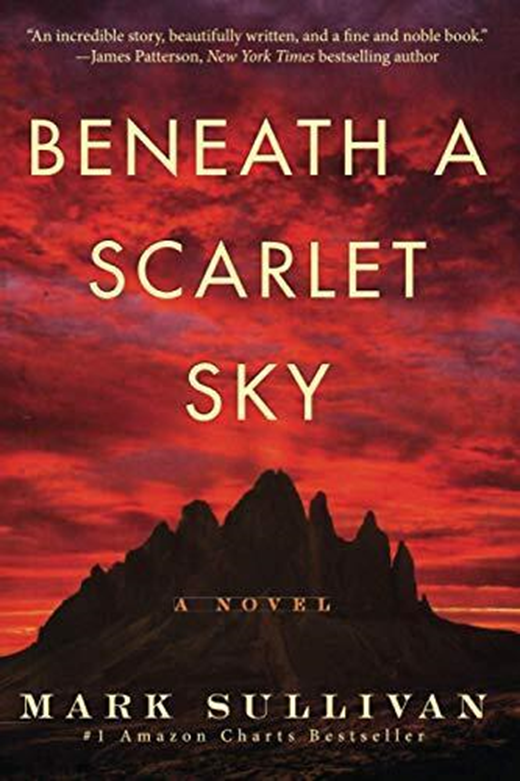
My discovery of this book came via a rather circuitous route. I wrote a couple of articles inviting readers to name their favourite and most influential three books, and this was one recommended by Marcia Abboud in my “What Three Books” series. The original article and sequel are on the links below.
The foreword to “Beneath A Scarlet Sky”, includes reference to the author experiencing brief suicidal thoughts, and contemplating while in a dark place, that he was worth more to family dead, and entertaining the possibility of deliberately crashing his car.
While sad to read, this shows a refreshing willingness to be more open about mental health issues now, and perhaps also illustrates the way that some writers struggle with inspiration and our craft, that there is sometimes a fine between genius and insanity that is trodden with care. Yet it is the cracks that let in the light and inspire the great art we are blessed with. The same evening of the day of these dark thoughts, Sullivan describes how the discovery at a dinner party, of the true-life story behind this book, gave him a renewed sense of purpose and will to live again.
Having read “Beneath A Scarlet Sky” I can see why Marcia chose it. It is an extraordinary story, that Sullivan stumbled across, and we are fortunate it has been captured for posterity. Pino Lella is an Italian who spent the last two years of World War Two, around the age of just eighteen, first helping Jewish refugees escape over the mountains into Switzerland, then in an extraordinary switch, encouraged by his parents who thought it would make him safer, became a chauffeur for a Gestapo General Leyers, in the Nazi SS, who oversaw slave labour projects.
Pino spied on his work and passed secrets to the resistance. The Nazis had entered Italy at the invitation of dictator Mussolini and fascist supporters. Friends and relatives of Pino assisted or fought with the partisan resistance, some treating him with hostility until his secret role became clear towards the very end of the war.
The author met with Pino, who was then in his late 70s, and spent time talking to him and researching the project. It is an interesting way for the story to be told. I have some reservations about using extensive artistic licence in this age of deep fakes. There is the risk of embellishment, of overstating or understating heroism, that alliances and loyalties may have been more complex and uncertain than portrayed, and that perhaps there were times of shifting loyalties, contingent on circumstances at the time.
The blend of fact and fiction can feel a little uncomfortable as a vehicle for the story, with its use of recreated dialogue, however diligent an effort has been made to describe events exactly as they happened. An alternative would perhaps have been for the book to have been narrated by Pino himself with Sullivan as a ghostwriter, in a work that was more clearly non-fiction, rather than in the way it has been done, which seems to place it somewhere in between genres.
Alongside those reservations about the combination of fact and fiction in the way the book is told, it must be said that the Nazi era and the Holocaust are vitally important to record, remember and learn from. So historical accuracy is essential to observe.
There seems some naivety by the author about the role of the Catholic church, which is shown in the book as fully on the side of those trying to save Jews, and heroically secretly supporting the partisans. The reality is much more nuanced and there were elements within the church across Europe as a whole, which collaborated with or fully supported the Nazis. It was a very mixed picture of outstanding virtue but also at some times and places, something darker.
Pino experiences the best of times and worst of times during the war. He has a passionate love affair with the maid in Leyer’s house, yet also witnesses some of the horrors of war, casual executions, barbaric treatment of corpses, the cruel treatment and transport of Jews, the casual brutality towards the slave labourers, whose lives are treated as worthless by the guards, when life or death hangs by a thread.
There are some profound insights in the book, about the nature of the human condition, in which there are extremes of good and evil, joy and pain and despair, captured in one memorable quotation:
“God giveth, and God taketh away. Sometimes in the same day.”
There is another deep observation later in the book when Pino decides to tell his story:
“…. …someone very wise once told me that by opening our hearts, revealing our scars, we are made human and flawed and home. I guess I’m ready to be made whole.”
The book touches on a subject that has been explored elsewhere, the possibility of there having been some “good” Nazis, though it clearly concludes that on balance this was not the case, that Leyers was responsible for the abhorrent treatment of slave labourers, four of whom Pino suspects Leyers shot in cold-blood, to conceal a theft of some gold. Huge numbers of the slave labourers died from over-work and neglect.
However, there are occasional glimpses into a more human side of the general whom Pino drives around, when he talks about his family, or apparently in a moment of compassion rescues a few Jews from a cattle truck.
It is an important question though. Were some Nazis conflicted, perhaps a mixture of good and bad like all of us, compromised due to the situation they were in, caught up in a wave of nationalism and xenophobia, powerful forces we still see in many nations today? Perhaps it is easy to criticise with hindsight, and post-factum knowledge of the horrors and atrocities some of them may not have been fully aware of at the time.
Are there sometimes shades of right and wrong? The Nazi Leyers, whom Pino chauffeurs, remarks poignantly at one point in the narrative, after he has been supervising the seizure of produce from Italian farmers:
“Winter is coming. My country is under siege. Without this food, my people will starve. So here in Italy, and in your eyes, I’m a criminal. Back home, I’ll be an unsung hero. Good. Evil. It’s all a question of perspective, is it not?”
A good and profound question. Is good and evil relative, absolute, or related to the context in which something is done?
This brings into focus the question of the decision Pino took, to work for the regime, and whether in his position we would have done any differently if we were pressured, as he was, by his parents as the book suggests. He survived, unlike some of his friends and relatives who opposed the regime more openly and in more conventional ways. Equally, he took considerable risks through spying, and such heroism deserves to be recognised as well.
At times in the story, Pino chooses survival over trying to save those whom he loved. The most significant example of this is when he witnesses the love of his life being executed after being mistaken as a traitor, in the revenge attacks after the Nazis fell, but fails to speak out sufficiently to save her. This torments him leading to a crisis of faith and his considering suicide, though a cardinal talks him down from jumping from a tower, and makes the powerful observation:
“Faith is a strange creature…..Like a Falcon that nests year after year in the same place, but then flies away, sometimes for years, only to return again, stronger than ever.”
Towards the end of the book, Pino is asked to deliver Leyers to the Americans. He struggles with this, coming close to executing him, but in the end, follows his orders to hand him over.
Even after the author’s extensive research, there is still mystery as to how and why Leyers was allowed to escape justice for his wartime crimes, something that is still not conclusively cleared up in the book. There is some suggestion that post-war concerns about the possibility of Italy turning to communism may have let some Nazi prisoners off the hook. Remarkably Leyers returned to Germany and lived a prosperous life after the war.
In terms of constructive criticism of the way the book is written, it contains some repeated phrases, something I guess that most of us are prone to as authors, based on a familiar and comfortable style. Sometimes Sullivan’s prose seems slightly simplistic. I can sometimes judge the literary quality of a book by the number of words I need to look up, and it was only a handful with this one! Another criticism is that if the story had been told by a native Italian it might have had greater depth, and contained more of an immersion in local culture, rather than occasional stereotypes.
However these are only minor flaws, and overall it is an extraordinary and memorable book, a story that needed to be told, and I am glad that Marcia recommended it.
At the end of the book Pino remarks:
“Life is change, constant change, and unless we are lucky enough to find comedy in it, change is always a drama, if not a tragedy. But after everything, and even when the skies turn scarlet and threatening, I still believe that if we are lucky enough to be alive, we must give thanks for the miracle of every moment of every day, no matter how flawed. And we must have faith in God, and in the universe, and in a better tomorrow, even if that faith is not always deserved.”
As always, thank you for reading.

To join a new Facebook group “Medium Matters” where writers can support each other and share articles.
Mastodon- you can find me here
Discord — link to an unofficial chat group for Medium members —