
Believing in Other Possible Worlds Isn’t as Crazy as You Think
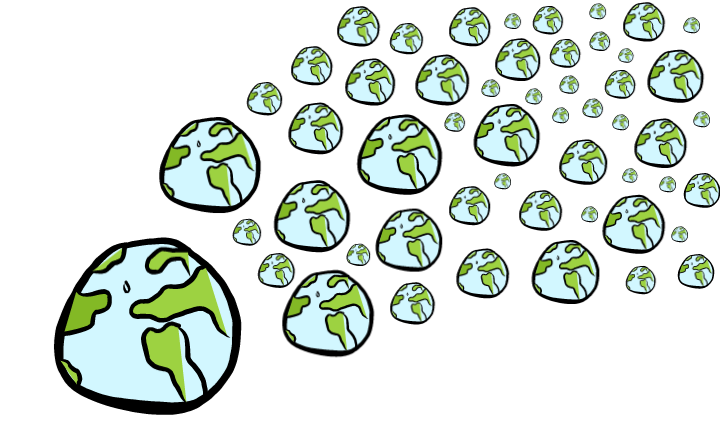
What does it take for us to believe that something exists?
This is a bit of a trick question, because there’s no on single reason we believe that things exist: we think that different things exist for different reasons.
I personally believe that apples exist because I can see, feel, and taste them. I’m generally quite happy to say that anything which I can see, feel, and taste, is something that exists.
There are some things whose existence I believe in for entirely different reasons. Take electrons for example. I’ve never come close to seeing, feeling, or tasting an electron, but I don’t have too many doubts that they exist. They play such a fundamental part in our understanding of the universe, and of science, that it’s hard not to believe that they exist.
To be a bit more specific:
- Our understanding of electrons allows us to make verifiable predictions.
- Electrons play an irreplaceable part in making these predictions; we can’t just substitute something entirely different into the maths and still get the right answers.
Electrons might seem like an esoteric example of something whose existence we might believe in, but in fact we believe in lots of things for similar reasons.
Say that you keep some cheese in a cupboard. Every time you check inside the cupboard, you find less cheese. You start to notice mouse droppings nearby, and that these increase in number as the cheese disappears.
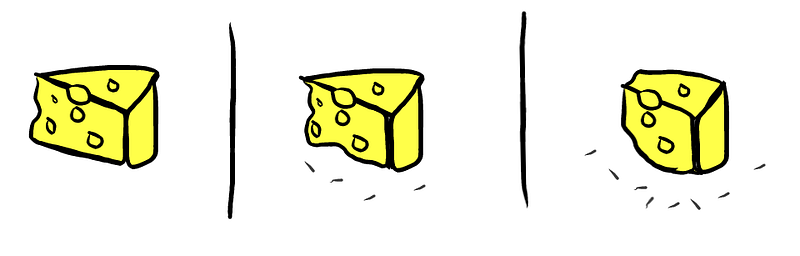
At this point, you’d be perfectly warranted in believing that there’s a mouse afoot: I believe there exists a mouse.
What you’ve done here is in fact quite remarkable. You’ve taken some observation, and inferred the existence of something that you’ve never seen. The mouse doesn’t have to exist based on the evidence — a friend could be playing a cruel prank — but the most reasonable response is surely to believe in the yet unseen mouse.
Possibility
Let’s put the cheese to one side for a second, and talk about possibility.
You’re reading this article right now, but there’s any number of other things that you could have been doing instead: you could have been eating; you could have been in the shower; you could have been asleep.
Possibility statements like these seem uncontroversially true. It’s hard to argue with possibility statements like Hillary could have won the 2016 election. Whatever you think her chances of winning were, it seems absurd to suggest that she had an exactly 0% chance of winning.
On the other hand, there are possibility statements which seem intuitively false. It doesn’t seem at all possible that something could be red and blue all over, that something could be tall & heavy without being tall, or that 1+1 could equal something other than 2.
Whether possibility statements are true or false, we often have strong intuitions as to which of these they are. But how do we explain why these statements seem so certainly true or false?
The truth of many ordinary statements can be explained by pointing to some external state of affairs. A statement like Michael is in this room can be explained by referencing the fact that someone called Michael is inside the room in question.
It seems that possibility statements, like Hillary could have won the 2016 election, can’t be readily explained by pointing to states of affairs in the world. It’s difficult to see how any collection of facts about the world accounts for our intuition that she could have won the 2016 election.
Other Worlds
To see how we can explain the truth of these possibility statements, let’s take what might initially seem like a big step. Let’s entertain the thought that there are worlds other than our own.
Every true possibility is played out in one of these worlds. There’s a world where you’re not reading this article right now, but where you’re skiing down a mountain. There’s a world where Hillary won the 2016 election. For every possibility, there is a world where that possibility is realised.
How does this help us?
If we believe that there are other possible worlds, then it becomes much simpler to explain why statements like Hillary could have won the 2016 election are true. The reason that the statement is true in our world, is that there is another possible world where Hillary did win the 2016 election.
Just as we’re able to explain the truth of Michael is in this room as being grounded upon there being someone called Michael, inside a particular room, we can explain the truth of possibility statements by pointing to other possible worlds where that possibility is realised.
Possible worlds don’t just allow us to give an account of possibility. We can also understand necessity statements, like 1+1 necessarily equals 2. We say that 1+1=2 is necessarily true in our world, because 1+1=2 is true in all other worlds. There’s no world where it isn’t true, therefore it’s necessarily true.
You can’t be serious
David Lewis, who is known for advocating a view of possible worlds broadly in line with the above, coined the phrase the incredulous stare to refer to the reaction most people had on hearing this idea.
The idea of other worlds is highly contrary to common sense, so much so that it might seem like a reason to reject them outright. But this is the point of philosophy after all, to challenge common sense intuitions. We need to come up with a better argument against possible worlds.
One potential argument is that believing in other possible worlds has high cost. We’re forced to admit an entirely new type of object, a possible world, and to believe in its existence. This seems as bad as inventing a new, ad hoc particle every time we stumble upon a result in physics that we cannot explain. In science we try instead to see how we can refine our understanding of existing particles to accommodate the new results.
The counter-argument to this starts by drawing a line between what things we believe in, and what types of things we believe in. If we invent new, ad hoc particles to accommodate new results in physics, we’re forced to believe in a new type of thing. Believing in new types of things is something we shouldn’t do unless necessary, as it bloats our view of what exists.
Possible worlds though, the argument goes, are not new types of things. They are the same type of thing as the world we inhabit. They are just as real and concrete as the actual world; we just don’t happen to live in them.
If we take this view, then believing in possible worlds doesn’t force us to believe in any new types of things, it just requires us to believe in many more worlds — things we already believe in, provided we think this world exists.
Where does this leave us?
In the cheese example earlier, we saw how common it is to believe in the existence of something simply because of its explanatory power.
When it comes to possibility statements, we have strong intuitions on what is and isn’t possible, and we should be able to explain what these intuitions are based on.
One way of explaining these intuitions — why it seems true to say that Hillary could have won the 2016 election — is to describe them in terms of possible worlds where these possibilities come true.
Despite seeming far-fetched, and contrary to common sense, this view is beautifully simple. It doesn’t require us to believe in anything new, so long as we already believe in our own world, and it has the power to explain the truth and falsity of possibility statements.
Sure, we’ll never see these worlds, but even if we never see the mouse we can still be reasonable in believing that it exists.


