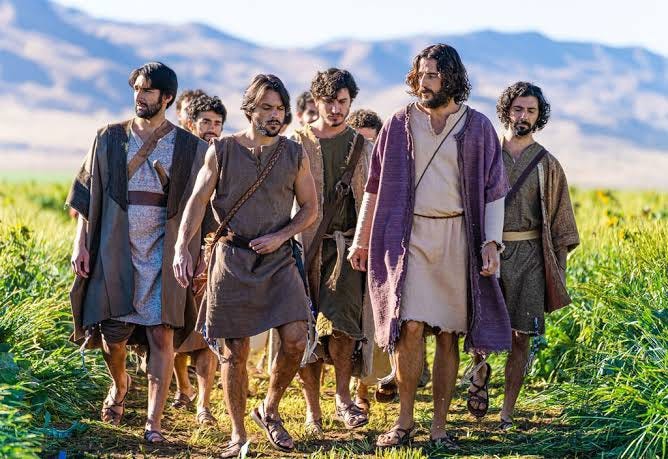
Believer or not, ‘The Chosen’ is stunning TV. And showcases what Christianity *can* be. New season.
Jesus was a rebel.
The lavish production is jaw-droppingly powerful in its depiction of Jesus and his disciples as real people. Being rebels. And simultaneously, on the part of the disciples, learning . . humility. Whilst skulking around, hiding from Romans and Pharisees.
Surprisingly for some, the Christ of the Gospels as recorded, and even the Christians of Acts and the epistles, are incredibly enlightened.
Jesus and His followers were for the common person.
The Biblical Jesus was rarely judgmental.
His teachings still resonate today and were not about self-righteousness, Bible bashing or special favour.
Far from it. The Sermon on the Mount especially encapsulates this enlightenment of justice and care, including the corresponding TV episode covering it. If it was about fairness, it was not the expectation of it but rather the serving of it.
“Blessed are the peace makers”. Or “When giving, do it in private. Do not let your right hand know what your left hand is doing.” And “If your neighbour asks you to go one mile, go two”.
If only (us) Christians were historically more Jesus like!
Yet the Messiah preaches wisdom also. “Be as gentle as doves. And as wise as foxes.”
In The Chosen – streaming on Netflix (season 1) and Angel.com (all 4 seasons for free) – we see Christ and his, often hapless, disciples, depicted as real people through 3 seasons, with a new one starting right now.

And it’s faithful to the Biblical narrative.
But adds so much more detail – including moments of mild chuckle-worthy humour – for us that must have indeed happened. Or something very like it.
I cannot recommend the show enough.
What’s so impressive is that it succeeds at around seven levels:
- It’s top-draw streaming TV
- It’s a stunning on-location-look production reproducing historical Judea
- It hits the spot whether you are a fan of the social philosophy or religious teachings of Jesus
- It works for mainline Protestants, Evangelicals and Catholics simultaneously
- Every facet is explored. The Jewishness of Christ. The Messiah’s unexpected focus on individual kindness and justice. The challenging politics for the disciples. They expected The Messiah coming to build an army. The personal hang ups of ‘the chosen’, some of which we know from the gospels. The geo-politics of the Roman occupation, the Samaritans, the Canaanites. Battles with the religious establishment. It’s all there.
- The way Christ and His disciples walk through phases of the ministry. Sometimes avoiding controversy. At other times flaunting it. On occasion relying on the miraculous. But usually needing to watch out for their lives. Through skullduggery. Simon Peter almost takes on the role of a body guard.
But above it all it’s seeing the Jesus I’ve always imagined depicted as a real person like never remotely achieved by any other production.
Jonathon Roummie portrays a Biblical mix of compassion, vulnerability, determination and inspiration.
I do not believe Jesus was a walking, talking magician. And not quite God on earth in totally unconstrsined form.
He was in human form. Highly restricted, as He chose according to Phillipians 2, He humbled Himself, made Himself of ‘no reputation’.
That means He had to live life.
He had to pray for guidance and miracles.
He had to actually create His parables.
He faced temptation.
We see all that on The Chosen.
I love seeing Jesus practicing the Sermon on the Mount. I love that. I do not believe He ad libed it.
Jesus was not a magician.
Watching the show just rekindles the desire to live that kind of gospel by example.
The pilot is a touch slow and jumping around, but it becomes addictive thereafter.
Wait for the episode about Jesus and the children. Or with the Pharisees. The first miracle. Nicodemus.
Awesome.
And we’ve got a fresh new season coming. Just download the angel.com app.
The show is free, lavishly crowdfunded.
Enjoy.
Season 4 of “The Chosen” presents escalating tensions as Jesus’ influence grows, prompting religious leaders to ally with Roman oppressors. This leads to increased opposition and violence against Jesus’ message, culminating in a demand for his followers to rise up against these challenges