
Believe In Your Work
There’s a difference between an article “not being good” vs “not being a good fit”

Writers sometimes take rejection to mean our work is not good. Particularly if you’re in the world of Medium where you go through the weekly process of submitting articles to your top publication choices, hoping for the “holy grail” of Medium curation.
It’s not uncommon for many of your first and second choice publications to reject you. There’s no shame in it. It’s all part of the process. That being said, it’s also not unusual to feel like a “failure” when you get the rejection—whether it’s in the form of a formal “Thanks, but no thanks,” or a publication just never responding altogether. (Which is the equivalent of a pub “ghosting” you if you’ve been accepted as a writer but never seem to have any of your work published by them).
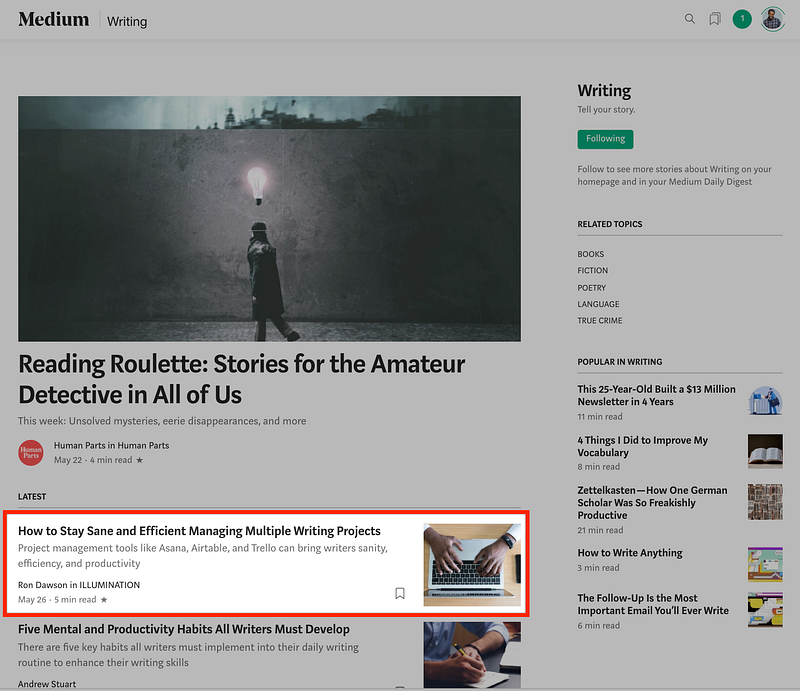
I recently wrote a piece that was rejected by four pubs. Two pubs said it wasn’t for them. Two just never got back to me. It wasn’t a particularly exciting story. In fact, it wasn’t a “story” at all. It was just my process of project management for writing. But I knew in my heart it was solid, practical advice applicable to a range of applications. The fifth time was a charm. And wouldn’t you know it—within hours of publication, it was curated to both the Writing and Productivity topic pages.
Earlier this month, I had another story I wrote that was a short lament about my personal journey of faith. I submitted it to a pub that publishes Christian-themed stories. They felt it was too provocative. Truth be told, based on their other Christian-themed articles, I had a hunch my “crisis of faith” article might not work for them. I even said as much in a private note to the editors. It still stung a little when they rejected it.
So, I submitted it to an interfaith pub who did publish it; and it has quickly become one of my most read and clapped articles this month. (I guess crises of faith, in particular Christian faith, are common these days.)
Writing is about wins and losses
In less than a week, I’ve had four articles curated to two topic pages each. One was about the forgotten art of the analog mixtape. One was the aforementioned “boring” article outlining my project management system for writing. Another was about race relations and the perspective of white privilege. And the fourth was a chapter from my book (which I’ve been publishing online). That’s the best curation record I’ve had (in terms of the number of curated articles in a particular period of time).
I do not mention this to boast. I have dozens of articles sitting autonomous from any publication. Some have done very well despite not being in any formal publication. Others I think are fantastic, but have zero claps.
This, my friend, is the age-old story of the artist. Work we think is brilliant will often get largely ignored, while work we could give two-sh*ts about goes viral. Go figure.
Yes. That is the life of an artist—but a writer in particular. It’s about wins and losses. Some pieces you write strike a nerve, while others don’t even prick the skin. It’s ultimately a numbers game. The more you write, the more wins and losses you will incur.
Keep writing.
The moral of the story
The important thing to do is to believe in your work. That project management article I mentioned at the top of this piece was rejected four times before being curated. JK Rowling famously had a dozen rejections of Harry Potter. Stephen King’s first novel, Carrie, was rejected over 30 times (the first “rejection” was by King himself. He tossed it out and it was his wife that retrieved it.) Little Women. Rejected. Chronicles of Narnia. Rejected. We can do this all day.
What all these authors had in common was the perseverance to keep putting their work out there. They understood that rejection didn’t mean they were a bad writer, or their story wasn’t good. It just wasn’t a good fit for the dozen or more publishers who passed on them. If they had given up too early, not only would they not have achieved their goal, but society and culture would be robbed of some of the most seminal pieces of art ever created.
Believe, but be open
It’s important to point out that believing in your work is not mutually exclusive to being open to feedback and criticism. All four of the curated pieces I mentioned were moderately to heavily tweaked based on the feedback I received. In the case of the chapter from my book, I completely rewrote the second half based on feedback from a lit agent.
If you receive enough feedback on any work of art from fellow colleagues experienced in the craft, you will almost certainly get valuable recommendations to make the art more clear, palatable, on-brand, poignant, etc. Sometimes we’re too close and our belief blinds us to the cracks and chinks in our work that need to be fixed. Whether you use Medium’s private notes feature, or the collaborative features of Google docs, make it a point to get feedback on the work you submit.
Also, be open to any recurring bit of feedback you get—if you find that something you’ve written is getting the same comment (good or bad) from a number of people. Whether or not you agree with it, if you experience a common theme in the feedback you receive, it’s worth noting; if for no other reason than to know that is an aspect of your work that needs to be addressed. Maybe it’s even something that needs to be embraced and championed.
The process of writing is like cutting open a vein and bleeding onto a page. It can drain the life out of you as you pour out your heart, soul, and talent. The self-inflicted wound you created to “bleed” life into your work may not have “healed” yet. So rejection stings. But believe, be open, and persevere, and chances are on your side, your work will be recognized and the process of writing it well worth it.
For more insights, education, and inspiration, get my newsletter.