
Belarus Revolution: Flowers Against Rubber Bullets
Historic lessons from Belarussian peaceful protests
On August 9, 2020, a guy with his hands up was walking towards a group of riot police in the center of Minsk, Belarus. Police were indiscriminately shooting rubber bullets, stun grenades, and tear gas at protesters. The protester kept on walking. All of a sudden, one of the grenades (preliminary witness guesses supported by verified videos) hit the guy in the chest and he fell dead. His name was Alexander Taraikovsky. He was the first victim of the brutal suppression of peaceful protests against rigged election results. You can watch the synchronized videos from Bellingcat below.
Earlier that day, citizens of a small country of 9.5 mln people in the center of Europe, Belarus, voted to choose a president of the country. For the first time in more than 20 years, there was a true opposition candidate the majority of the people voted for. But official results were rigged to an unprecedented scale. Former autocratic president, Lukashenko, known as the last dictator of Europe, won 80% of votes according to the officially declared results. Belarussians didn’t agree with the count and took to the streets in peaceful protest. What happened next will be written in XXI century history books as one of the most brutal repressions of peaceful protests by KGB, riot, and jail law enforcement forces. Equipped and ready to suppress any protest, riot police took peaceful protests for aggressive attacks and launched a military operation against anyone who was outside in the streets marching or not, inside cars, on bicycles, or home balconies that evening. They shoot rubber bullets, stun and tear gas grenades at marching people and people on balconies shouting to stop the violence. The police would grab anyone passing by and beat with batons, fists, and boots with predator brutality and sadistic passion. Very often, when a couple of policemen started beating a person, another group in uniform would join almost killing the person. There is plenty of video evidence of shooting rubber bullets at people peacefully sitting on a bench or walking their dogs, at ambulances, and cars. They would smash windshield windows of passing by cars. If a driver stops to ask why, they would beat the guy, loot the car, throw the person into a police van, take him/her to jail and take the car away. There is video evidence when they assault a teenager with a bike waiting for his parents by the shop. They start beating the kid who was screaming, “I’m fifteen!”. When his parents showed up, they switched over to beat them, then threw the kid into a police van and took him to jail. There is plenty of video evidence when a person not resisting the arrest with his hands behind on his head is brutally beaten for the sake of being bitten. There are numerous stories from volunteer medics who were severely beaten, taken to jail, and tortured for providing medical assistance to wounded. But the worst happened to people on the way and inside jails. Police and special law enforcement forces used medieval and Gestapo concentration camp style tortures to teenagers, women, and men to an unprecedented scale. Once a person is inside a special riot vehicle, they would start fiercely beating a person with whatever they had. They would rape women, rape men with batons, cut long hair, and force the person to eat it. They would beat a person if he/she starts bleeding, vomiting, fainting, pissing, or just screaming from pain. They would throw dozens of people in the same vehicle cell designed for few. When people arrive at a detention center, they would be met by a two-column row of policemen with batons. Every detained person had to go through this torture conveyor to be heavily beaten by every policeman in a row. The worst nightmares were inside the detention centers. They threw people in open small fenced areas forcing them to lie with their noses pressed against the concrete floor, their hands tied with tie wraps. If a person moves, turns a head, a hand, a leg, or tries to change a body position, that person undergoes severe punishment with batons, boots, and metal objects. People had to lie in that position for many hours. The detention centers were not designed for so many people. In some of them, there were so many people, they would pile them one on top of the other. People were told that those who were underneath could hardly breathe but at least they were not beaten like the top ones. When a person fainted from tortures, they poured water and continued beating. They would jump on a person breaking his bones. Terrible cries could be heard far outside the detention centers to waiting outside relatives’ horror. They didn’t give people water and food for 1 to 3 days. Maybe more. More evidence will emerge later. They didn’t call medics to help wounded or people with health issues. They didn’t allow medics to collect the worst injured people. We don’t know if they are alive. They didn’t allow people to go to the toilet. They asked people to give passes to their phones. If a person resists, they would break their fingers, threatening to, or rape. They threatened people with execution by a firing squad. They would position people to the wall imitating the execution, or just pressing their guns to the foreheads, or putting a grenade in a person’s underwear and running away imitating there would be a grenade explosion. They tortured people to sign the protocol where people admit they were guilty of crimes they hadn’t committed. We still don’t know what happened to the stubborn ones who refused to obey. They were so brutally tortured, that people who saw it couldn’t stop crying when telling those horror stories.
81 person is still missing so far. I took the above evidence from the open sources on the internet and my friends and relatives in Belarus. I feel a moral obligation to write about it to deliver to the world what happened in Belarus. But my writing here is not to list all the atrocities and crimes against humanity committed by the illegal dictators’ death squads. I hope, they will end up in jail for their crimes.
I listed all the above atrocities to contrast the indiscriminate police violence with the peaceful protests. Of course, there were some fights with police when people were trying to liberate a randomly arrested person. But they were exceptions.
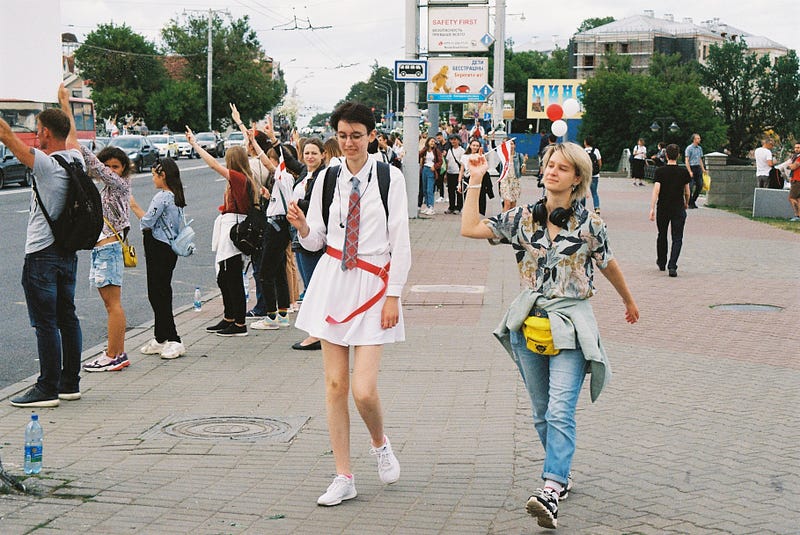
After two days of extreme police brutality, people, mostly women dressed in white, poured into the streets, holding flowers. That was their response. That peaceful response discouraged police from further violent actions. More than 200,000 people joined protesters following days to show the biggest ever anti-dictatorship rally in Belarussian history.
Both police brutality and a peaceful response to it consolidated people against the dictator regime.
When people respond massively in peaceful protests against the oppression, they force the tyranny to make mistakes.
I know it takes about two weeks before the article is published on Medium.
But I hope, by the time it is published, the dictatorship in Belarus will have died.
If it doesn’t, still Belarus is no longer the old style sleeping nation tolerating the dictator.
There are obvious historic lessons to be learned from this peaceful protest in Belarus. As I commented on a Medium post “Activists use Telegram to coordinate Belarus protests” by @DFRLab:
Protests in Belarus show that modern soft dictatorships relying on total suppression of mass media and neutralizing activists got into two traps that can lead to their collapse.
When they suppress all opposition mass media, they immediately stop receiving feedback from society and lose the real picture and are not prepared to respond. People meanwhile get fed up with the official mass media stuffed with lies, manipulations, and propaganda, and start looking for alternative mass media.
Their success in neutralizing, deterring, jailing, and killing of opposition activists leads to a decentralized protest like in Russian Khabarovsk and Belarus. Riot police and law enforcement forces have been trained to suppress a group of protesters in a limited area like it was in Ukraine. But they looked and acted dysfunctionally in these two regions. When they used their tactics to disperse huge crowds scattered all over the country they made enormous mistakes consolidating people against them and helping the opposition to recruit more followers.
Let’s see where this new trend will take us.