
Being Chinese American in China During a Pandemic
There are current events, and there’s history.
April 2020
Back from Work
“Honey, I’m home!”
I haven’t stepped through the door. I haven’t touched the door handle. I don’t touch it unless we are both outside.
“Coming!” In Russian, she says the word three times.
“I cannot hug my wife.”
Her hurried, almost giddy, footsteps approach the other side of the door. The wooden slab swings open, and once again I am crushed by one of the necessary realities of our new normal: I cannot hug my wife, who for good reasons calls me an egoist on occasion.
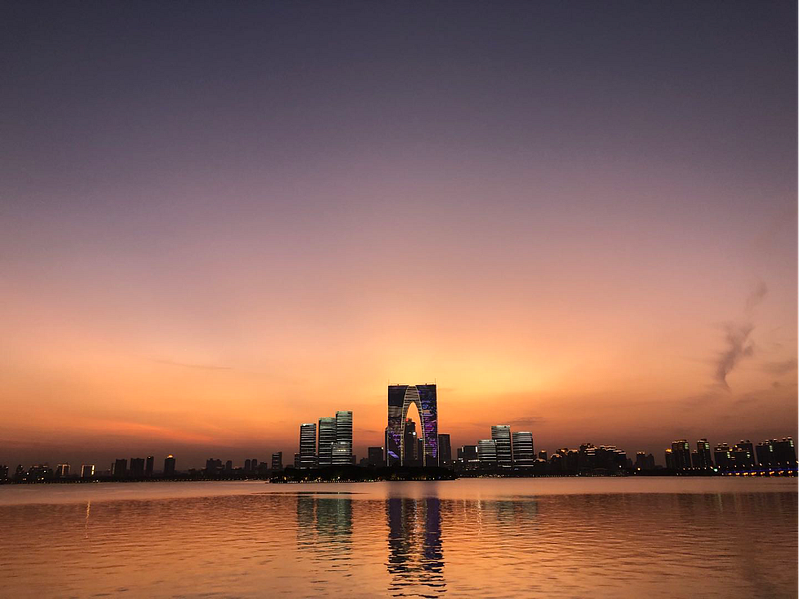
Our apartment in Suzhou, a Chinese city occasionally known as the Venice of the East, is spacious by Chinese standards and adequate by American standards. I first visited this garden city half a lifetime ago as an international student. I am now living here as an international teacher.
In college I spent a summer studying in Shanghai, far from sunny Southern California. One weekend three classmates and I took an hour-long train ride to Suzhou and spent the night. I have no idea where those three are now.
After crossing the threshold, shutting the door behind me, removing my facemask, and receiving a hands-free peck on the lips from my wife, I tilt my head back, spread my arms, close my eyes, and hold my breath.
Entry Procedures
She sprays me copiously with disinfectant that’s 75% alcohol — five percent higher than the minimum recommended by the CDC. I turn around, and she repeats the process. I turn back around, and when I feel that it is safe to open my eyes and stop holding my breath — no more lingering particles of ethanol in the air — I do.
Then I remove my jacket and hang it on the door, remove my shoes and lay them against the wall, ensuring that all clothing that is worn outside the home never reaches beyond our doormat. It is a large doormat. I drape my shirt and pants across the back of a chair kept for this exact purpose.
Before I touch anything in the apartment, I trudge to the bathroom and wash my hands with soap and water for twenty seconds, interlacing my fingers, scrubbing the backs, tugging the thumbs, rubbing the fingertips. I turn the faucet on and off with my elbow. On some days I use my forearm.
Many Moons Ago and Now
When I arrived in mainland China the very first time, in the summer of 2004, a year had passed since the peak of the SARS outbreak. I had heard about the virus throughout my senior year in high school in Southern California. A particular moment that stood out occurred in economics class, when our teacher greeted a guest by asking in jest, “You haven’t been to Asia lately, have you?”
When I arrived in China the most recent time, in March 2020, the CoViD-19 global pandemic was heating up elsewhere in the world and cooling down here. My wife and I spent seventeen days in quarantine and entered a China that was awakening from a deep slumber.
“…arriving in my ancestral homeland, a place that my parents, born and raised in Vietnam, had never been.”
For me, the significance of my maiden voyage to China was not arriving in what was the epicenter of an epidemic that had passed not long ago; it was arriving in my ancestral homeland, a place that my parents, born and raised in Vietnam, had never been.
Returning to China this time was not only about going back to work in the former epicenter of a pandemic that has yet to pass; for my wife and me, it was also about, after months of self-exile from our country of residence, going back home to live our life, the home where our married life had started.
In the era of Trump, when an Asian American made the first serious bid for a presidential nomination — probably because Andrew Yang, the candidate, believed change was needed more than ever, and in the time of coronavirus, when Asians around the world are subject to a range of discrimination, from online hate to offline violence — probably because the rise of nationalism and the far-right have bred ignorance and spread misinformation, living in China as a Chinese American has become more of a quandary than it always has been.
One day during the summer of 2004, I walked around inside an empty shopping mall in the center of Shanghai. The building had been constructed, but consumer demand and entrepreneurship had not caught up.
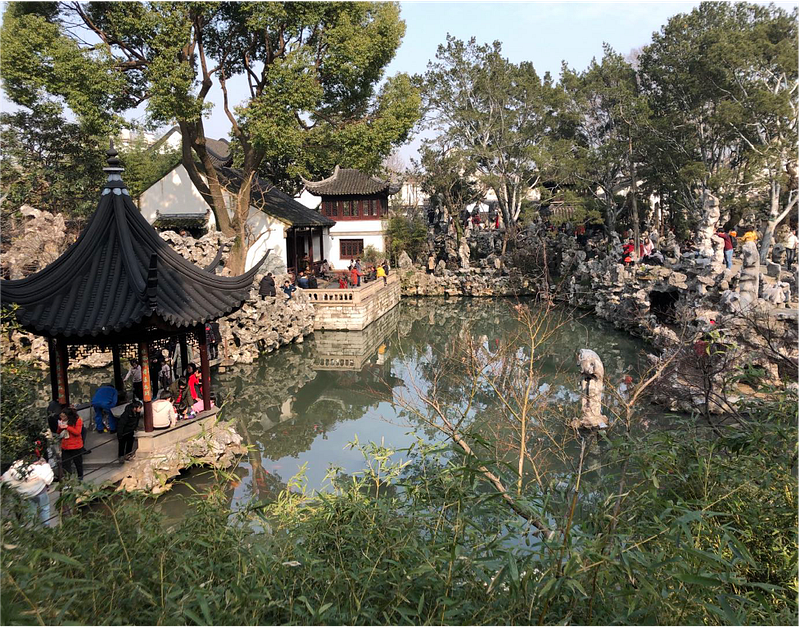
Sixteen years later, during the height of the pandemic, all of China was filled with empty shopping malls, this time for a very different reason. That summer, as my classmates and I strolled in one of the gardens of Suzhou, a tour guide followed and pestered me to hire her, suggesting that I could translate for my classmates. Now, only licensed tour guides who wait to be hired via the office are allowed to work in the gardens.
Wandering
In the intervening years of not living in China, I lived in half a dozen other countries and visited dozens more, learning a couple of new languages, meeting the love of my life, losing her, and finding her again.
“In 2010, a passport was not needed to purchase train tickets.”
Between then and now, I have lived in China two other times: once starting in 2010, once starting in 2015, both times as a teacher. In 2010, a passport was not needed to purchase train tickets. That had changed by May 2011. Because Beijing hosted the Summer Olympics in 2008 and Shanghai hosted the World Expo in 2010, the metro system in both cities and throughout the country had developed with astonishing speed.
The third time I lived in China, the country was on its way to becoming cashless, but I still used cash and hailed taxis on the street, which was becoming an anachronism. Now, I nearly never use cash and almost always use my e-hailing app. My first time in Suzhou, we had taken a slow train from Shanghai, one prefixed by K or T. These days, between the two neighboring cities, we only ride the bullet trains, prefixed by D or G.
Despite the enormous ways in which China has changed since my summer here in 2004 as an international student, perhaps the smaller changes that occurred only between 2019 and 2020, pre-pandemic and post-peak-of-pandemic, are the ones that demand our daily attention most.
New Normal?
I am still teaching my lessons online as of the end of April 2020. The school has reopened, but only half of the students (the older half) have been called back, mine not among them. The building is eerily quiet. When I go to the tiny school gym — and I only go when it’s empty — I disinfect everything I touch before and after. A walk-through temperature detector and hand sanitizer are placed at the entrance. A guard checks my temperature every morning upon entry and has me record it along with my name on his attendance sheet.
Every time we enter our residential compound, we must show our residence passes and have our temperature checked. If our temperature is close to 37.3 Celsius, we avoid going out. Every time we enter most public spaces, we must show our green QR health codes and have our temperature checked.
Sometimes, we must show our passports as well. Despite the loudspeakers announcing that every passerby entering an enclosed area should show their QR code and identification document, most guards don’t bother with the latter. This one did.
Upon seeing my obviously foreign wife, he asked me whether I was a Chinese national. I said no. Then he demanded to see our passports, disregarding my green code. When he found the most recent entry stamps, he said we were not allowed to enter our own neighborhood shopping center.
“I was furious.”
Apparently, even though the Chinese government requires fourteen days of quarantine, this guard believed that foreigners should be subject to a month. To my own surprise, I was furious. My wife pulled me away.
Old Normal
I have long reaped the benefits of playing both sides of the field, claiming my American side or my Chinese side as befitted circumstances.
My first two years working in China, I taught at universities, where I was consistently mistaken for one of the students. I rarely corrected the mistake — except when I was refused entry into the faculty line at the local bank, at which point I brandished my faculty ID.
On long train rides I enjoyed the feeling of being undercover and chatting with Chinese passengers as though I were fully one of them, getting their point of view on a variety of topics, mostly related to education, since I was usually grading a stack of essays.
In the Chinese high schools where I have taught, during schoolwide meetings, I got to hear the information in both languages and compare for accuracy, which I would relay to fellow expat colleagues.
“I would also keep my language toolbox secret from my students, which made for a roaring surprise at the end of one school year.”
I would also keep my language toolbox secret from my students, which made for a roaring surprise at the end of one school year. Outside of China, in regions like Latin America, Russia, and the Middle East, it has been prudent to say I’m Chinese rather than American.
I have also experienced the drawbacks of having a face that supposedly does not match my passport.
I was once handed the wrong passport on a bus after a border crossing in the Balkans. It belonged to the Chinese national in the back.
“Where are you from?” “America.” “Originally?” This was a conversation I had with a shopkeeper in Cappadocia. He asked the insulting question with a smile. My wife and I took our business elsewhere.
At my own school, one of the cleaning ladies asked where I was from, to which I responded with the truth, to which she replied, “You don’t look like an American.”
At my own neighborhood center, my barber said, “I thought Americans had blue eyes.”
The list of instances goes on.
It’s Not So Bad
To call these instances, even including the one with the guard who thought a month was necessary, “drawbacks” would be a sign of disrespect to all the Asian Americans — indeed, Asian Brits and Asian Australians and all Asian diaspora communities around the world — who have suffered outright attacks in the wake of the coronavirus, echoing the anti-Muslim and anti-Arab hate that surged after 9/11.
Evidently, more than a decade and a half later, that hate was still burning strong, with Trump’s Muslim travel ban.
“We must learn about the history and culture of the places we visit.”
Modern, mindful travelers seem to come with an outspoken humility and a soft-spoken ego. We must learn about the history and culture of the places we visit. We must recognize the differences among the peoples of the world and understand enough of our immediate surroundings to adapt to them. We must not impose our way of thinking on others. We must not leave a place worse than we found it. We must spread the knowledge, the experience, the message when we return home.
Except “home” is fluid, more so for some than for others — and also more demanding.
That Ego
With a soft-spoken humility and an outspoken ego, I am fiercely proud that I am among the Asian Americans who can occupy both spheres with comparable competence. America has been my home since my parents immigrated there when I was four-years-old; I have made China my home several times over ever since I studied here when I was eighteen.
I occasionally tell my expat colleagues, “If you’d gotten my sister or any of my cousins instead of me, good luck with the language help.”
If you are a hyphenated anything or a member of an immigrant family or a part of a diaspora community, whether you like it or not, your two choices are to occupy both cultures or be confined to a sub-culture.
Too many choose the latter, or it is chosen for them, for occupying one sphere — even if it is a sub-culture — is often difficult enough. Making a life in one country, even the one where you were born and raised, can be a lifetime’s work. If you have immigrant parents, then it may be two lifetimes’ work, yours and your parents’.
Making a life in two countries, even if both are “home,” demands fluidity in cultural behavior, historical knowledge, language ability, and geographical awareness.
Many immigrant parents choose not to teach their children the ancestral language, fearing a deficiency in the language of the new land. Although my parents forced my sister and me to wake up early on Saturdays to attend Chinese-language classes during our pre-teen years, it was not until as an adult that I began to grasp the Chinese language on my own.
To quote Tyrion Lannister, “Never forget what you are. The rest of the world won’t.” I have an American passport. I have an Asian face — and Chinese blood to boot. Many parts of the world still do not understand that these two facts can go together.
“[I]f I did not speak Chinese, if I did not know Chinese culture and history, I would not be treated like a foreigner; I would be treated like a disgrace.”
Living in China, if I did not speak Chinese, if I did not know Chinese culture and history, I would not be treated like a foreigner; I would be treated like a disgrace. Shame on me for shaming my ancestors. Shame on my parents for letting me forget my roots. Shame on me for traveling without the proper tools, for taking this privilege without taking the responsibility.
Us
Whether I chose travel or travel chose me is a spiral staircase that has no end. Anyone who is a part of my life knows and understands that travel is an inextricable part of my life, and has been ever since in college I made something of a name for myself in my family and within my circles of friends as a traveler, which explains the ego, though my wife calls me an egoist not exactly for this reason.
She is from Azerbaijan, where I used to live and work, and she waits eagerly for the day when travel restrictions lift and she can take me home to meet her aging grandfather. It does not matter whether I occupy one or two spheres. It does not matter that she and I are from vastly different spheres. It does not matter that neither she nor I have seen another interracial couple like us.
She and I occupy one sphere.
While I was washing my hands with soap and water for twenty seconds, she was disinfecting my phone, my wallet, and keys.
My hands are clean now. With an outspoken humility and a soft-spoken ego, I walk over and hug my wife.
I am home.
Dash Ip wrote this article in April 2020. He’s written a novel since then.


