Being a White Woman Right Now
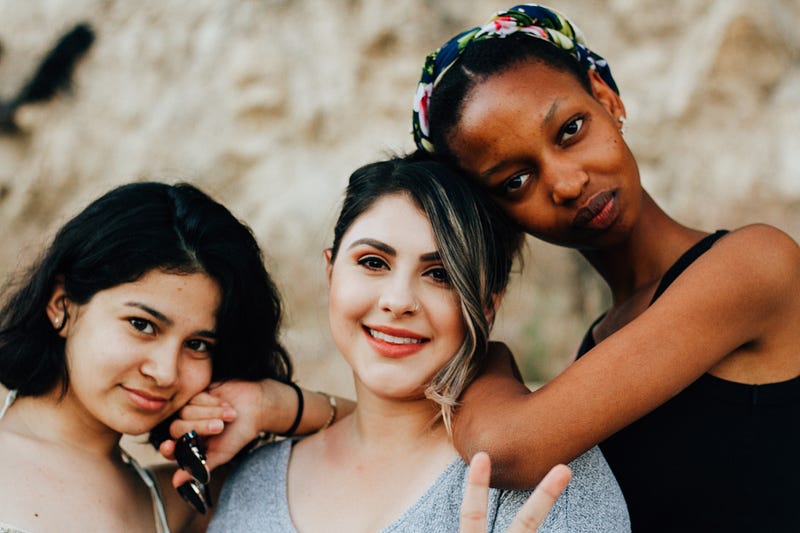
With close Black female friends
I just finished reading a very loving email from one of my closest female friends, a Black woman, whose friendship I left behind in my move to Denver. We didn’t lose touch, we just have a lot farther to drive to have lunch. Or, inhabit a couch for a night or two, as the case may be.
We are approaching 35 years in this journey.
Sonja and a few others know my heart. And because they know my heart, they know that all I need to do is send them a note saying that I am thinking of them, for they also know the dense weight of years and history we have. Implicit in that is, and has always been, you need me, I am in my car or on the next flight. You need a place, you have a bedroom, long as I’m not in my tent (a line that is making her laugh right now). She knows. They know. Safety exists as best I can provide it, and Sonja found that in my house for two years between accelerating rent prices and a relationship that recently culminated in marriage. She’s safe now, too, as best she can be, as best any Black person can be. Which is, frankly, not much.
I have read multiple stories by Black women who are telling White women what to do and what not to do.
Black writers (tagging you Marley K.) whose words I have read for a long time, and those whose material I am new to. Each article varies in the instructions, shut up, be quiet, speak up, stay home, come out, stop asking stupid questions, ask me questions, the five things you can do, the seventy-five things you can do to fight racism.
It’s a bit exhausting in one sense in that if you are not accustomed to having Black intimates, you have no clue what to do. No matter how well-intended, one effort in one direction is likely to be the wrong one according to someone else. The requests and demands are as different as the extraordinary diversity of the people writing the articles.
What that teaches me, as someone who has worked for a long time in diversity, as with all things, there is no single “right” response. It depends on who is writing the article, her point of view, experience, how she grew up, all those things that shape us and our intelligence and social needs.
A while back I started following Zora, long before these issues had reached today’s fever point. In and of itself this is meaningless. I want to know what my Black sisters think and feel. I grew up with two, which makes Black voices familiar and normal to me. Zora’s Black voices are as varied as the extraordinary backgrounds from which these women hail. Caribbean, African, North African, Muslim, the list is endless.
Reading their material is like international travel. Sometimes it’s tragic. But truth doesn’t care how you feel about it.
I would no more lump all my white sisters into one single category any more than I would my Black sisters. We are far too individual, our experiences unique.
Which is why each of the stories which are at times, hurled at us in rage, offered as guidance, or presented as pleas can be hard to interpret. Whether or not you can listen, which is far more essential now than at any other time, depends on your tolerance for difference, your tolerance for discomfort, your tolerance for righteous rage.
As I like to repeat myself (kindly forgive me), I will here: discomfort is the handmaiden of growth. If you think you’re uncomfortable as a white woman right now, you have no clue what that’s like not being able to wash that off at the end of the day when it no longer makes a point. When you ARE the point, the flashpoint, and it never relents. I can’t write about that. I can only read what my Black sisters say about it. Listen. Validate. Respect.
There is a small weekly rag here called The Eugene Weekly, which is what Westword used to be for Denver. Still is, depending on whom you ask. Alternative voice, and smart writers who are fearless. The June 4th edition has one page dedicated to Say Their Names, from Eric Garner to George Floyd. In deference to Black Medium writer Renee Nishawn Scott, I would point out that Black women are also listed here from Michelle Cusseaux to Breonna Taylor.
Renee’s article:
For you see, it’s not just about being Black. It’s also about being Black and female, which carries a completely different level of marginalization.
Being old and Black and female is, well, please don’t get me started. My friend Sonja turns 60 this month. She is scared. She has damned good reason to be. I am scared for her.
I read the articles, and do my best to hear. When I have called those people I love I do my best not to ask stupid questions, albeit stupid depends upon who is asking, and who is being asked. Everything depends on the depth of connection and the level of trust. And more, of course, but it begins there.
I have nothing to offer those women I love other than my commitment to stand guard at the door to the room where they can scream. The knives they throw sometimes hit me. That’s part of loving them. Sometimes I bleed with them. That’s what friends do.
In the many decades I’ve known Sonja she has at times stood mute guard at the door while I have beaten myself up for bad boyfriend decisions. No judgment. None needed. She simply kept me in a safe place, knowing I’d find my way back to sanity in my own time. Sometimes she has bled with me. That’s what friends do.
I’ve done the same for her, when BFs or a husband stripped her of money or of dignity, and she needed a place to hurl invectives at them, herself and anything else she felt worthy of her anger.
This is what love looks like among my female friends. We don’t look to fix or apologize for or negotiate away each others legitimate rage. We don’t try to make it all better, especially when we cannot. It’s not our job to strip our beloved friends of the work they must do.
In time, when humor replaces blind self-hatred, we can spew our coffee onto the table, guffaw until we hurt. What was precious, continues to be precious, is to stand mute guard at the door while our sisters rage, and hear them.
It’s not our Black sister’s job to ease our discomfort or assuage our pain or tell us it’s all right when it isn’t, never was, and is a long way from ever being all right. She’s not our nanny or the wet nurse.
In this sense, I agree with Marley K. when she says in variety of ways, time to shut the fuck up.
On the other hand, I absolutely understand Gabriella Effie Forson who argues that our silence is deafening:
If you are new to the conversation (as one other Black female friend says, and I wholeheartedly agree, where the fuck have you been?) it’s time to listen. Learn. Pay attention. Sit with your discomfort, which you and I as white girls can more easily dump at day’s end, but a Black (or Hispanic or Muslim etc.) woman and her family cannot. There is no Katy Bar the Door against police with the license to kill even it if is the wrong address.
One of my favorite younger writers on Medium, Gillian Sisley, wrote this in response and out of respect:
I would offer that each of us as women has a piece of this. Gillian and I share a history of sexual abuse, which she points out gives us a modicum of understanding. Yes it does. However being a person of color on top of that, and not having a safe place, is a whole other order of magnitude.
I appreciate very much that Gillian understands the difference.
A great many of us care, have always cared. Some have different and possibly more intimate experiences and insights to the Black life than others. All that does is allow us to hear differently. Perhaps without the compulsion to fix or calm or pat someone on the shoulder. That said, there is no overarching Rx right now, no one size fits all, which is going to either help or satisfy or calm down or assuage. Not the point. Not the time to do that.
The point is to hear all the voices. Not to choose whom to believe and whom to argue with. Not to decide that one voice is true and another off the mark. All the voices are valid. Just as one writer’s request that we shut the fuck up is perfectly legit, so is another’s entreating us to speak up. Because it depends.
When I am on the phone with the Black women I love, my job is to listen. Unless she wants to know what I think.
When I am on the phone with a police department or the city council or any kind of governing body, my job is to speak the fuck up. Whether or not they want to hear what I think. My tax dollars, and I vote.
When I read the words of Medium writers of color, my job is simply to hear. Learn. Acknowledge. As I wrote Marley K., Attending, MK.
Honestly, what else is there to do right now but listen? And sit with all the feelings that rise? As a society we’ve required our Black sisters to do that for centuries without giving them permission to really speak their peace.
As for what we can do, I again ask you to read a Black woman’s words.
One of my favorite articles from this past week was by Michelle Silverthorn:
Out of all the articles I’ve been reading, this one struck me as one of the most insightful, for it includes a questionnaire. That questionnaire can reveal a great deal about your upbringing. It can, if you pay attention, give you very clear direction on how to change society moving forward. For if you as parents (I have no kids) do not expose your children to people of color, normalize what this country still treats as different (read: less than, bad, frightening, etc) then your children will perpetuate what we have right now.
When we have a world where a white person doesn’t cross to the other side of a city street simply to avoid walking too close to a Black person, perhaps we have taken a step forward. When we have a world where my beautiful, brilliant, superbly funny friend Sonja won’t get followed around a high-end boutique simply due to her color, perhaps we have made progress. When we no longer have a world where a Black female doctor who offers to attend a passenger in distress on an airline and the flight attendant pushes her aside to get “a real doctor,” perhaps we have taken a step forward.
However these are stigmas that are so deeply ingrained that most of us aren’t even aware that they exist. As white women, we are largely not subject to them ourselves, so we don’t notice. Just like we so often don’t even see Black people.
As Medium writers: my white sisters, do you seek out photos of people of color to populate your articles? Do you invariably choose white folks out of habit and familiarity? Your photos speak to what constitutes normal for you.
That’s a symptom.
As mothers: my white sisters, do you seek out playmates and play dates and schools that isolate kids by color/gender/culture/religion? Your children’s friends, books, playmates are what constitute normal for you.
That’s a symptom.
As Michelle points out, do you seek Black friends, for themselves, not as ornaments or ammunition to prove you’re NotWithThem? For if you have few friends of color, and maybe one Black friend, then that’s what constitutes normal for you.
I’m not telling you you’re bad. I’m pointing out that these kinds of choices are what perpetuate the status quo. If you want things to change, change who comes to dinner. Change who your kids play with, go to school with. Change where you go to church.
Change who you run with, work out with, hang out with, learn from, work with. Who hangs at your house until the wee hours. Whose secrets you share and whose life you treasure as your own.
If that sounds too uncomfortable for you, for your family, your friends, your church, you have your answer. Possibly, a way forward, but not without costs.
Diversity and tolerance begin at home, in our families. Kids know nothing of bias or racism until they see it modeled. Normalized.
I no longer care if you know this. I care whether you do anything about it. For until you and I are completely at ease with the Black family who moves into our neighborhood, the Black kids who play on our backyards, the neighbors who share dinners with us and hang out at our barbeques as a matter of everyday normal life, who populate our churches and workplaces and temples and synagogues and schools, nothing changes.
Meanwhile, please just listen. Just….listen. And attend.
Then will you kindly do something.