avatarFreda Savahl

Free AI web copilot to create summaries, insights and extended knowledge, download it at here

1654

Abstract

ch document reports the cat uses sound mimicry to lure its prey.</p></blockquote><blockquote id="3eac"><p>During the day, they rest in safe tree branches or clumps of climbing vines wrapped around trees in the rainforest.</p></blockquote><blockquote id="23e8"><p>They use their urine-sprayed scent & scratch marks on the ground & tree branches to mark their territory. Their vocalizations are short-range.</p></blockquote><h2 id="2ca6">Special adaptations.</h2><blockquote id="f604"><p>Because of its ankle flexibility, like that of the clouded leopard, this kitty can climb head-first down trees.</p></blockquote><blockquote id="6acc"><p>The ankles of the Margay can rotate its foot to 180 degrees outward. Captive cats have been seen jumping nearly six meters straight up in the air & nine meters horizontally.</p></blockquote><blockquote id="1052"><p>Their broad soft feet & mobile toes enable them to hang upside down with one foot holding on a branch.</p></blockquote><blockquote id="7837"><p>Beautiful big eyes aid in nighttime vision.</p></blockquote><figure id="325a"><img src="https://cdn-images-1.readmedium.com/v2/resize:fit:800/0*HQWldpyDcxf-0Xva.jpg"><figcaption><a href="https://upload.wikimedia.org/wikipedia/commons/b/bd/Margay_in_Costa_Rica.jpg">https://upload.wikimedia.org/wikipedia/commons/b/bd/Margay_in_Costa_Rica.jpg</a></figcaption></figure><h2 id="4341">Conservation.</h2><blockquote id="64d5"><p>The Margay is on the IUCN Red List of near extinction. Statistics reveal 14,000 killed in a year.</p></blockquote><blockquote id="1c41"><p>Ten subspecies over a sizeable geographical area have been identified & s

Options

een roaming in the rainforests from Mexico to Argentina.</p></blockquote><figure id="d542"><img src="https://cdn-images-1.readmedium.com/v2/resize:fit:800/0*4_58hKtJUG-EG12N.jpg"><figcaption>By Ltshears — Own work, Public Domain, <a href="https://commons.wikimedia.org/w/index.php?curid=4238848">https://commons.wikimedia.org/w/index.php?curid=4238848</a></figcaption></figure><figure id="5c14"><img src="https://cdn-images-1.readmedium.com/v2/resize:fit:800/0*d-ys5B1vzMLd0DU0.jpg"><figcaption><a href="https://upload.wikimedia.org/wikipedia/commons/7/77/Margay_distribution.jpg">https://upload.wikimedia.org/wikipedia/commons/7/77/Margay_distribution.jpg</a></figcaption></figure><h2 id="7d97">So how did the kitty get the name Margay?</h2><blockquote id="f14d"><p>The scientific name Felis Wiedii was used by Heinrich, Rudolf Schinz in 1821 in his first scientific description in honor of Prince Maximilian of Wied-Neuweid who collected specimens in Brazil.</p></blockquote><blockquote id="e045"><p>The name Margay strings from the word Margao, derived from the Guaraní-peoples of Bolivia, Paraguay & Southern Brazil. The term means wildcat.</p></blockquote><p id="460b">Source: <a href="https://wildcatconservation.org/wild-cats/south-america/margay/"><i>https://wildcatconservation.org/wild-cats/south-america/margay/</i></a></p><p id="e155">Source<i>: <a href="https://en.wikipedia.org/wiki/Margay">https://en.wikipedia.org/wiki/Margay</a></i></p><p id="db12">Source: <a href="https://simple.wikipedia.org/wiki/Margay"><i>https://simple.wikipedia.org/wiki/Margay</i></a>.</p><p id="0226">Thank you, readers, for your views.</p></article></body>

Wildlife

Behold The Stunning Wild Kitty!

The Mysterious Margay!
Source: Animals World, Nature & Quotes

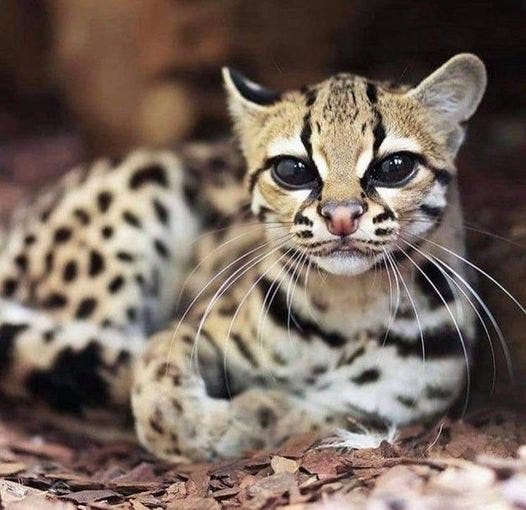
The Margay Cat. (Leopardus wiedii.)

This kitty is a solitary nocturnal cat, (except for a mother with kittens.) It is a small wild cat native to Central & South America, living in the evergreen, deciduous forest.

Wildlife traders hunted the cats in the 1990s, mainly for their exotic fur. In addition, deforestation causing habitat loss decreased their population significantly, resulting in their classification as threatened on the IUCN Red List.

Characteristics.

The Margay weighs from 2.6 to 4 kg, with 48 to 79 centimeters body length. Its exquisite fur is brown with rows of dark brown or black rosettes & longitudinal streaks. Its long tail has numerous dark bands & a black tip.

Lifestyle.

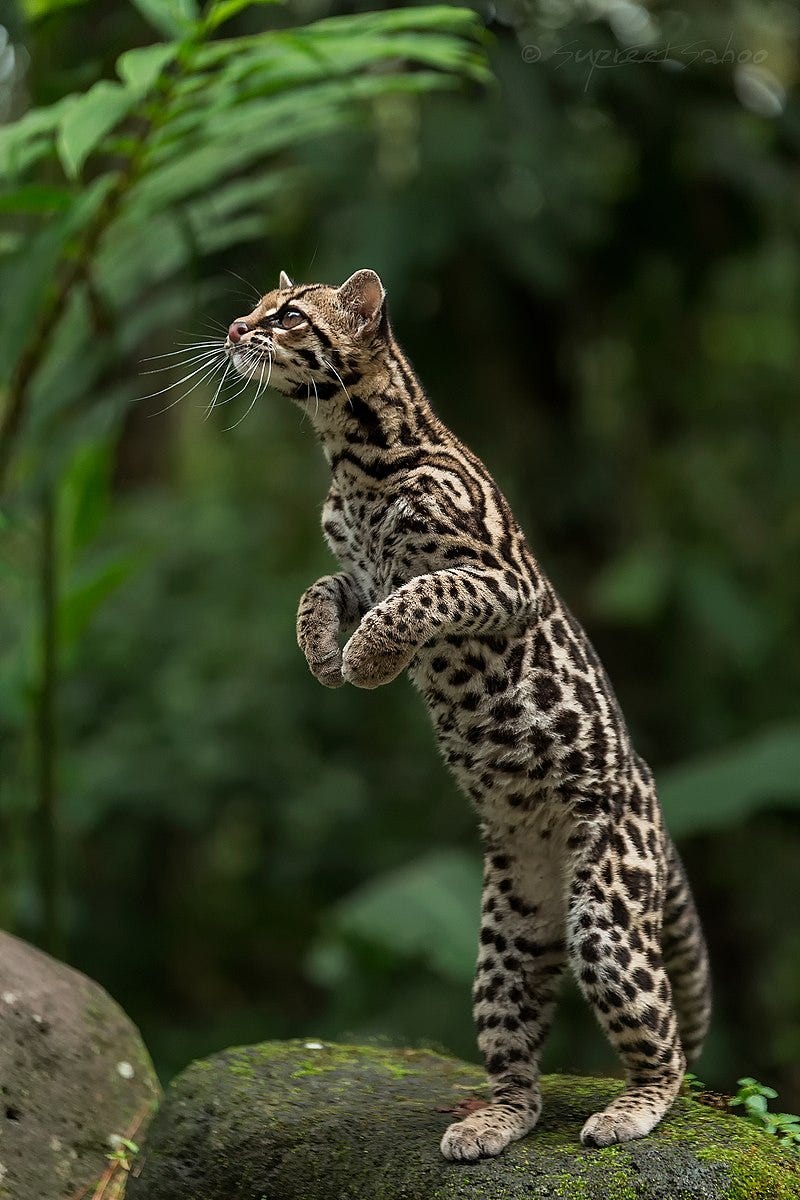
Margays are the wizards of the treetops & well adapted to an arboreal habitat.

The Margay hunts its prey by traveling on the ground but also take prey in trees. They eat small mammals, birds, eggs, & tree frogs. Their spectacular agility allows them to capture small primates, like a baby pied tamarin monkey.

A scientific research document reports the cat uses sound mimicry to lure its prey.

During the day, they rest in safe tree branches or clumps of climbing vines wrapped around trees in the rainforest.

They use their urine-sprayed scent & scratch marks on the ground & tree branches to mark their territory. Their vocalizations are short-range.

Special adaptations.

Because of its ankle flexibility, like that of the clouded leopard, this kitty can climb head-first down trees.

The ankles of the Margay can rotate its foot to 180 degrees outward. Captive cats have been seen jumping nearly six meters straight up in the air & nine meters horizontally.

Their broad soft feet & mobile toes enable them to hang upside down with one foot holding on a branch.

Beautiful big eyes aid in nighttime vision.
https://upload.wikimedia.org/wikipedia/commons/b/bd/Margay_in_Costa_Rica.jpg

Conservation.

The Margay is on the IUCN Red List of near extinction. Statistics reveal 14,000 killed in a year.

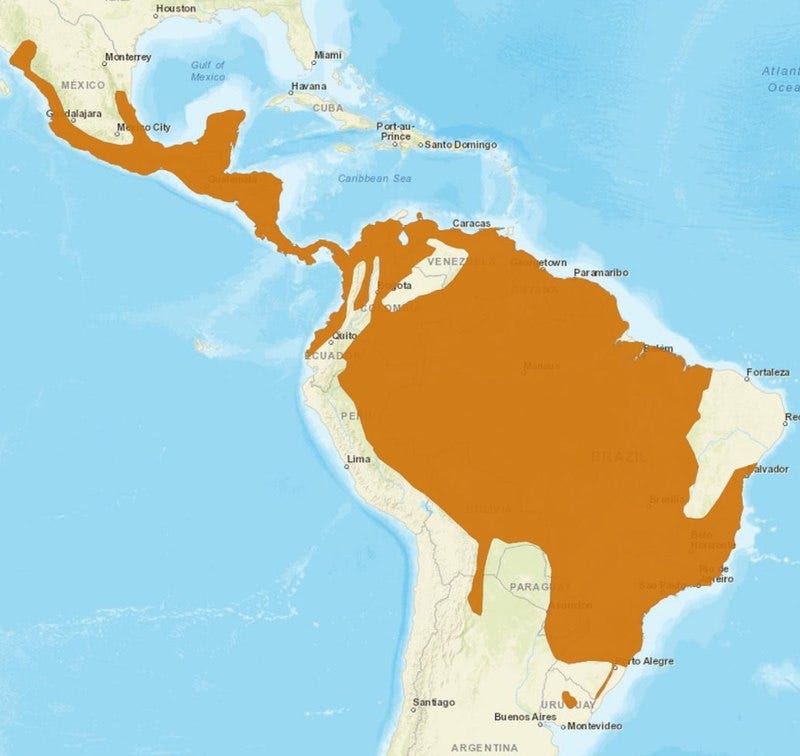
Ten subspecies over a sizeable geographical area have been identified & seen roaming in the rainforests from Mexico to Argentina.
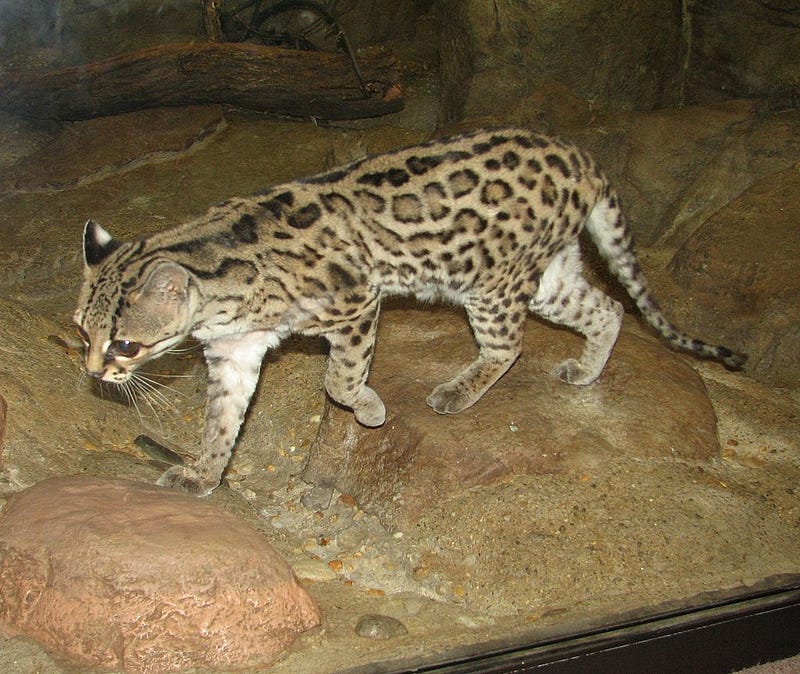
By Ltshears — Own work, Public Domain, https://commons.wikimedia.org/w/index.php?curid=4238848
https://upload.wikimedia.org/wikipedia/commons/7/77/Margay_distribution.jpg

So how did the kitty get the name Margay?

The scientific name Felis Wiedii was used by Heinrich, Rudolf Schinz in 1821 in his first scientific description in honor of Prince Maximilian of Wied-Neuweid who collected specimens in Brazil.

The name Margay strings from the word Margao, derived from the Guaraní-peoples of Bolivia, Paraguay & Southern Brazil. The term means wildcat.

Source: https://wildcatconservation.org/wild-cats/south-america/margay/

Source: https://en.wikipedia.org/wiki/Margay

Source: https://simple.wikipedia.org/wiki/Margay.

Thank you, readers, for your views.

Nature Writing
Wildlife Conservation
Cats
Research Reports
Species Survival
Recommended from ReadMedium