Before We Can Change Our Prejudice We Have to Be Honest With Ourselves
Prejudice is something practically everyone experiences but the ability to change it first comes from recognizing that it exists within us.
Everyone is a prisoner of his own experiences. No one can eliminate prejudices–just recognize them. ― Edward R. Murrow
This past weekend, I learned something about myself that I am not proud of. Despite my convincing myself that am open minded and accepting of all people providing they aren’t engaged in spreading hate, I found out that this may not be entirely the case.
This realization occurred while I was on the bus coming back from my writing group with someone else who attends it. She wanted to catch the bus further from where we were meeting when there was a stop just a couple of blocks away. She said something about running into a crowd or a group of protestors or something else that I didn’t fully understand. But it was a beautiful day and walking a little more before boarding the bus was welcome.
Once on the bus, we rode for a while, then the woman seemed to see something ahead of us which I couldn’t since I was facing backwards. “That’s what I was afraid of. Muslims protesting. I’m glad we walked further away from this to get the bus.”
Whenever someone says something like this, I admit, I have a knee jerk reaction. Being Jewish I have a hard time when someone lumps an entire group of people together and then says something they feel applies to all of them. The woman I was with was also Jewish and though I didn’t say anything to her, I know I immediately once more wondered how someone who is a member of a long persecuted group could make assumptions another another minority that is also often persecuted.
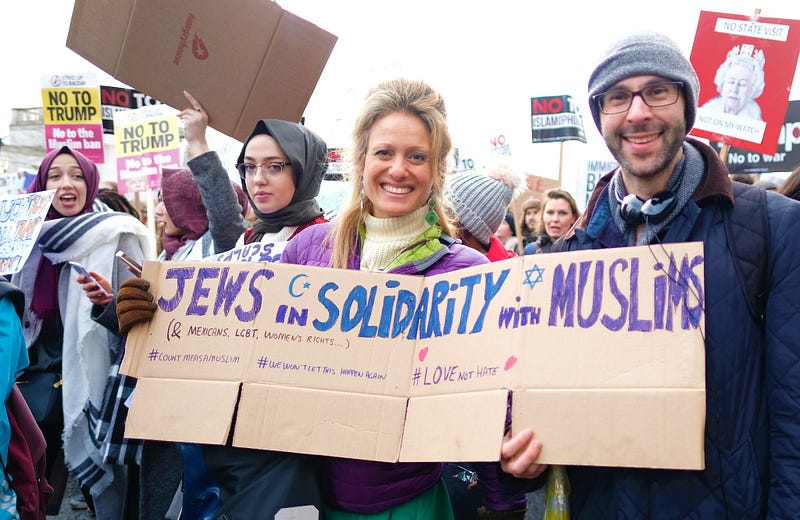
I have never understood why much of the world seems to think that Jews and Muslims are natural born enemies. We are descended from the same Patriarch and the two religions are more similar to each other than other religions are to Judaism.
I understand that there have obviously been problems between us but also know that these events have been carried out by a relatively small group of radical elements who were not acting in accordance with the precepts of the faith. The idea that within the Torah or the Quran it states that one or the other (or both) groups were instructed by God to wipe out the other is simply false and does not underlie either religion.
I have always been interested in learning about other cultures and religions that I am not familiar with. When I taught at a University I had students from all over the world and took the opportunity when it presented itself to learn about different belief systems. What I found was that there seemed to be similarities among all of the religions I heard about.
Being Jewish I am well aware of the more difficult parts of our history including numerous instances of prejudice and discrimination, more than one forced Exodus and several incidences of attempted genocide. These occurrences took place around the world and across time from when we first became a nation at Mt. Sinai up until and including the present day.
While I hope I would have always had a tendency to focus on the positive adaptive elements of different cultures and religions and to see the beauty each one held, I think that being Jewish has made me more sensitive to that inclination. I also think my personality is such that I always root for the underdog and feel the necessity to defend those that others criticize or attack when the reasons for these things don’t hold water. Obviously, prejudicial views fall in this category.
So whenever anyone said anything negative and biased about Muslims, depending on the situation I usually try to carefully point out that when you attribute something to “Muslims” as a group you are talking about more than two billion people in 232 countries. While they may share a religion, there are certain aspects of the religion that may differ along with their culture, background, customs, social elements and other factors. In addition, there are also individual differences based thoughts on their thoughts and preferences, personality, physiological predispositions, ways of coping and the specifics of how they view the world.
What happened next on the bus took me by surprise. When we pulled up next to where the group was protesting, I immediately felt anxious. There were about 20 people with signs very calmly standing or speaking with each other.
When we stopped at the light by them, I made sure not to look at them directly despite the fact they weren’t paying any attention to the bus. I have a vague memory of being warned at some point that making eye contact with strangers might lead them to do something bad to you.
All of those participating in the protest had their heads covered, the men with taqiyah (caps), the women with headscarves. Other than that they were dressed in informal western clothes, jeans or khakis with sweatshirts, leggings with tunics, and sneakers or the like.
Given that many groups of Jews cover their heads in a similar fashion the way they were dressed wasn’t different than many of my friends, my reaction couldn’t have been due to their appearance. They weren’t agitated nor were they yelling, chanting or otherwise acting in a manner that might suggest the possibility that things might erupt into something else.
To the contrary, they seemed tranquil and composed, so my reaction couldn’t have been due to their behavior. There weren’t even that many of them so I couldn’t argue that when a large group was engaged in an activity that involved strong emotions, there was the risk that their behavior might deteriorate into a mob mentality.
I am able to go back now and say these things, as I can recognize my effort to justify my reaction now that the incident is past for what it was — an attempt to sooth my righteous indignation at my own response. Because the fact is that there was something about seeing a gathering of 20 or so Muslims gathered to protest — peacefully — that made me nervous. This indicated of course, that I wasn’t as accepting, tolerant or lacking in prejudicial thoughts as I had wanted to believe.
And while it’s possible that I could have this general attitude whenever I come into contact with a large number of strangers, the fact is I don’t worry if the group has a makeup more similar to my own. I don’t think that this is unusual. We tend to feel most comfortable around those we have things in common with, whose ways seem familiar and who are similar to us. But this can be due to feeling like we don’t fit in or have nothing to contribute since we don’t have much in common or it can be due to fear of what may happen because we are different. This last part can translate into or reflect already existing prejudice.
I am struggling with this, because even though I am being as honest as I can, I am still not able to say that I won’t have exactly the same reaction if I were to run into another group of Muslims protesting something tomorrow. This worries me because fear is a powerful mistress and it can cause you to say or do things that you don’t mean to and which in other circumstances you wouldn’t even consider. I also don’t like what it says about me.
There is also the fact that I was on a bus safe and sound traveling away from them, yet still felt a sudden spike of anxiety which didn’t go down until they were out of sight. This means that the reaction was automatic and not moderated by intellect which can also suggest that the intellect won’t weigh in with reality testing that would help dissipate the anxiety.
While I still have work to do on this issue, the fact that it is now at least conscious means that I won’t ignore where it’s coming from even though the emotional component is no longer there to motivate me. I can also recognize that there are inconsistencies in the way I’d like to see myself and the way I truly am. I know that awareness is the first step to combating prejudice. Holding myself accountable for justifications that I might try to use to dismiss my responsibility is another step.
Since entering high-school, I’ve been lucky to have friends from a very wide range of backgrounds, experiences, orientations and perspectives. Thinking about them today, I’ve come to realize that the people I admire the most aren’t necessarily complete free of prejudice. They are the one who recognize these thoughts, question them, ask for feedback from others about them and challenge them. They are aware that other people see things differently than they do and they are willing to consider others’ beliefs and even potentially adopt some of them when they make more sense than their own.
Today on 9/11 I have spent a lot of time in reflection on these topics. Even now, as the day comes to a close, and I think about the friends I’ve had through the years, I hope that I can do a better job of emulating them in the future. In the end, I don’t know how close I’ll come. But I do know that I will become a better person for the effort.
Thanks to Michael Shook (Prejudice And Love At The Grocery Stores), Sandeep Kaur Dhillon (I’m Indian. He’s Black. My Journey From Prejudice To Love), and Jenny Justice (The Important Difference(s) Between Prejudice, Discrimination, and Oppression) for the inspiration for this piece.

If you enjoyed reading this article, you might also like these:
You can find links to my other work on Medium and follow me here. Thanks for reading and for your support of Mental Gecko!