
History Matters
Before “Moms For Liberty,” There Was “Daughters of the Confederacy”
The “daughters” fought to ban offensive textbooks, and wanted “proper” (whitewashed) history to be taught
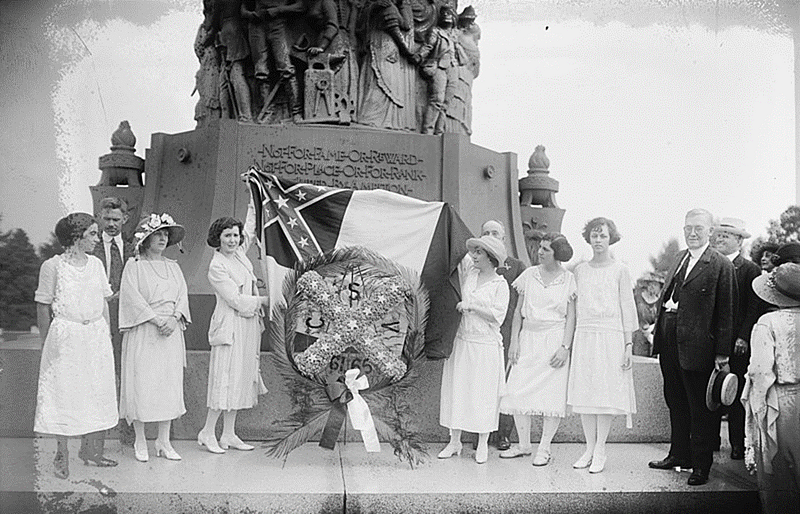

The United Daughters of the Confederacy (UDC) was founded in 1894. They had a twofold mission: to erect monuments to the “heroes” of the Confederacy and to make sure students learned the “true history” of the Civil War and the Southern way of life. They promoted the myth of the “Lost Cause” in schools all across the South. They did an excellent job of it.
Its echoes still linger to this day.
The mythological history they embedded in the education of US citizens is so tenacious that a candidate for president, Nikki Haley, had to hesitate to mention “slavery” when asked what caused the Civil War. She knew better, but she was also smart enough to know that to mention slavery would lose her votes.
The UDC still exists, by the way, just as the “Lost Cause” myth does.
As late as 2010, the Texas Board of Education removed slavery as the central cause of the Civil War and replaced it with states’ rights and secession. It wasn’t until 2018 that they put it back, but still insisted that slavery, secession, and states’ rights were equal factors.
Everything old is new again, as they say. Now, we have Moms for Liberty complaining about “offensive” books that make white people “feel bad” and demanding that history be taught properly.
UDC pioneered pressuring school boards, doing letter-writing campaigns (the ancient version of Twitter and social media trolling), leveraging political pressure to get their way, and yes, banning books. All done with a very particular (very white, shall we say) agenda.
Just like Moms for Liberty is the friendly feminine front face for the Proud Boys, former UDC member and Seattle chapter president Heidi Christensen (who quit the group in 2012) said “In some ways the UDC was the KKK’s more feminine, genteel sister organization.”
Flattery over facts
Because the “Lost Cause” myth is so fundamental to how Nikki Haley could say with a straight face, “We’ve never been a racist country,” and Trump could say Lincoln did a lousy job and could have avoided the Civil War, we need to take a look back at the United Daughters of the Confederacy.
Battles over education and what students will — and will not — be taught is an old battle. Some causes, like the “Lost Cause,” just never seem to die. Why? Because we were founded as, have been, and still are a racist nation. That is a fact that must be confronted if we are ever to have any hope of finally moving past that.
You don’t move past racism by wishing it away, pretending it was never there, or even mumbling some inane statement like, “We should be color blind.” That is what a coward says, who doesn’t want to deal with difficult subjects and find real solutions to them.
James Baldwin, in his 1965 essay “The White Man’s Guilt,” said:
“…people who imagine that history flatters them (as it does, indeed, since they wrote it) are impaled on their history like a butterfly on a pin and become incapable of seeing or changing themselves, or the world.”
I write this piece as an invitation to people to unpin themselves and rejoin the human race in all its complex shame and honor, failings and successes, hopes and dreams. We all can only be wise custodians of the future if we learn genuine history, and learn it thoroughly, in all its complexities and from many viewpoints.
That means learning both about 1776 and 1619.
A history book is supposed to be about history, isn’t it?
Did you know that Mississippi students weren’t required to learn about the civil rights movement until 2011?
Mississippi still had “Lost Cause” history textbooks right up to 1980.
The “Lost Cause” myth says: Slaves were happy and well-treated, and slavery was a benevolent institution. Trouble-making abolitionists in the North caused conflict between North and South. The South had a constitutional right to secession and fought for “states’ rights.” Confederate soldiers and generals were heroic and saintly, none more so than Robert E Lee.
In the 1970s, James Loewen of Tougaloo College and historian Charles Sallis of Millsaps College wrote a new history textbook called “Conflict and Change.” It portrayed the truth about slavery. It also discussed lynching, white supremacy, and Jim Crow segregation.
The Mississippi Textbook Committee rejected it, with a 5–2 vote on racial lines. The five white commissioners complained it focused too much on Black history (sound familiar?). They also complained it had too many disturbing pictures, including one of a burned lynching victim (sound familiar? Moms for Liberty often complains about “disturbing” stuff they need to protect kids from).
“Conflict and Change” was rejected by Mississippi. The authors sued in court. They won.
During the court hearing, there was a memorable exchange between textbook committee member John Turnipseed and the judge:
“Didn’t lynchings happen in Mississippi?” U.S. District Court Judge Orma Smith asked.
“Yes, but it was all so long ago, why dwell on it now?” Turnipseed replied.
“It’s a history book isn’t it?” the judge shot back.
The not-so-high moral ground of book banning
In 1919, the Rutherford Committee was formed to ensure the “Lost Cause” was in history textbooks. The most prominent member of the committee, who gave it her name, was Mildred Lewis Rutherford of the UDC.
Another prominent member of the committee was Julian S. Carr, former Confederate general and industrialist. He once gave a speech on the campus of the University of North Carolina in 1913 at the dedication of a Confederate veteran memorial, where he told the tale:
“I horse-whipped a negro wench until her skirts hung in shreds, because upon the streets of this quiet village she had publicly insulted and maligned a Southern lady, and then rushed for protection to these University buildings where was stationed a garrison of 100 Federal soldiers. I performed the pleasing duty in the immediate presence of the entire garrison…”
I just quote that to paint a picture of the people wanting to set school textbook standards. Calls to my mind one of the founders of Moms for Liberty, who was engaged in a threesome with her husband, but now her husband faces allegations of sexual assault against that woman. Not a direct parallel, of course, but I just thought I would mention it.
Self-proclaimed moral and valorous people so often tend to be anything but, don’t they?
In 1919, Mildred authored and her Committee published “A Measuring Rod to Test Text Books, and Reference Books in Schools, Colleges and Libraries.” It was a collection of standards for history books, i.e., make sure they contain the “Lost Cause.”
She followed that with “Truths of History,” a 114-page book that expanded on the Measuring Rod, mostly with diatribes against the North, but also it listed by name books to be banned.
State chapters of UDC promptly launched campaigns to ban those history books from schools. (CRT bans, anyone?)
Textbook publishers faced a problem. Schools in the North still wanted quality material with real history. So, publishers opted to create two versions of their books, the original to sell in the North, and then a watered-down history book for schools in the South.
Ignorance doesn’t sprout from nothing. People complain today about the racism and ignorant attitudes in some parts of this country, among some groups of people. However, ignorance is by design and it has had more than a century of cultivation behind it.
How do we even begin to measure the damage done by UDC?
How do even begin to measure the potential damage that could be done by Moms for Liberty?
Why are they still here?
As I said, the United Daughters of the Confederacy still exists, but they are a more demur organization now. Membership has fallen off dramatically from its peak during WWI when they had nearly 100,000. Now they are closer to 14,000. They lost considerable numbers after George Floyd and the summer of protests (which is heartening, I guess).
The UDC earnestly wants everyone to know they are not racists.
We have heard this before, haven’t we?
They have a memorial building (looking disturbingly like a mausoleum) located in Richmond, Virginia. During the summer of protests, it was the target of graffiti, vandalism, and ultimately a Molotov cocktail thrown through a window. It still stands, though now guarded by a private security force hired by UDC, all Black men. Again, by design, as UDC really, really wants you to know they are not racist.
Anna Venarchik wrote a fascinating article called “Yes, They’re Pro-Confederacy. But They’re Just the Nicest Ladies” about her quest to visit with some UDC members there and get a tour inside that memorial in Richmond (spoiler alert: she doesn’t get that tour). I highly recommend reading it.
There is one thing I must quote from it. It was something Virginia General Assembly Minority Leader Don Scott, a Democrat, said to her about UDC:
“The fact that they still exist is tough to deal with,” he told me. “If you go to Germany, there’s no ‘Daughters of the Nazis.’”
I’m not going to engage in the unwinnable back-and-forth over who is racist or not.
The real point is that America has a lot of people who are white butterflies that have pinned themselves to a board. May I suggest, for your own good, that you unstick yourself?