
BEEF Accurately Shows The Dark Side of The Asian American Experience
And hypercompetitiveness among Asians
Warning: spoilers for BEEF
On one Friday night, I finished Netflix’s BEEF and its entire first season between 10 p.m. and 5 a.m. I just couldn’t stop watching it not only because it was incredibly funny, but because I resonated with the themes and subplots as a first-generation Asian-American as well.
The main conflict is between the two show protagonists, Danny Cho (played by Steven Yeun) and Amy Lau (played by Ali Wong), trying to ruin each other’s lives after they have a road rage incident in a parking lot. Predictably, they go on to have a love-hate relationship in their obsession with ruining each other, but early on in the show, it’s all hate.
Amy is the pinnacle of Asian success, sort of. She’s the owner of a multi-million dollar business that she’s on the verge of selling for a lot of money. She’s at the height of her career and is the breadwinner for her family, as her wealthy husband stays home to be the caretaker for their child. The only way an Asian immigrant parent would be more proud of Amy is if she was a doctor.
Danny, on the other hand, struggles, to say the least. He is a construction contractor whose finances and career are not going well. He has rating lower than three out of five stars on Yelp, has a younger brother that does nothing to contribute to rent, has a cousin who is in and out of jail and tanked his parents’ motel business by running an illegal business, and as the older son, Danny feels a substantial obligation to provide for his parents and buy them a nice house where they can be comfortable and feel like they are successful in America. As unhappy as Danny is with his life, he still feels like he needs to be the one to make everyone else in his family happy.
Unfortunately, in many Asian circles, parents point to someone like Danny as an outcast and a model of what not to be like. It’s messed up, but he doesn’t make a lot of money, he’s not a doctor, engineer, or business owner, and although the show is mute on Danny’s education status, but based on a conversation about his ex-girlfriend, it’s implied Danny did not go to college.
I hate this mindset regarding the Danny’s of the world in the Asian community, but it’s there, and it spills into some of the youth as well who judge a person’s worth based on their prestige, status, and education level. They’re kind of the black sheep in Asian families and communities from an elder’s perspective, but I know a lot of people who meet the same criteria as Danny and honestly, they’re a lot more fun to hang out with than the Amy’s of the world who can be somewhat snobbish and stuck up (on the surface, at least).
The dark side of the Asian American experience
Of course, BEEF’s whole premise examines the dark side and underworld of the Asian-American experience over these surface-level appearances of status, accomplishment, and education. A lot of first-generation Asian-Americans might never run multiple red lights, stop signs, and people’s gardens to get back at someone who was rude to us in the parking lot, nor may a lot of us kidnap our arch-nemesis’s child and demand ransom money for doing so.
But a lot of us feel that rage and angst and those feelings are captured well by the actions of Danny and Amy and every Asian person channels those feelings somewhere. There’s an intense lack of belonging most Asian people feel in mainstream American spaces that’s kind of difficult to explain, so we throw ourselves into various pursuits with crazy intensity — it might be work, school, success, League of Legends, etc.
Danny and Amy are not equals in terms of social status, but they are equals in their loneliness and willingness to blow up their whole lives over an incredibly petty traffic grievance. For them, their competition trying to mess with each other is a feeling like no other in their lives, a level of exhilaration and outlet for rage no other part of their disappointing and underwhelming lives grant them.
Despite Amy and Danny’s differences in achievement and status, they both refuse to back down from trying to ruin each other’s lives. They go to quite extreme lengths to do so and deceive the people they love, including using fake names and dating profiles to get close to immediate family, crashing huge career events, and leaving fake reviews on Yelp. The extreme lengths only escalate later on in the show, peaking with Danny and his family kidnapping Amy’s daughter for ransom money.
It’s kind of fitting the two take out all their on another person of the same race and around the same age as them because, well, who else would it be appropriate to take out that kind of anger on?
I think it’s also important to note that the two of them have a lot of obligations and a lot on their plates, including feeling the need to take care of and provide for their whole families and elders. Outwardly, they do have to maintain the appearance that they’re good, caring, and compassionate people. They really don’t have any other choice because of who they are in their respective families.
In private, however, all they do is engage in this war where they treat each other horribly. They can act like how they really feel all the time. Both are very layered people, but the show brilliantly shows that the Danny and Amy’s of the world are so dedicated and kind on the outside, but so wounded and angry on the inside.
Asian one-upmanship
There’s a lot to resonate with in BEEF if you’re Asian-American, including dynamics between first-generation Asian Americans and parents.
However, what I felt most resonantly was the dynamics between Asian peers around the same age, particularly the hypercompetitiveness and the dark side around it. We see this but quite literally, Asians can have quite a lot of beef with one another when pride and competence are at stake, to an almost animalistic and subconscious point.
Nowhere is this more evident in Danny and Amy’s battle, but it’s also evident in more subtle, minor scenes that I couldn’t help but chuckle at.
In the third episode of BEEF, Danny is at a very low point in his life and decides to visit his ex-girlfriend, Veronica. Veronica is now married to another Korean man named Edwin who seems to have it all, like the Amy’s of the world on the outside. He seems to have a good job, is good-looking, and the two have a nice house.
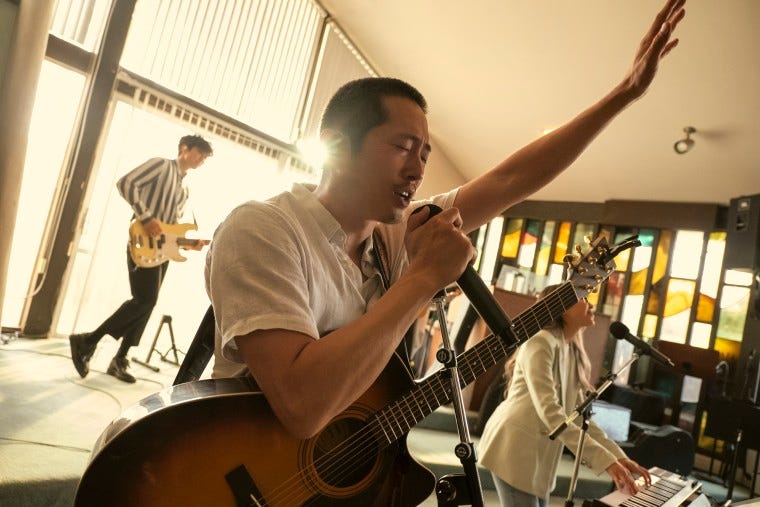
Not only that, but he’s the leader of the praise team at the church, sings, and plays the guitar. When Danny and his brother visit Edwin and Veronica, they invite them to come visit their church.
Danny actually takes them up on the offer, and in the viral scene where Danny does go to church, he starts breaking down crying during worship. I actually felt goosebumps during this scene because I’ve been there, too, and for all the problems in the evangelical Korean and Asian churches and how conservative and judgmental they can be, I’ve had genuine spiritually rich experiences in those spaces and times where I felt reached on a level I didn’t feel reached elsewhere.
Regardless, Edwin is a neutral character at first, but during interactions with Danny, Edwin is passive-aggressively condescending. He wonders how Danny could drive over an hour to their church, asking if Danny’s business is slow. When Danny fixes the church’s broken sign, Edwin thanks him for his work of volunteerism and charity, only to take another jab at Danny and point out the sign is a bit crooked. It’s brought up multiple times that Edwin is on the church basketball team, and suggested that Danny should play against them.
“Well, we’re really good,” Edwin says as if there’s no chance Danny could beat him.
Eventually, Veronica does suggest that Danny join the praise team, since he used to play the guitar too. And when Danny brings his cousin, and his brother, and his cousin’s friends to the church, they assemble a basketball team to play recreationally and have fun against Edwin’s “really good” team.
Unfortunately (or fortunately), the basketball game is anything but recreational. Edwin and Danny’s teams get crazy competitive against each other. Edwin starts to miss a lot of shots, screaming at himself to “FOCUS” in a state of intense rage. Eventually, it becomes pretty clear that Danny’s team is better, and Edwin is not happy. Edwin starts to break down on the church basketball court, kicking a trash can and yelling “fucking fuck!” in front of the entire congregation.
Danny’s team wins, and Edwin being the praise team leader and cussing all over the court is not a good look.
Eventually, Edwin has to resign from the praise team due to the burdens and expenses of young parenthood. And the person who replaces him? Danny.
This hypercompetitive rivalry is coated in passive aggression, but Edwin losing his spot and status in the church to Danny is a blow to Edwin’s pride he never recovers from. Edwin starts accusing Danny of running a criminal enterprise and also tries to ask to join that alleged enterprise himself. Edwin also starts charging magazine subscriptions to Danny’s house as a prank and does other things to try to mess with him out of jealousy: Veronica always speaks so highly of Danny as “the best she’s ever had,” and Edwin feels small in comparison.
Takeaways
Someone who seems to have it all like Edwin losing all his status and pride to someone whose life is falling apart like Danny is a major twist of fate. But this one-upmanship among Asians is not uncommon.
Again, it’s a comedic Netflix show, so a lot of these things haven’t happened to me in real life. But my Asian friends and particularly my Asian male friends and I can get to the same level of competitiveness as depicted between Danny and Edwin in BEEF.
In high school, the greatest form of academic pressure actually wasn’t from my Asian parents: it was from my Asian peers. You never, ever wanted to be the Asian with the worst grade in the room, and of course a lot of my Asian peers and I would share how we did on a test or essay as a form of one-upmanship and competition to see who was the best Asian on the day. It was never really about what the non-Asian people in the room thought of us — it was just a fun competition we had amongst ourselves.
I had one Asian classmate who lamented how our biology teacher would always say “everyone did really well on this test…except one or two kids.” He said he was usually one of the one or two kids, and that he didn’t care because he wanted to be a mechanic anyway and because his pursuits and values were much different than the rest of us. He’s doing great now, but his mindset seems so much freer, better, and more liberating in hindsight than ours was.
But Asian men in particular aren’t just hypercompetitive about academics and work. Something as trivial as pickup basketball also becomes what seems like a life-or-death battle. A lot of Asian guys who lead praise team and go to church for half the day every Sunday will all of a sudden throw elbows and start dropping the f-bomb left and right when things don’t go their way. To be clear, I’m a Christian do it too, and I find it very fun to take something like basketball or soccer so seriously, but I’m not a saint and just a regular guy.
It’s not always hypercompetitive, and as my Asian male friends and I get older, we realize it’s all fun and love at the end of the day, even if we regress to our more primal need to prove our dominance in a game of basketball.
I’m somewhat of a heterodox and outcast from the values of keeping up appearances, saving face, and reputation depicted in the church in BEEF and a lot of the Asian cultural values that exist — or at least I try to be. But I will say I’m just as competitive as the next Asian dude, so I’m a hypocrite in that regard.
I don’t know if there’s a reason for it other than it being an outlet for what’s lacking in the Asian American experience, but the next time I’m getting on the court with a bunch of other Asian dudes, everyone better watch out — elbows will be thrown, loose balls will require all out dives, and people might get injured.
If I can pinpoint one logical reason why we go so hard, there’s only one — because it’s a lot of fun.
In terms of the dark side of the Asian American experience, well, I think the show just puts into words and subliminal actions what a lot of Asian Americans feel when they feel a lack of belonging and dissatisfaction. Even the hypersuccessful like Amy or the seemingly perfect ones like Edwin have the capacity to regress into the worst versions of themselves.