
Becoming a Data Driven Organisation Part 2
In Part 1, I set up the stage and discussed various aspects which make a business data-driven.

In this post, I will discuss the challenges that keep businesses away from becoming Data-Driven (DD hereafter).
Today, it is evident that data is the critical asset, and AI is the vehicle that helps businesses thrive. It has made business leaders aware of and come up with the desire to take advantage of the opportunities that data and AI offer. However, contrary to the desire of becoming data driven and infusing data science and AI into their businesses, business leaders still have to deal with many challenges, despite investing their resources toward their data- & AI-related strategic initiatives.
If you like to stay up-to date with this kind of stuff on data science and AI, covering both business as well as technical deep dives, be one of the FIRST to subscribe to my YouTube channel here!. I’ll be sharing lots of amazing content like this in video form. Thanks for your support :)
The following paragraphs present common challenges that companies encounter on their route to becoming data driven.
- Short-term focus on Return on Investment (ROI): The focus on short-term objectives, e.g. let’s finish this project and then we will start with an AI or data project in a few months. This type of thinking keeps many businesses away from leveraging AI and Data Science until some of them hit the point where their competition comes in and seizes the opportunity.
- Lack of vision: Some companies struggle due to their leadership not being knowledgeable enough to start such AI initiatives. And, if they have some know-how, they lack the pragmatic approach to link their know-how with actionable plans to get value out of AI and Data-power that they have in their bay.
- Shared ownership: This is yet another big challenge that many organisations face. Some business units (BUs hereafter) are really advance d in terms of their knowledge and urge to act on AI projects, while others are no where near to anything like that. As different BUs within an organisation have interdependencies and need one another to get anything done, this lack of shared ownership comes in the way when they want to execute AI projects. Sometimes, this comes in the form of budgetary approvals; other times, it comes in the form of lacking resources, access to data and skills needed.
- Single mindedness: Some BUs, or their leaders, are so focused on their tasks or domain that they do not want to look outside of their domain. Even if they do so, they hardly spend any effort or resources to take the next steps.
- ROI focus: In some cases, where the stakeholders do recognize the value that AI and Data Analytics can bring, they still fall short on connecting and converting that value in terms of ROI metrics.
- Strategic gap: Being unaware about the strategy needed to attain the value out of data and AI efforts. Not being able to visualize the full picture or true understanding of what it would mean for them if they were to become a DD organisation.
- Lack of skilled resources: Due to the shortage of data scientists, it becomes a next-level challenge to look for skilled and experienced data workers (data scientists and other data professionals). This is due to many aspects:
- (a) Demand for data scientists is too high, while the supply is too low.
- (b) Not every organisation can afford to pay the salary that skilled data scientists rightfully ask for.
- © Retention of data scientists.
- (d) BU leaders and hiring managers, due to the skills gap, end up hiring the claimants but not the skilled data scientists.
- (e) Even if they managed to hire skilled and good technical geeks, there comes another challenge, which is how to help them bridge the gap between business and technical concepts of data science: How can they make data science relevant, valuable, and meaningful for the BU leaders and other stakeholders across the organisation.
- Reluctance to change: The main challenge is that we as humans are reluctant towards change, even though we might not accept it. When someone tells you that you need to move to new tools and platforms and leave what you have been using for the past many years., Your first reaction is No, I am not going to do that, or why should I do this? I am doing all my work perfectly and finish my activities on time. That might sound natural, but we are in an era where we need to combine both natural and artificial intelligence together.
- Cultural Change: As with any other innovation and technology-adoption, data and AI are no stranger to the fact that change is hard to implement and it takes time. This depends on the culture of the organization and readiness of the leadership to accept and manifest change in their business routines. As Humans, we are reluctant to change.
As a second example, during the aftermath of Covid-19, when calls were made for lockdown and social distancing, and to start working from home, it took many of us days, if not weeks, to get used to that. However, the good news is that once you decide to implement the change, it will happen, so is the case with social distancing and working form home- They have become the new norms and normals.
- Trust in Data: Business leaders are concerned with the question of trusting data, if the data insights contradict the long-standing business norms. Studies show that two in five organisations say that their people do not trust insights. This is due to the fact that those people believe that almost one third of their data is in-accurate. Poor data governance leads to data debt, which means your data is not fit for the purpose of analysis, and it is likely to be highly innacurate.
- Data Literacy: The lack of data literacy and AI literacy are causing people to look at this chart below of confirmed cases in the USA for Covid19 and say we are almost ready to go back to normal. We need to take into account a more data literate workforce so that we could truly benefit from the potential that data and AI have to offer. Statistics show that 84% of organizations see data literacy as a core skill. This includes the ability to read, understand, work with, analyze, and build arguments with data. In essence, lack of data literacy skills directly impacts ROIs in data and analytics.
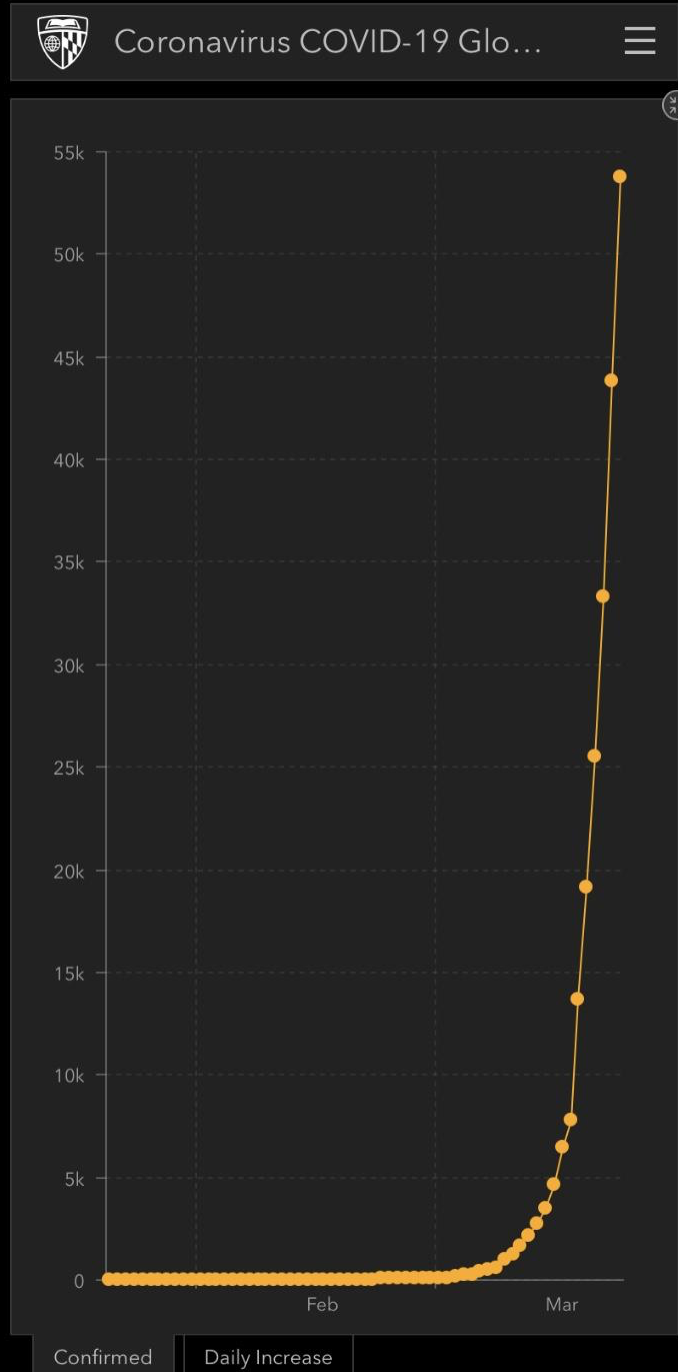
There are many other examples that can be quoted to dictate the dire need for data and AI literacy.
Other factors that get in the way are costs, migration or integration aspects, filling the knowledge or skills gap vs meeting the daily business or customer requirements … the list goes on. These are the factors that hold most companies back from becoming truly data-driven.
In the next blog, I will discuss the changes that organizations need to implement to truly benefit from data and AI.
Thanks for Reading!
If you like my work and want to support me…
- The best way to support me is by following me on Medium.
- If you want to write on medium and submit it to a publication. Check here for Data and AI and for more general and diverse topics, you can submit your articles to Diversified Knowledge
- Follow me on Twitter here. I’ll be posting lots of updates and interesting stuff there!
- Also, subscribe to my YouTube channel here!
- Follow me on LinkedIn here.
- Check out my website.


