
Become a Consistent and Profitable Trader — 3 Trade Strategies to Master using Options
An Introduction to Options and 3 ways to Profit using Them

Build Your Wealth
Building wealth takes consistency. Sure, you can fast-track your way to riches with some luck, skills, and/or knowledge, but for a lot of us it takes patience, discipline and time. It is often a marathon that takes years to decades to accomplish. In a previous article I share how I began to find consistency trading stocks and options. Although I am certainly not the most brilliant trader, I’ve been chugging along for years, absorbing as much as I can from people and applying the strategies that work for my risk tolerance. Whether that means cutting my losses early or spending days just sitting on my hands and watching things find a range, I’ve gotten better at sticking to my trading plans.
This year I decided I’m going to be spending 2021 mastering these three trades to squeeze as much juice from the market and my stock positions as possible:
- The Covered Call
- The Poor-man’s Covered Call
- The Put Credit Spread
If you’ve never used options before, this article will begin to explain what they are, as well as expose you to some simple strategies that use them.
Disclaimer: All three techniques covered in this article use stock options to gain additional flexibility in the market compared to just buying or selling stocks. Before getting too deep, let me preface this by saying options can be volatile and open you to additional risk. They DO NOT fit with every trader’s risk tolerance. Before trading options, understand what you’re getting yourself into and do your due diligence. The examples in the article are not trade recommendations. They are for education.
If you need financial advice, seek a professional.
What is a Stock Option?
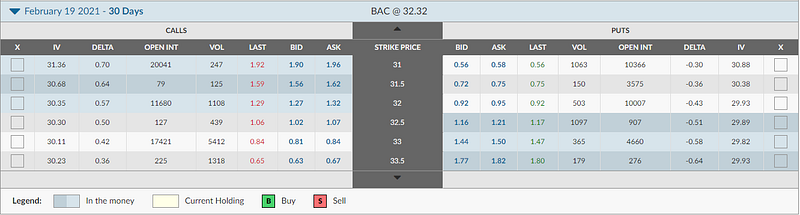
Options are intimidating to new traders because there is a lot of jargon and numbers involved with them. Starting with a simple definition, a stock option is a contract that gives an investor the right, but not the obligation, to buy or sell a stock at an agreed upon price and date. You might see/hear people use the term contracts and options interchangeably. For example, “I have 10 contracts for BAC (Bank of America)” could mean I have 10 options.
One options contract accounts for 100 shares of the underlying stock. When you’re looking at the price of an option, you are seeing the premium per share and need to multiply that price by 100. For example, an option priced at .50 would cost 50 dollars because .5 x 100 = 50. Options pricing models are often complex and take several factors into consideration.
There are two types of options contracts, Calls and Puts. I’ll talk more about them individually later. For now, just remember a call is a bet the stock will go up. A put is a bet the stock will go down. Before covering the specifics about the contract types understand there is more to options than I can explain in this article, but I’ll give you the gist of it so you have a grasp of the strategies later on. Let’s start with two key terms:
- Expiration Date
- Strike Price
Expiration Date

One of the reasons options are risky is because they are contracts that expire on a specified date. This is known as the expiration date. For example, as of today, 01/19, I could go to my broker and buy an option for BAC that expires 02/19/2021. There are expiration dates going out a few years in some cases.
If you buy an option contract, time works against you. If you sell short an options contract, time works in your favor. The expiration date is important to understand because it helps traders price the contract through the time value. Time impacts the option’s price. That means buying a contract with a lot of time (far out expiration) will be more expensive than buying a contract that is about to expire. It makes sense when you think about it because the underlying stock has more opportunity to move in the direction you want when it has more time behind it. Time value is used in various option pricing models like the Black Scholes Model.
Strike Price
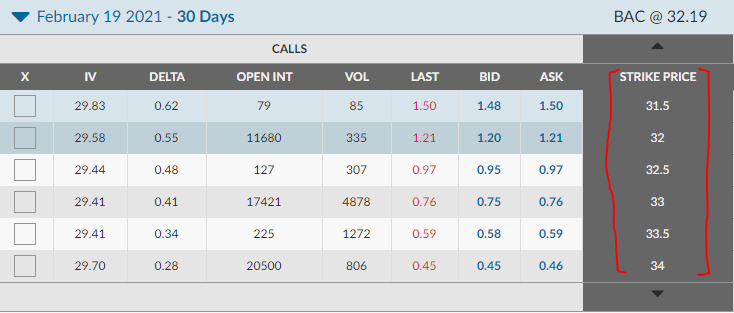
Remember, options let you buy or sell at an agreed upon price, as well as date. The strike price is that agreed upon price. It determines whether an option should be exercised. It is the price that a trader expects the stock to be above (when trading calls) or below (when trading puts) by the expiration date. For example, if I think BAC shares will be above 34 dollars a share by 02/19, I would buy a call option with a strike price of 34. If the price of BAC is above 34 dollars a share on 02/19, my call option is In-The-Money and I can exercise it to buy 100 shares for 34 dollars a piece. Say the share price is 35 dollars and my strike is 34. I just made 100 dollars minus the premium I paid when I bought the option.
Using the image above, lets say I buy the 2/19 call with a 34 strike at 0.45. That means I’d pay 45 dollars today (100 x 0.45). If the share price is 35 on 2/19, I’d be able to exercise the contract to buy 100 shares at 34 dollars a share. Then I can hold or sell them for 35 dollars making 100 dollars from the transaction (3500–3400=100). But since I paid 45 dollars initially, I’m really only making a gain of 55 dollars (100–45 = 55).
Note that American options can be exercised any time before their expiration date.
If the share price is below 34 dollars on 2/19, my call option expires worthless. It has no value because it would be cheaper for me to buy the shares at market price than it would be for me to exercise the option and buy 100 shares at 34 dollars a share. For example, if BAC is at 33.50 on 2/19 and I own a call option at the strike of 34, I would simply pay the market price of 33.50 instead of 34 through my option if I wanted to buy 100 shares. Exercising the option to buy 100 shares at 34 instead of 33.50 is giving someone free money!
If you don’t want to actually buy the shares, simply try to sell the option contract for a higher premium than you paid, just like you would a stock. Remember you have no obligation to exercise the contract. Contracts that are in-the-money will always have some intrinsic value.
What is a Put Option?
In the previous examples, I talked about using calls. Remember, a call option gives the holder of the contract the right to buy the underlying asset at a specific price on a specific date. Buying a call is essentially betting the underlying stock will go up in value.
The flipside to a call is a Put. A put option contract gives the holder of the contract the right to sell the underlying asset at a specific price on a specific date. Buying a put is essentially betting the underlying stock will go down in value.
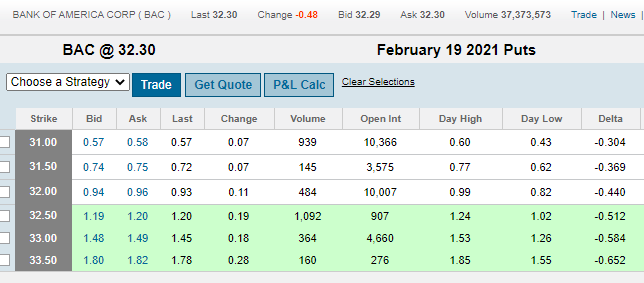
If the stock price is below the strike, the put is in-the-money. Notice in the image BAC is at 32.30. Since that is less than the Strike of 32.50, the 32.50 put is In-The-Money and can be exercised to sell 100 shares at the 32.50 price, potentially protecting the trade from loss. For example, say I own 100 shares of BAC at 32 dollars a share. If I thought the price would drop below 32 dollars a share by 02/19, I can buy a put contract with a strike of 32 for that expiration date. That is called a Protective Put. Using the image above, lets say I pay 95 (100 x 0.95 = 95) dollars for the put contract at the 32 strike.
On 2/19, the price is at 30 dollars. I can exercise my put contract and sell my 100 shares for 32 dollars, protecting myself from the 200 dollar loss. Of course, since I paid 95 dollars in premium when I bought the contract, I’m only saving myself 105 (200–95 = 105) dollars in this scenario. A put is kind of like insurance.
Now that you know some of the basic terminology around options, let’s talk strategy.
The Covered Call
The covered call strategy is useful if you think a stock is going to trade in a range for a while. This is a strategy I’ve started to use to gain extra income from my stock positions. Since an options contract accounts for 100 shares, you need 100 shares of the underlying stock before trying this strategy. If you have a small account, look at cheap stocks that have options, like AMC, to learn this strategy.
In a covered call strategy, instead of buying a call, I am writing a call against the shares I own. Since I own the shares, if the call I sold expires in-the-money, I’m not on the hook for supplying shares I don’t own, hence it’s covered. If I didn’t own the shares, it is called selling naked options.
I’ll give an example. Say I have 100 shares of AMC at 3 dollars a share and I think the price will end below 4.50 a share on 02/19/2021. I can write a call, (also called sell to open), against my shares to capture the premium on the options contract.
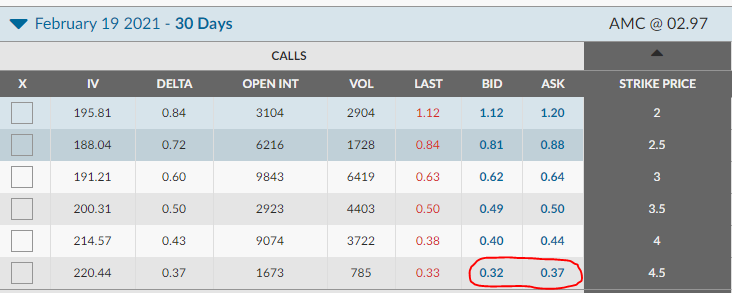
Looking at the image above, say I sell a 4.50 call for 35 dollars today. On 02/19, the stock price is only 3.50. That means the contract expires worthless and I keep all 35 dollars.
If the price of AMC is 5 dollars at expiration and I haven’t exited the short call, whoever owns the contract I sold can exercise the contract to buy my 100 shares for 450 dollars. That means my gains are capped. However, at any point before expiration I can buy to close the contract I wrote so I don’t risk losing my 100 shares.
What to consider before trying this strategy?
There are a couple things I consider before selling a covered call:
First, I sell at a strike price I would have sold the stock at anyways. Like in the example, if AMC is at or higher than 4.50 when my contract expires, I won’t be upset to lose my 100 shares since I decided I’d sell at that point before buying the AMC shares.
Second, I try to sell when when the Implied Volatility (IV) is high. It is imperative that you understand IV before trying any options strategy or you can more easily lose money. Implied volatility is essentially the market’s forecast of movement in a security’s price. Typically IV spikes higher when the stock is expected to make big moves or is currently making big moves. Notice the IV of 220.44 for the 4.50 Strike in the image above. That is a high IV and occurred in part because AMC went from 2.20 to over 3.30 in two days.
IV is important to understand because high IV can drive up an option’s price. It is not smart to buy an option when IV is high. If the stock’s price doesn’t move like expected, IV drops and the option price along with it. That is called IV Crush and happens all the time around earnings. It is common to see the options price and IV increase around earnings because the market is anticipating a big move. Even if the underlying stock moves up, IV can drop if the move wasn’t as big as expected. In turn the option’s price gets crushed, hence IV crush. You lose money even though the underlying price moved in the expected direction! Sell when IV is high; buy when IV is low.
The Poor-man’s Covered Call
This is another strategy to capture option premium. Just like the covered call, the Poor-man’s covered call involves selling a call for premium. Except in this set up, instead of owning 100 shares, use LEAPS. LEAPS stands for Long-term equity anticipation securities (LEAPS). They are options contracts with expiration dates that are longer than one year.
Why Use LEAPS Instead of 100 Shares?
If I want to make a long-term play on an expensive stock like Microsoft (MSFT), I need to pony up 22,434 dollars for 100 shares at its current price. I don’t have an extra 23 grand sitting around. By using LEAPS instead of shares, I have the leverage of controlling 100 shares without actually needing to buy 100 shares. Thus the name, the poor-man’s covered call.
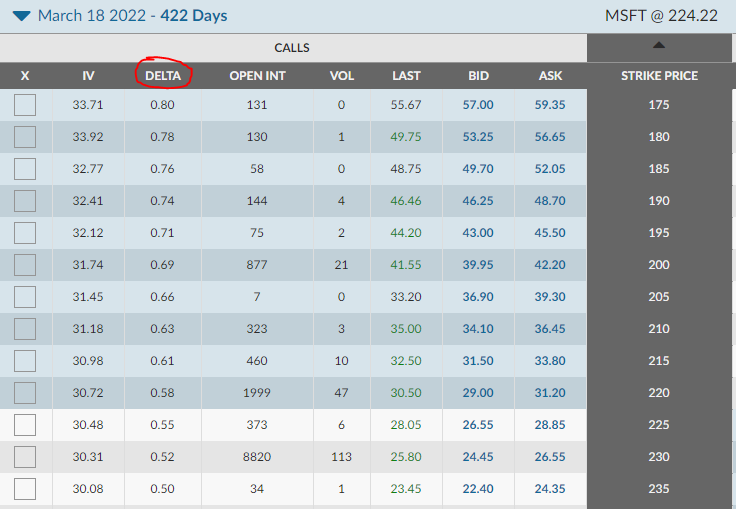
If I’m confident the MSFT share price isn’t going to fall dramatically and increase over time, I can pick up in-the-money LEAPS for 5500–6000 dollars, depending on the desired DELTA. That is a much cheaper price than the 23,000 I’d have to spend on 100 shares!
To complete the trade, Once I own the LEAPS, I sell a call expiring soon when the conditions are right like I would when selling a covered call. This essentially creates a call spread since I’m long a call and short a call at the same time. Ideally, the short call will expire worthless allowing me to capture all the premium paid for it.
What to consider before trying this strategy?
Before trying the poor-man’s covered call, you need to understand option delta (as well as everything else I’ve covered in this article). I typically buy LEAPS with a delta around 0.80. Delta is the ratio that compares the change in the price of an asset to the corresponding change in the price of its derivative. Delta is positive for calls and delta is negative for puts. For example, when an option has a delta of 0.80, the option price will change $0.80 x 100 for every dollar move in the underlying stock assuming all other things remain equal. By that logic, a share of stock has a delta of 1.0.
When an option is deep in the money, the delta is close to 1.0. As the option moves out of the money, the delta gets closer to 0. That means as the share price moves up, the LEAPS price will move up at a rate faster than the out-of-the-money call sold short. For example, if I buy MSFT leaps with a delta of 0.80 and sell a call expiring this week with a delta of 0.30, a dollar move in MSFT will increase my leap by 80 dollars and my short call by only 30 dollars.
Keep in mind delta will increase or decrease as the underlying stock price changes. If the price of MSFT tanks to 175 tomorrow, instead of a delta of 0.80, my LEAP will have a delta around 0.55.
The Put Credit Spread
The last strategy I want to discuss is the Put Credit Spread. This strategy is a bullish strategy that aims at capturing option’s premium on stocks you think will go up. Instead of buying a call and having time work against you, open a put credit spread and have time on your side.
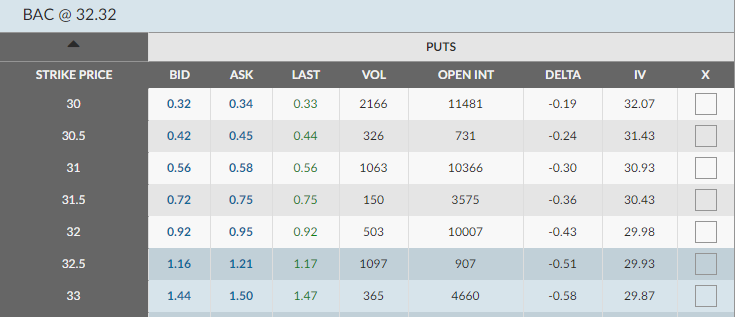
For example, I think BAC is going to 34 dollars a share. I could write (sell to open) a put at the 31 Strike and buy a put at the 30 Strike, taking in a 24 dollar credit (57–33 = 24) for opening the spread. Ideally, both will expire out of the money allowing me to keep the credit of 24 dollars.
What to consider before trying this strategy?
In addition to considering implied volatility, delta, and expiration date when opening put credit spreads, it is important to understand the risk of being short a put. When short a put, if the contract gets exercised, I need to pony up money for 100 shares of the stock. That means it is best to only open put credit spreads on stocks I actually want to own, just in case my contract gets exercised.
Also, I only ever sell strike prices I’d actually be fine with paying. Continuing the example, I open the 31/30 put credit spread on BAC and the price drops to 30.50 putting my 31 put in-the-money on the expiration date. If that contract gets exercised, I’m on the hook to buy 100 shares at 31 dollars a piece. Since I think that 31 dollars a share is a fair price, I want to own BAC, and I can afford 100 shares, I am comfortable taking the risk.
If the price drops far enough to put both the 31 and the 30 strike in the money, I can exercise my 30 dollar protective put to cap my loss on the trade. For example, say the BAC share price is at 28 when my spread expires in-the-money. I will buy 100 shares at 31 and sell them at 30.
Congratulations on learning three options strategies!
Final Thoughts
Remember it takes time to learn these strategies, just like it takes time to build wealth. Although options can be risky, understanding how to use them can increase your consistency of profits in the stock market. Hopefully this article can serve as a jump-off point to get you started studying options. Whether you want to try a covered call, a poor-man’s covered call, or a put credit spread, make sure you’re following your trading plan and making moves consistent with your risk tolerance. Join me in spending 2021 focusing on getting better at them!
Start studying options trading on investopedia today!
Disclaimer: All examples used in this article are not trading recommendations are strictly educational. Use financial markets at your own risk. If you need finical advice, seek a certified professional. Trading is simply a hobby for me, not my profession.
Thank You!
- If you enjoyed my work, follow me on Medium for more!
- Get FULL ACCESS and help support my content by subscribing!
- Let’s connect on LinkedIn
- Analyze Data using Python? Check out my website!