
Finding your writing voice by studying your favorite books
June 2017
“What if suddenly the economic system would be overthrown?” My dad asked me. I told him to be quiet as I wrote down the plot of what would become the plot for two consecutive stories (thanks dad).
In June I travelled to Japan for the first time. The trip was great as you can imagine, great food, beautiful history, temples, castles and nature. But also crazy, hectic and weird (I am of course talking about Tokyo). A great mix I must say. In Japan I finished writing my second story, The Sapien Zoo.
Back home I started to map out a story in which a hacker shuts down the current economic system, and introduces basic income — but with some twists. While I was mapping out my ideas for the story, I had more ideas for this story and its characters. Eventually, I had so many storylines, plot twists and scenes, that I decided to make them into two stories. The second would have its own theme, but would be a logical follow up to the storylines from part one. Story one would ultimately become The System Shutdown.
In this post I want to share some tips and resources for starting your stories, especially when you don’t have a degree in English or Literature (like me). Heck, English is not even my first language! But somehow I find it easier to write in English. Above all, I love the language, the sound and the expressions. Especially when I hear a female British accent.
Read good books
This is probably the most important piece of advice I ever encountered. Plus, I heard or read it on multiple occasions. Study the greats, the classics and the revered authors, but do so wisely. Don’t read Anna Karenina because of the fact that it’s a classic, read it because you like the story. There are hundreds of good classic books out there, but not all will be your cup of tea. Personally I loved The Three Musketeers, The Picture of Dorian Gray, Jane Eyre, and Pride and Prejudice, to name a few.
If you only take away one thing from this post as a (aspiring) writer, take this:
- Study one classic from before 1900
- One classic from the last century
- And one from the last decade or so
What makes these books such classics? Is it because of their themes, their tone, the characters, style, morals, wit, …? How come they have stood the test of time? Can you find patterns between those three books?
For example, if I had to pick now (because, let’s face it, favorites change often):
- 1 from before 1900: The Picture of Dorian Gray — Oscar Wilde
- One classic from the last century: I can’t choose, so: The Fountainhead — Ayn Rand & The Lord of the Rings — J.R.R. Tolkien
- And one from the last decade or so: Shantaram — Gregory David Roberts, tied with the Harry Potter Series — J.K. Rowling.
(I am very good at following my own advice…).
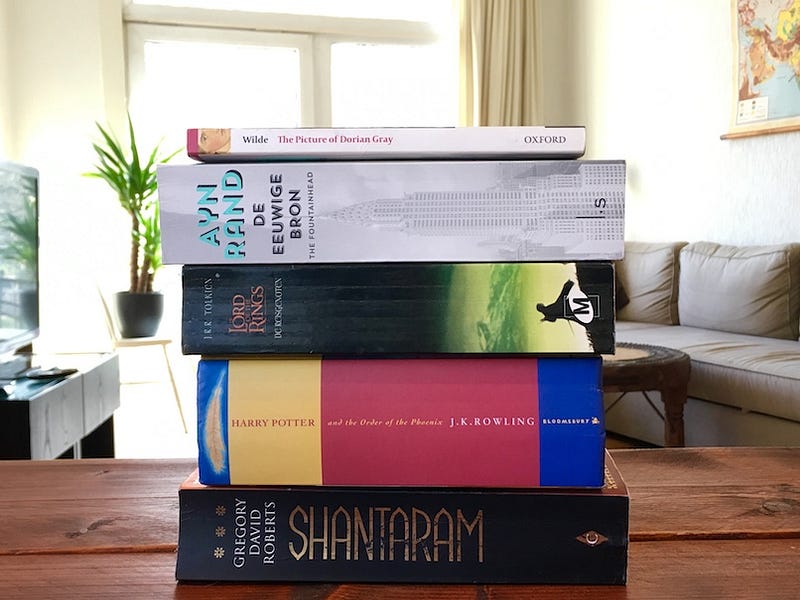
What do they have in common? Well, these books are still being read and loved all over the world. They have very distinct and recognizable characters. Once you’ve read the books, you can describe these characters like you would describe your friends. The themes are different here. You have the Hero’s Journey* in LOTR and HP. Dorian and the Fountainhead are mainly character centric and hold up mirrors to us as a reader. Plus, almost every sentence in Dorian is a beautiful quote (how did Wilde do it?!). All are philosophical, in their own way. And for me, Shantaram just comes from the pages, transporting me to the streets in Mumbai (even when I have never been). Also, that one is filled with unforgettable characters.
Find patterns, find what you like in these stories and learn from them. Consciously or unconsciously, you will take what you have learned from these stories and put it into your own work.
“A hero ventures forth from the world of common day into a region of supernatural wonder: fabulous forces are there encountered and a decisive victory is won: the hero comes back from this mysterious adventure with the power to bestow boons on his fellow man.” — Joseph Campbell.
Study texts of authors you admire
I haven’t studied English or literature and English is my second language. Granted, in High School I participated in an advanced English class for three years and I’ve lived in the UK for a while. This helped immensely. When English is your second language, begin with what you know. Don’t start writing above your level. It wouldn’t make sense. You must however, study the texts of great authors. Preferably authors and stories you love and admire. Study the different past tenses in English. How do these authors use them? Pick up on your grammar. Look at how these authors construct their dialogue. (Note: this is usually in the present tense). What words do they use to express how people interact with each other? Notice that the way people talk in dialogue usually differs for every character has his or her own character traits and way of expressing themselves.
Study and write down words you’re not familiar with. LOOK THEM UP! What expressions are used? Never directly translate expressions from your home country. It will be a mess. In Dutch we have a saying for when the truth — finally — comes out. Translated it goes like this: now comes the monkey out of the sleeve. I think I’ve made my point here.
In the works of your favorite authors, notice how they describe people and places. How do they set up a scene? Identify how authors play around with plot twists and suspense. How do they make sure that you HAVE to continue reading?
In my opinion, the greatest writing school is reading work you admire and study the texts carefully. Oh and one more thing, don’t aim to be the next Oscar Wilde, be realistic.
—
*The Hero’s Journey. You have probably heard of this or read about it. Almost every story out there is narrated according to this concept identified by Joseph Campbell. Here’s a summary written for movies, but it explains the concept well. Also I recommend the book by Joseph Campbell himself.
Originally published at www.turnerstories.com.
Prefer to listen to short fiction stories while you’re commuting, walking, running or cooking? Listen to the Turner Stories Podcast.

This story is published in The Startup, Medium’s largest entrepreneurship publication followed by 308,692+ people.
Subscribe to receive our top stories here.
