
Beautiful and Less Attractive Hindu Wedding Traditions
When it comes to weddings, Indians are not checking their wallet.
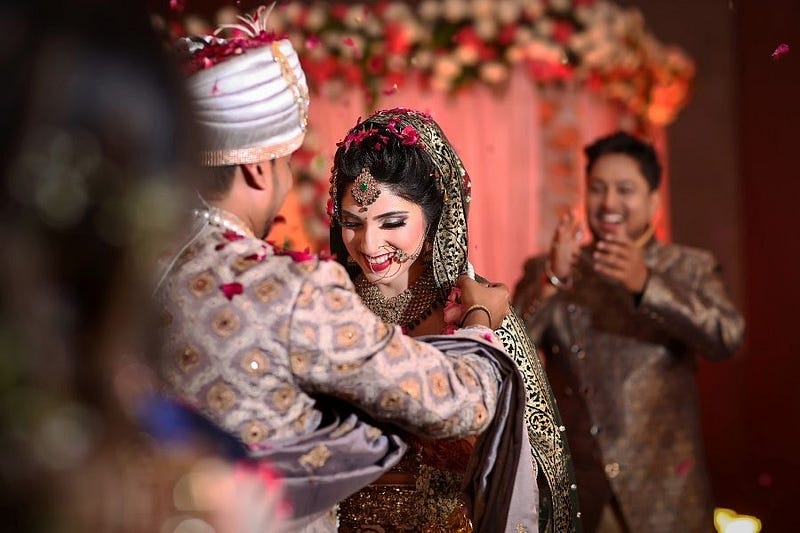
The Hindu wedding ceremony is the most beautiful in the world. Hundreds or even thousands of guests get an invitation. Relatives come from far away, and many fly back home from abroad. Even penniless families lavish on the ceremony and hospitality for which they often keep on saving for their entire lives.
So it comes as no surprise that the largest wedding ever was held in India with a crowd of 150.000 people. The chief minister of Tamil Nadu spent 23,000 USD on his son’s wedding ceremony, 466.000$ for the venue, and 621,000$ for dinner.
One of the wealthiest Indians, Lakshmi Mittal, financed the second most expensive wedding in the world. The wedding cost 60 million$. They sent the invitations in a silver box containing airline tickets and a 5-star hotel reservation in Paris.
The engagement took place in the Versailles Palace, while the wedding reception at a 17th-century castle. The highlight was Kylie Minogue singing at the Eiffel Tower.
Wedding Traditions — Who Bears the Costs?
According to Indian tradition, the parents of the bride have to cover all the wedding costs. This custom is still much respected in the countryside. But the expenses equal to their multi-year income, and the girl’s family often gets indebted for a lifetime. This is why it is less desirable to have a daughter. Nobody spares money for a wedding because they do not want to feel ashamed of not spending enough. During these few days, they spend tens of thousands of dollars. Nowadays, if the bride’s family cannot bear the cost, the groom’s family will overtake all or part of the costs.
The relatives occupy a whole hotel or guesthouse for the time of the wedding.
Indians strongly believe in astrology. The astrologer decides on the wedding date based on the birth horoscopes of the couple and the stars’ position. So either there are many weddings at a given time or none.
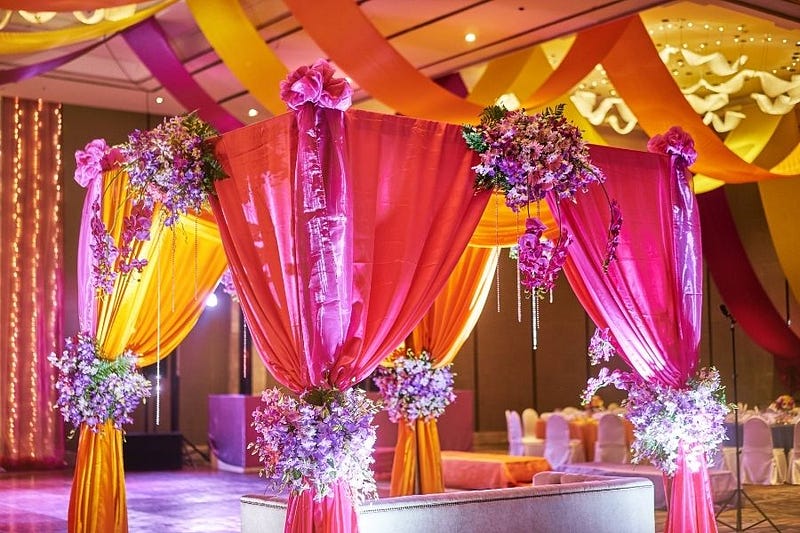
The wedding usually takes place at home or in a private garden that specializes in such events. Here they set up the wedding canopy and decorate the courtyard with colors and lights. Passers-by notice already from a distance that a wedding is about to take place. At the top weddings, thousands gather under the tent that is so big that it could even cover a city district.
The Indian Wedding Dress
Brides always wear the traditional sari. For sure, it is much more ornate than the everyday sari. A professional will tie the sari as it should look perfect on the big day.
Banaras is famous for the bridal brocade embroidered with gemstones. The wedding sari is usually red, dark green, or yellow., but red is the luckiest color. In northeastern India, brides wear white saris with a red pattern. A wedding dress can cost as much as 1,000$. In Rajasthan and Gujarat, they wear a blouse and embroidered skirts decorated with tiny mirrors.
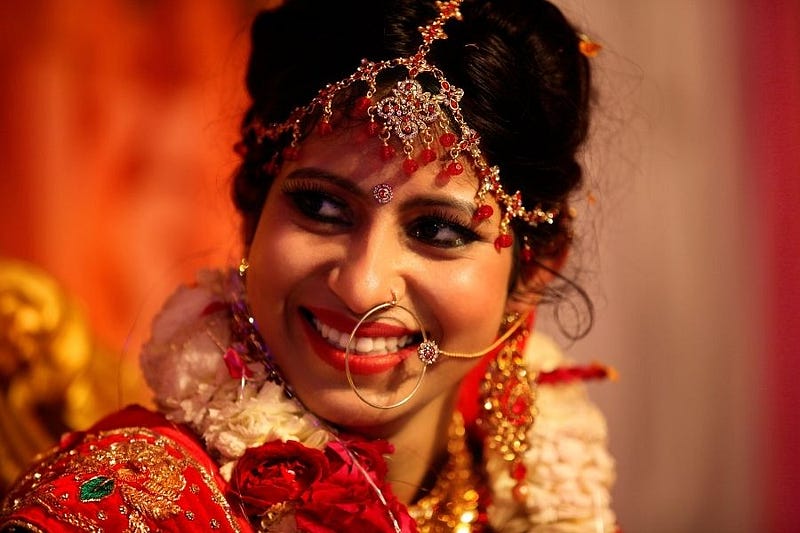
The bride often wears an ornate shawl and a tikka (jewelry hanging on her forehead), necklaces, bracelets, nose rings, and possibly ankle chains. Brides usually receive jewelry and gold from their mother as a dowry. A girl from a wealthy family has a ring on every finger, a dozen gold bracelets around her arm, nose rings, earrings, necklaces, belts, anklets, and tiaras. Sometimes they even coat the bride’s forehead and face with gold powder as a sign of wealth.
The groom usually wears a long silk coat with tight silk pants and a fancy turban. But nowadays, grooms also appear in western-style suits on the big day.
The groom and the bride also often wear a garland of flowers around their necks and a giant necklace of Indian currency, rupees in the hope of later great wealth.
The Preparations for the Ceremony
The bride and groom get prepared the night before. In the presence of the brahmin (priest), the bride is perfumed and dressed up nicely. Her arm is painted till the elbow with red henna while the friends are singing traditional songs. They take great care of the perfect makeup and jewelry.
The maternal uncle and female relatives surround the bride, and the brahmin is singing while the guests throw rice on the couple.
Hindu Wedding March
The groom approaches the bride’s house on the back of a white horse or if he is wealthy on the back of an elephant. Servants carry the neon tubes of the generator to provide ornamental lighting.
A team of drummers and trumpeters accompany the groom to create a wedding atmosphere. Half of the musical selection consists of well-known Bollywood songs. The wedding ceremony begins at 11 in the evening.
Hindu Wedding Ceremony
Under the ceremonial canopy decorated with saffron flowers, they present the bride to the guests. The ceremony takes place before a holy fire lit in a metal pot. Fire is the symbol of purification, and Agni, the god of fire. They feed the fire with sandalwood or mango leaves.
The brahmin reads Sanskrit sacred texts while the couple places rice and butter as offering on the fire. The bride takes Curcuma on her hands, the groom recites lines from the Vedas, the first written books in India, and swears to his father-in-law that he keeps the three promises of marriage: Dharma (law of good life), artha (profession, beneficial activity), kama (law of love).
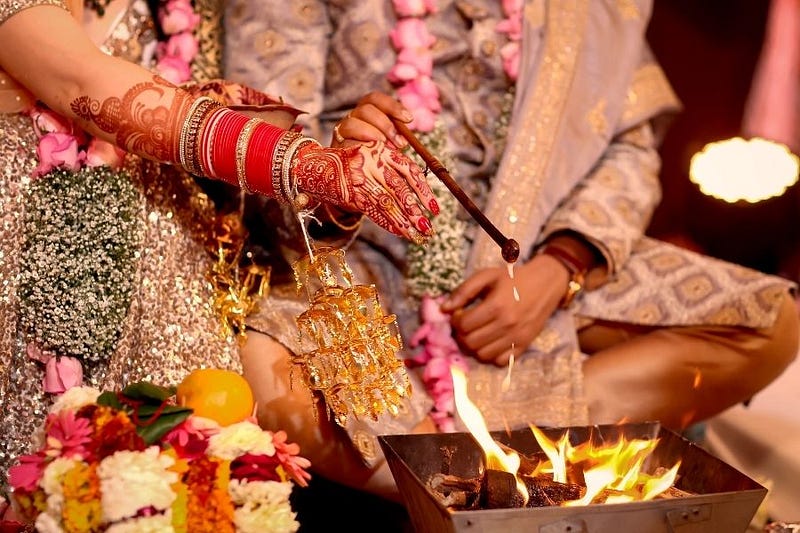
The centerpiece of a Hindu wedding is the “sapta-pad.” The brahmin (priest) knots the couple’s clothes. They take seven steps around the sacred fire while holding hands. Then they put a string of flowers in the other’s neck and mark the forehead with sandal paste. It is like the exchange of rings for Christians.
The seven steps symbolize the everlasting journey and friendship ahead of them. From this point, the formal oath taken before the god of fire makes the marriage irrevocable. Sometimes they tie their right hands or the bride’s sari to the groom’s dress and cover the bride’s face. During the seven rounds, they pledge:
- earn enough to look after their family, - live a healthy life, - care about the well-being of their spouse, - live together as friends and make each other happy, - eat and drink together and spend special occasions together, - will have children, love them and take care of them, - adapt to each other anytime, anywhere.
As the last thing, the groom marks the hair of the bride with a line of red color, “sindoor.” It indicates that she is a married woman. Finally, the guests throw flowers on the young couple.
During the wedding, the newlyweds sit on a podium like a royal couple and accept the congratulations. In India, the guests are really having fun, while the newlyweds only occasionally go on the dance floor. The couple usually does not look extremely happy. Just think about that they barely know each other. Up to now, 90% of marriages are arranged by parents. The guests wear beautiful Indian-style evening dresses and saris.
A multi-day wedding is a perfect opportunity at the same time for other parents to start searching for partners for their daughters and sons.
In the end, the bride leaves for the groom’s family home, which is one of her most memorable moments.
The Tradition of Demanding Dowry in India
According to Indian traditions, the girl’s family hands over the dowry to the groom’s family before the wedding. For Indian families, this is an extreme financial burden and has often made the family completely indebted.
Understandably, the birth of a girl was considered a disadvantage, and many chose abortion when it turned out that a girl was on the way. It also shows in the gender proportion in the Indian population, as the latest census of 2011 displays a ratio of 943 women per 1000 men. For this reason, gynecologists cannot disclose the sex of the future child. Despite being considered a crime to demand dowry, it still happens indirectly in many cases.
Mahatma Gandhi, the “Father of the Nation,” a leader of Indian independence, already wanted to ban the practice of dowry by the constitution in 1947.
Since 1961 the demand for dowry has been legally prohibited, and it qualifies as a crime.
But at some places, especially in the countryside, ancient customs do not change quickly. In cities, families are more flexible when it comes to weddings. If the girl’s family can afford it, then they give. If not, the families will share the costs, or even the groom can fully take over.
The girls in India usually did not inherit anything from their parents. What she received at the wedding as dowry was all that was meant for her. It is changing too. Brothers and sisters sometimes share the heritage, but the more significant part still goes to the brother.

Rich or poor, arranged or a love marriage, it does not matter. Dowries still occur all over India. Even among the untouchables who live on the periphery of society.
According to statistics, 28% of India’s population lives below the poverty line and two-thirds barely above it. Dowry is a huge burden for most families. Many people spend most of their savings on dowry and weddings, borrow money for this one event that they cannot afford, and then spend the rest of their lives paying off their loans.
When the Bride’s Family Could Not Provide the Dowry
The demand for a dowry continued many times after the wedding, and if the bride’s family could not fulfill it, it was a great shame for the family. The groom interrupted the wedding or threatened to divorce right after. Sometimes he poured kerosene or acid on the bride to destroy her beauty for a lifetime.
A young divorced woman is heavily stigmatized, and her family is deeply ashamed, especially in rural areas where traditions are even more deep-rooted. As a result, many women have been the victims of marital violence or psychological terror. The fear of indebtedness caused to their family has pushed many girls to commit suicide. Every year, 7–8,000 die in disputes over dowry.
It also happened that the man killed his wife, then remarried and collected a second dowry. Because of the high level of corruption in India, the groom can often escape justice.
The Law on Dowry has been amended twice. In 1983 they added that the mother-in-law could face arrest if she is harassing or abusing the bride for the dowry. In 1986 pushing the bride to commit suicide by demanding a dowry was declared a crime. It was an enormous step in improving the situation of women.
The laws already exist, but many people ignore them. The problem is that most women find it difficult to prove that they have been abused, which means that they cannot count on psychological help or the help of the police. It only becomes news when the crime already occurred.
Wealthy Families Also Stick to the Dowry Traditions
But they ask it indirectly. For example, the bride’s family needs to pay the rent or the child’s tuition. In cities, the dowry shows the social status of the bride’s family. It influences how the future family would treat the girl. The large dowry is a status symbol.
A wealthy family overwhelms the bride with gold, wedding necklaces, bracelets, nose rings, belts, anklets, headdresses. The amount of jewelry reflects her value. It is also a kind of guarantee for the bride if the groom dies or makes her leave the house. Today, the bride’s family usually gives everything to their daughter as a gift, not to the groom, as police are increasingly monitoring it.
The dowry can amount to $100 or even $ 20,000, a new home, a car, gold, furniture, dinner sets, or a combination of these. If there is any doubt about the bride’s virginity, they may demand more.
If the groom comes from a good family and has a well-paying job, it is a kind of investment in a prosperous future. If the bride has some illness, bodily disorder, this is a form of compensation for marrying her.
The system will not change as long as there are families who demand dowry. If love marriage becomes more common, it will probably set back this practice.
But traditions are generally enrooted in society, especially in the countryside, and it is not expected to change any time soon. At the same time, Indian weddings are one of the most spectacular in the world, an integral part of the local culture.
Thank you for reading.
You can share your outstanding stories and inspire others. Just click the below image and be a writer for The Masterpiece.
