
Part 2: The Bargain Bin Feeding Frenzy Continues
Beatlesque Bargains Bring Fluctuating Fortunes.
The end of the Beatles was just the beginning.
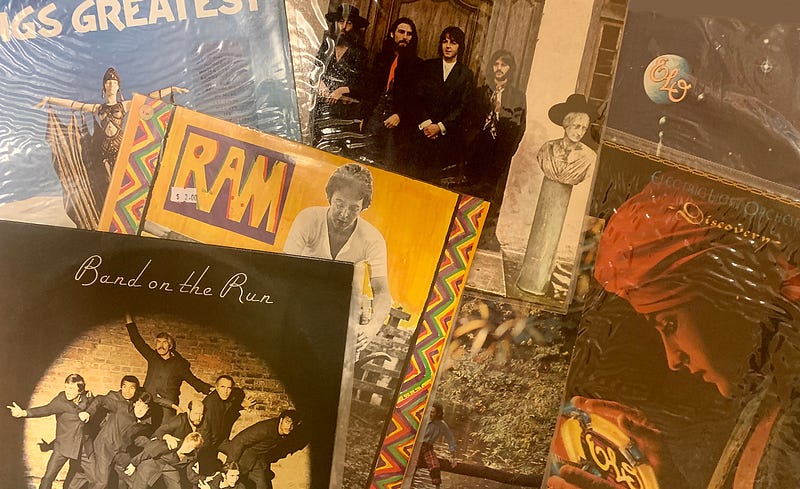
I arrived too late to the Bargain Bin Feeding Frenzy to pick up any of the Beatles albums proper, but there was more than a fair share of Beatles-adjacent music.
And one actual Beatles album.
Hey Jude — The Beatles
Compiling together a bunch of Beatles singles that never made it onto their album releases, Hey Jude has a certain logic but is strangely incoherent. From Can’t Buy Me Love to The Ballad of John and Yoko in the space of five years is truly an extraordinary journey, yet the tracks sit together as well as any random playlist.
Still, having a copy of lesser-known tracks like Rain and Old Brown Shoe on vinyl is nice.
I expect the cover photo came from the same session that gave us this unusual film clip:
Bargain-o-meter: 3 out of 7.
Wildlife — Wings
I’ve recently seen many opinions that much of Paul McCartney’s early post-Beatles work is sorely underrated.
With this in mind, I was excited to give Wildlife a spin for the first time.
Side one doesn’t get off to a good start. Mumbo, while channeling a solid Little Richard vibe, is kind of silly, as is Bip Bop. A completely unnecessary Caribbean-tinged version of Love is Strange is worse. Side one finishes off with Wildlife, the title track, and it’s a marked improvement. A McCartney take on I Want You. It feels the most Beatlesque while also highlighting what the collective lost when they all went solo.
Side Two does a little better. Some People Never Know and I Am Your Singer are both good, the latter featuring some sweet backing vocals from Linda.
Tomorrow is better, a classic McCartney hook-laden pop affair, perhaps looking for the flipside of Yesterday.
Dear Friends is also solid, and in an alternate universe, I imagine this as sounding like ELO, though that’s not how it works, I’m sure.
While I’ve heard Wildlife criticised for being too laid back, I think it suffers more from some fairly average songs. McCartney can be just as effective on a sparse track like Dear Friends.
Something better for the first three songs on side one, ideally with something a little more single-worthy, and Wildlife would be better remembered.
Bargain-o-meter: 2 out of 7.
Ram — Paul McCartney and Linda McCartney
Released in the same year as Wildlife, there are certain similarities between the two, yet by every measure, Ram is the superior album.
The songwriting is more inventive, with Paul delving deeper into his Bag of Hooks. The production is more imaginative, achieving textures and tones that sometimes sound like proto-Radiohead.
Furthermore, Ram managed a hit in the form of Uncle Albert/Admiral Halsey (“Hands across the water”)
Of the albums I wasn’t familiar with before this purchase, I expect this is the one that will get the most repeat listens.
Bargain-o-meter: 7 out of 7.
Band on the Run — Wings
The best Wings album by a fairly long margin; it’s certainly a favourite.
It does, however, have a slight taint after reading Tony Visconti’s autobiography. Paul, ever the megalomaniac, failed to give Tony his due credit for the arrangements on the album, something that wasn’t corrected until decades later.
Classic classic rock; hard, soft, fast, slow, serious, and funny. Paul hadn’t quite succumbed to the self-consciousness requiring him to write Silly Love Songs. What’s missing is Paul’s penchant for all things “clever,” which frankly is a relief.
Bargain-o-meter: 5 out of 7.
Wings Greatest Hits — Wings
More so than any of the solo Beatles, Paul McCartney and Wings managed a very solid swag of hits.
As much as the cloying Silly Love Songs and Mull of Kintyre warn out their welcome, his Bond Theme Live, Let Die, and Jet both still sound rocking.
Throw in Band on the Run, Junior’s Farm, and Uncle Albert/Admiral Halsey, and it all makes for a decent best-of collection.
Still, I think Maybe I’m Amazed would have been a better choice than some of the tracks.
Bargain-o-meter: 1 out of 7.
If there is one band and one person more than any other that picked up the Beatles torch and ran with it, it is ELO and Jeff Lynne. These two albums come at the tail end of ELO’s hit-packed run through the seventies.
Discovery — Electric Light Orchestra
Showcasing the massive hit Don’t Bring Me Down (that’s grooss, not Bruce), it’s their last album of the seventies and, in many ways, the last canonical ELO album. The cover features the ELO “object” and as such, draws a line under their classic hit-making era.
After El Dorado, ELO had settled on an album formula that played out across their next four albums, concluding with Discovery.
It’s easy to argue not much progress was made during this period, yet it’s a winning formula that was a suitable canvas for Jeff Lynne’s many talents.
In many ways, the albums are interchangeable, and Discovery suffers for being the last. Shine A Little Love, Confusion, Horace Wimp, Last Train to London, and Don’t Bring Me Down are as strong as anything on the other albums.
As a whole, not quite as incandescent as New World Record, yet less bloated than Out of the Blue. Worth the price of admission for any ELO fan.
Bargain-o-meter: 6 out of 7.
Time — Electric Light Orchestra
While separated from Discovery by Xanadu, which isn’t really a pure ELO album, there is an unerring sense that ELO is ending.
At least the hits, anyway.
Time is a concept album, and the one hit, Hold On Tight, doesn’t quite fit in and feels like it has more in common with Rocky Burnette’s Tired of Toein’ the Line and Bob Seger’s Old Time Rock and Roll. Erzatz nostalgia is at odds with an emerging new wave.
I didn’t notice it then, but many signs are on offer. Firstly, the picture on the inner sleeve shows the band reduced to a four-piece (although Discovery was the same).
The real game changer is the extent to which synths have replaced the strings. While these textures are quite promising on some levels, the songs fail to elevate the project above the merely pleasant. It seems inevitable that concept albums end up with tracks that only make it onto the album because of the concept, songs that don’t really stand on their own. Time is no exception.
As with many creative pursuits, your biggest weakness can become your biggest strength and vice versa. While Jeff Lynne’s ability to extend the musical vocabulary of the Beatles into some of the biggest hits of the 70s was his main strength, as tastes changed and Lynne had stretched the concept beyond its breaking point, his chart fortunes began to decline.
This is the second part of the Bargain Big Feeding Frenzy. You can read the first here:
For more of my thoughts on the Beatles, you may enjoy this.