
Why the World Can Be so Much Better - Part Two
I ended Part One of this article a few days ago with the following question:
So, for me, the fundamental question is how to make beneficial social and organizational emergence and synergy happen more often than the supervening forces that push us backward.
As noted in Part One, Supervenience sucks. And when the threats, black swans, and swans of many different colors fly over your house and make your world suck, you need an effective, often life-saving response.
Historically, the bad things that happened to human beings were largely a result of unexpected natural hazards- volcanoes, earthquakes, large predators, one in thousand-year storms or droughts, ice ages, and unfriendly tribes who wanted your land. The thing is, today, we are our own worst enemy. We’ve created the six horsemen of the apocalypse, from covid-19 to economic crises, resource crises, the climate crisis, and the biodiversity crisis- not to mention the human extinction crisis that will be coming to a place near you soon if we do not address those first five crises effectively.
Basically, we have to get ahead of these crises and threats to our survival if we are to make it through this perilous time. How?
Hope for the Best, Plan for the Worst, Pre-Adapt
I know this is something of a cliche, but it has stood the test of time for one simple reason- it’s spot on. Humanity has spent most of its history teaching its youth to “Be Prepared”. Prepared for all those natural and sometimes human hazards and threats mentioned above. But even in our wildest dreams/ nightmares, we have failed to be prepared for the six interconnected, accelerating crises that might mean human extinction, those six horsemen of the apocalypse.
Why? Because they have only come into public awareness in the past half a century, which is an incredibly short time in the 100 000 year history of homo sapiens. It is only now we are personally beginning to see and experience the effects of these six crises in our own lives, and most people who know what is really going on are scared/fearful/astonished/shocked. This should not be happening, we cry, as we attempt to stay cool/dry/alive in the historically worst global heatwaves, droughts and floods hitting our planet in 2022. But it is, and will only get worse according to even the most conservative scientific predictions, especially if we do little or nothing and continue business as usual.
As we saw in Part One, two of the three coping mechanisms we humans use to face unpleasant news simply exacerbate the problem through either excessive negativity or over-positivity, while the third coping mechanism demands that if we want more people to dedicate their energy and money to make the world a better place, then we should make it much more widely known that it is possible to make the world a better place. How?
Set a Good Example
For all you parents out there, you’ll know that children learn best from example. You, their friends, teachers, role models, and so on. What does it mean to set a good example in these challenging times?
We started the Thriveability Foundation with a simple slogan: “Thriveability begins with you and me”. The old adage: “Reduce, Reuse, Recycle, Upcycle” is a good starting point and a good place to begin setting a good example. But we need to go much further, beyond plant-rich diets, permaculture, homegrown and local food, ecovillages, and other popular ways to save ourselves and our biosphere. We need to change the system that allocates 95% of the resources on our planet, more of which later in this article.
Here’s what NOT to do- A study of 20 famous billionaires revealed that their average footprint came in at a whopping 8,190 tons per year, mostly because of their yachts and private planes. Compare that to the average American who emits 14.4 tons and the average world citizen who emits 4.2 tons.
According to a 2020 study from the University of Leeds, the wealthiest 10% of the 86 countries they studied consume, on average, 20 times more energy than the bottom tenth. This gap mostly comes from transportation, where the wealthy consume 187 times more fuel than the poor. This is because people with lower incomes rarely fly or drive a car. The researchers found that the richer you are, the more energy you consume, and this was true across all countries studied.
A 2020 study by the United Nations Environment Program (UNEP) said that just 10% of the world’s population emits close to half of the world’s greenhouse gases, while the top 1% account (those earning more than $172,000 per year) for 15% of emissions, more than twice the bottom 50%. That means that the top 70 million people emit more than the bottom 3.5 billion. The study concludes that if we are to stave off climate change, the top 1% need to cut their emissions by 97%.
Canada has also recently voted on a luxury tax that is coming into effect on September 1, 2022. The new levy targets vehicles and aircraft priced above CA$100,000 ($77,700) and certain boats above CA$250,000 ($194,250). It will be calculated at 10% of the full retail value of the vehicle, aircraft, or vessel, or 20% of the value above the threshold.
The wealthy already lead such privileged lives. Do we want to allow billionaire brats to continue to get away with killing our planet so that they can shave a few minutes off their travel time?
Put Your Own Oxygen Mask on First
Anyone familiar with flying in a passenger plane knows that every pre-flight safety briefing includes the following advice: “In the event of sudden cabin depressurization, you are advised to put your own oxygen mask on before attempting to help others.” Why? It seems fairly obvious- without oxygen, you will soon be rendered unconscious, then dead, long before you can help anyone else.
What does this mean in the context of the deadly threats we face right now globally? To use another cliche, you have to be part of the solution and not part of the problem, starting with yourself. Let’s assume you’ve made some lifestyle changes and are setting a better example for your family, friends, colleagues and the world at large. In my own experience, this feels good too, so your sense of guilt of being complicit in ecocide is dramatically reduced. Now what?
You’ll also do yourself and the world a favor by not allowing yourself and those you care about to become a victim of supervenience. The risks and threats are now all in plain sight, the maps and models of impacts well known, to enable you to avoid being a victim of heatwaves, droughts, ferocious storms, wildfires, and rising sea levels, economic crashes, and food and water shortages. Different maps and models show the negative regional impacts in great detail- simply type: “climate change impact maps” into a search engine.
Here is an example of the extensive information available on how to avoid becoming a victim, offering advice on relocating to places that are more conducive to surviving the inevitable consequences of climate change.
Become an Anti-Fragile Consumer and Citizen
We need to change the system that allocates 95% of the resources on our planet, called “mono-capitalism” where only money matters. This is the first lesson we teach in the Global Change Agent program, the first of seven acupuncture points we need to activate to heal ourselves and heal our planet.
Please excuse me for getting a little technical in this section, but it is important to distinguish between the many words and concepts thrown around in the name of “sustainability” “regeneration” and “agile”.
The deep sh*t we’re currently in as a species and a biosphere demands we become ultra-precise in the way we frame our current situation and the various systemic “solutions” that are sprayed around the internet on a daily basis, starting with “ESG” (an investment evaluation term used mainly for greenwashing by mega-corporations and banks standing for “Environment, Society, Governance”), through “This is the end of civilization as we know it” and ending with “There’s gonna be a revolution (somewhere/somehow)”.
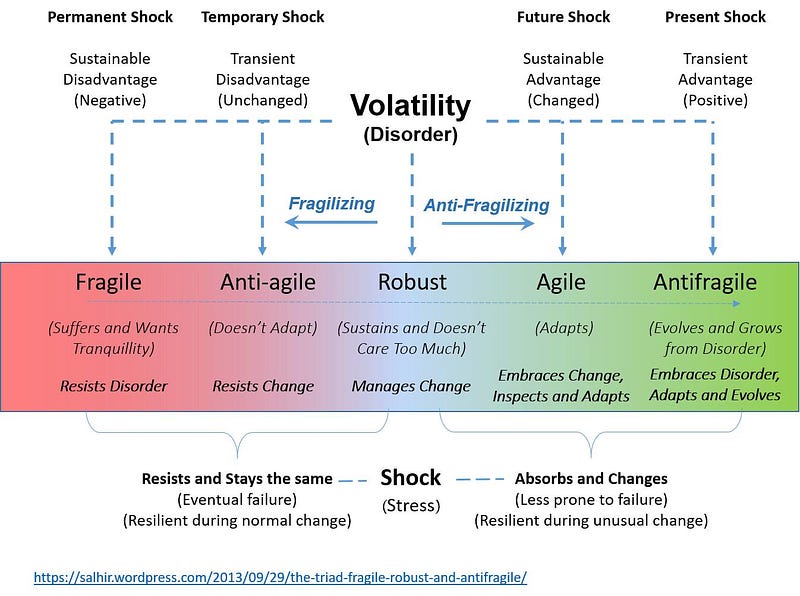
Antifragility is a property of systems in which they increase in capability to thrive as a result of stressors, shocks, volatility, noise, mistakes, faults, attacks, or failures. Antifragility is beyond resilience or robustness. The resilient/robust resists shocks and stays the same; the antifragile gets better.
An adaptive system is one that changes its behavior based on information available at the time of utilization (as opposed to having the behavior defined during system design).
While adaptive systems allow for robustness under a variety of scenarios (often unknown during system design), they are not necessarily antifragile. In other words, the difference between adaptive and antifragile is the difference between a system that is robust under volatile environments/conditions and one that is robust in a previously unknown environment- which is exactly where you and I are today. We are literally living in a time where it is difficult if not impossible to know whether and when we’re all toast, or whether we can somehow make it through this harrowing time, and how.
So, to put the challenge simply: how can you and I learn to embrace disorder, adapt and evolve so as to be thriveable, in other words, to become anti-fragile?
In the Global Change Agent program (see the free mini-course for starters), we answer this question through 12 modules including practical sessions that help you become anti-fragile.
Schools, universities, games, and sports have long been used to create environments in which life lessons can be learned through interaction in social and natural settings. In the 21st century, the range of options to generate habitats for the evolution of human potential and anti-fragility has expanded dramatically.
Institutions from the military, and sporting organizations to commercial and for-impact organizations have also specialized in developing the skills and competencies they need to fulfill their missions by giving new joiners opportunities to prove themselves, from executive development and management trainee roles to internships and aid projects in developing countries.
The key to the effective use of developmental environments is to match them with the specific level of development and skill/competency sets that need to be developed. Although this matching occurs more or less naturally in educational and new joiner settings, things get more complicated as adult development unfolds, and the slings and arrows of outrageous fortune inflict damage on adults in their lives and careers. It pays to learn to become anti-fragile to reverse this damage, and the earlier in life such lessons can be learned, the better.
Learning to face everything and avoid nothing while enhancing one’s ability to thrive requires an integrated skill-set that can be learned at any age.
Focus on “Ground Truth”, Not Weaponized Media serving Game A Elites
Ground truth is information that is known to be real or true, provided by direct observation and measurement (i.e. empirical evidence) as opposed to information provided by inference. We used to rely on ethical journalism to bring us the ground truth about the world every day. Now there are four public relations people pushing stories for every principled journalist, and guess who is winning the war on truth?
Today we can find ground truth through direct observation, networks of well-informed peers, ethical AI, and machine learning. There are many ways to distinguish between spam and fake news BS, and what is actually happening. The old adage: “Lies, damned lies, and statistics” applies even more forcefully today than ever to our socially mediated information streams.
Beware of Thinktanks — non-governmental organizations that research policies with the aim of shaping government. One out of three so-called “think-tanks” push libertarian, climate change denying, and ultra-conservative policy proposals to Republican and Conservative governments in both the USA and the UK. This leads to the phenomenon of “predatory delay”, buying time for the fossil fuel, chemical, and polluting industries in general, enabling them to earn obscene profits while destroying our biosphere.
Libertarian thinktanks in the US, such as the Heritage Foundation and the American Enterprise Institute (AEI) have had close relationships with incoming Republican administrations for decades, furnishing them with staff and readymade policies. Conservative thinktanks have long been influential in British politics, too, but the sheer number of connections between Boris Johnson’s cabinet and ultra-free market thinktanks was something new.
In the past fifty years, the much talked about “level playing fields” for business, citizens, and those without a voice, including nature, have been dramatically skewed toward greedy elites at a very high environmental and social cost- perhaps even the end of human civilization and half of life on earth as we know it.
We need antifragile citizens able to not only see these dynamics in action but also counter them with wiser choices as voters, consumers, leaders, and workers. One of the most pernicious false narratives put out by right-wing “think-tanks” representing the “elites” is “trickle-down theory”, which states that lowering taxes on the wealthy lets them invest more and thereby create more jobs- when the opposite is actually true.
Greedy elites own over half of the media in the world- and in some countries every single media outlet (while banning all others). Some of us still apply outdated “common sense” where our understanding of the complexity and uncertainty in our world is reduced to an oversimplified statement of cause and effect in a merely complicated world of discrete events. Seeing the world in “black and white” makes it very difficult to cut through the false narratives being pushed by weaponized media in every country around the world.
In order to deconstruct the weaponized messages being put out by a weaponized media, we must do what Peter Drucker, the pre-eminent management guru of the 20th century suggested- get in our strategic psychological helicopter to hover above the problem and see all of its pieces in their entirety as an interacting system so that we can apply the next common sense to understand cause and effect in a world of complex interweavings.
To quote: “Becoming a learning leader is about developing the creativity, skill, and courage to get into our strategic psychological helicopter, transcend the current perception of the problem and then throw new light and perspective on the problem; to … change the mindset, the paradigms of those responsible for solving it”.
The ability to see and act from ground truth requires critical, systemic, and integrative thinking skills which can be developed at any age when the stakes get high enough- and the stakes for humanity and 90% of life on earth have never been higher.
Creative Imaginations as an Antidote to Dirty Growth
“Cognitive” has two equally significant meanings: “to know” and “to beget”. Taken together these two meanings suggest that all birth is an awakening to knowledge. To know and to generate are inseparable. But knowing is not the same process for all of us- some people are quite linear, black and white, and conventional in their understanding of the world, especially “experts”. Others are more open, post-conventional thinkers who enjoy playing “what-if” games in exploring different possibilities and scenarios.
Scientific research demonstrates that engaging people’s imagination with desirable outcomes is the fastest way to rewire the brain. Creative imagination and visions that synergize ideas, people, and resources are needed to complement the passion for beneficial change that fuels those committed to making a better world possible.
This implies an appreciative intensification of what people stuck in siloes are already doing, adding a rich pool of ideas, people, and resources to their efforts, rather than serving as a distraction. In other words, it makes your day job easier and more fun and delivers different but much more significant, thriveable results. Who wants dirty growth when we can already “see” the clean, green, open, and creative economy of the future right in front of us?
Demand a Green New Deal Where You Live
Healing the old wounds of the degenerative, exclusive fossil fuel economy is essential to build support for a Green New Deal amongst the communities left behind by it, requiring developmental environments such as incubators supported by social impact investors and others to help those communities integrate into the green economy.
Green New Deal proposals call for public policy to address climate change along with achieving other social aims like job creation and reducing economic inequality. The name refers back to the New Deal, a set of social and economic reforms and public works projects undertaken by President Franklin D. Roosevelt in response to the Great Depression. The Green New Deal combines Roosevelt’s economic approach with modern ideas such as renewable energy and resource efficiency
This involves designing and implementing new policies and programs that are able to gain sufficient support to pass through federal and state/provincial legislatures and be implemented and seed-funded by the executive branches of government. The private sector also needs to support such programs within private-public partnerships to scale up such programs so as to reach all the communities struggling with poverty, unemployment, pollution, and related issues.
In the USA and Europe, some first steps have been taken to enact Green New Deals, although the follow-through will be critical to delivering enough carbon drawdown and preservation of biodiversity. Given the level of heavily funded resistance from conservative and right-wing opponents and lobbyists, some of us thought this might never happen.
To start, this week the US Congress finally approved the Inflation Reduction Act of 2022, making a historic down payment on deficit reduction to fight inflation, invest in domestic energy production and manufacturing, and reduce carbon emissions by roughly 40 percent by 2030.
Meanwhile, in Europe, the European Green Deal will transform the EU into a modern, resource-efficient, and competitive economy, ensuring:
- no net emissions of greenhouse gases by 2050
- economic growth decoupled from resource use
- no person and no place left behind
The European Green Deal is also a lifeline out of the COVID-19 pandemic. One-third of the 1.8 trillion euro investments from the NextGenerationEU Recovery Plan, and the EU’s seven-year budget will finance the European Green Deal.
Promoting the Green New Deal of the 21st century also requires the ability to harness newer social and digital media technologies and channels, making the development and implementation of successful public policy dependent on gaining wider social approval for such programs.
This means you and I supporting and voting for politicians and businesses that actively accelerate green new deals at all levels of government.
In Summary
We’re at a turning point in human history. We either let degenerative, exclusive, only money matters Game A drive us and 90% of life on the planet toward extinction, or we choose Game B, the regenerative, inclusive, multi-capital, developmental pathways that can lead to our survival, and possibly, thriving if we take it seriously enough.
The devastating impact of the individualistic, libertarian “heroes journey” psychology and socio-economic policies that have become the core ideology underlying mind-blind ecocide and neoliberalism, is currently overwhelming us and the living world we are reliant on. The giant con job and the con artists that led, amongst other disasters, to the events of January 6 2020 on Capitol Hill, are still alive and well. In response, we need to become fractally aware of and transcend the psychological and institutional dynamics we are experiencing as we accelerate the transition from Game A to Game B. The seven “tips” outlined in this article provide each of us with a firm starting point to begin the thriveability journey., but they are only the beginning. The Dreaded Global Drama Triangle is currently in evidence in the global zero and negative-sum games being played in almost every arena- whether Ukraine, Afghanistan, UN Climate Change negotiations, politics in general, or any other highly charged field of human endeavor.
While “muscle alliances” seek to act as dominators and enforcers, globally and locally, the victims are perpetually rescued by the global rescuers who plant expensive band-aids on the symptoms of the Dreaded Global Drama Triangle, while completely ignoring the deeper underlying root causes that need major psychological and cultural surgery. Our biophysical crises are the direct result of our socio-cultural maladaptation.
There is a growing awareness amongst several hundred million activists, entrepreneurs, conscious capitalists, innovators, and convenors of collaborative coalitions, that Game B is not only desirable and possible but that it is already here, as unevenly distributed pockets of the future in the present.
You and I, in these “future-creative pockets” now need to rethink, uplink, and transactivate our potential to build the new model that emerges from the Glorious Global Empowerment Triangle, where victims become co-creators, dominators become helpful challengers and rescuers become mentors and learning accelerators. The Global Transformation Triangle is the key to moving step-by-step from a world game dominated by the Dreaded Global Drama Triangle to the Glorious Global Empowerment Triangle.
What we need is radical, rapid transformation, not incremental tinkering and predatory delay by the powers that currently rule Game A. To do this each of us needs to become agents of global change and transformation.