
Be Grateful
Scientific insight into this unique feeling and its great potential.

Today the great natural disaster did not happen, no friend died and it did not even rain. Thus, a Stoic of antiquity might have summarized his day. The representatives of this Greek-Roman school of thought around Epictetus (around 50–135 A.D.) and Seneca (4 B.C.-65 A.D.) developed a refined recipe for happiness in life almost 2000 years ago: In any case, start from the worst!
If it happens, you will be less disappointed than the optimist, it will be different, you will be relieved and happy. This is one of many ways to become aware of the miracle of existence in everyday life. Between office stress, tax returns, and rush hour traffic, we quickly lose sight of it. But even on a bad day, most people have a lot to be grateful for.
There are more and more indications that people who train their sense of these things are more satisfied, lead more fulfilling relationships, suffer less often from depression, addiction, or burnout, and can deal better with strokes of fate. According to recent research such as that of Paul Mills of the University of California at San Diego, gratitude is even good for health.
People with heart disease who appreciate the good things in life more are less depressed, sleep better, are more confident in their ability to control their disease, and have fewer inflammatory markers in their blood that promote heart failure. More and more findings suggest that gratitude is not just the result of better living conditions, but rather the cause of satisfaction and the associated health benefits.
That man can be grateful at all is probably due to an evolutionary benefit of this impulse. Those who were grateful for a favor were more likely to return it. Such reciprocity possibly already strengthened social bonds in our ancestors. Even today, gratitude promotes altruism. It also reduces aggressiveness, creates a feeling of connectedness, and thus helps to build and deepen interpersonal relationships. In contrast to feelings of guilt, which usually only ensure that one gives back about as much as one has received, gratitude seems to increase the general willingness to do good to others.
Philosophers, ethnologists, and social scientists have long been concerned with the complex sensation. Psychology, on the other hand, only discovered it as an object of research 20 years ago. The measurement of gratitude began with the birth of a new current within the discipline: Positive Psychology.
Martin Seligman is regarded as its pioneer. The US-American psychologist has become known above all for his research on “learned helplessness”. This refers to an acquired form of passivity: Those who repeatedly experience that they cannot escape from bad situations will at some point stop trying — even if they could do something about it now.
He proved this learning mechanism, which can be involved in the development of depression, in experiments with dogs. If the animals are given unpleasant electric shocks from which they cannot escape, some of them develop symptoms that resemble depression. If they are then offered an escape route, they no longer seize the opportunity.
Focus on strengths instead of weaknesses
In 1997 Seligman was elected president of the American Psychologists Association. Two years later he gave a sensational lecture in which he pleaded for psychology to deal with the joyful sides of the human psyche instead of the defects of the soul.
A remark of his daughter is said to have given him the decisive idea: The good-humored five-year-old had called him “grouchy” while working in the garden. What would it be like, he wondered, if we cultivated our natural strengths instead of correcting alleged weaknesses?
Together with his colleague Mihaly Csikszentmihalyi, he worked out the concept of Positive Psychology. They developed tests and questionnaires to measure positive personality traits, intervention approaches to promote virtues and researched their development throughout life. With this, they wanted to give psychology a new direction.
Seligman and his colleagues analyzed central works of philosophy in addition to the holy scriptures of the world religions. In the process, 24 character strengths crystallized, which they assigned to six virtues: Wisdom, courage, humanity, justice, moderation, and transcendence. The latter comprises appreciation, hope, humor, spirituality, and gratitude. Thus, the promotion of gratitude is still an integral part of positive-psychological happiness training today.
However, this approach was partly ridiculed in expert circles. Some doubted that the questionnaires met scientific quality criteria and criticized the research methods of Positive Psychology. Others even see sectarian traits: “This approach of persuading everyday people to take psychological personality tests and then offering psychological writings that could help them to achieve a better life is fatally reminiscent of the practices of the Church of Scientology,” says Philipp Mayring, professor emeritus of psychology at the University of Klagenfurt. “I do not see Positive Psychology as competing with Clinical Psychology, which deals with the treatment of disorders, but rather as a useful complement. Where it is scientifically applied, it has its justification,” Anton-Rupert Laireiter opposes. A Professor of Clinical Psychology, Psychotherapy, and Health Psychology at the Universities of Salzburg and Vienna.
What am I grateful for?
The first studies on the effect of gratitude on mental health appeared at about the same time as the rise of Positive Psychology. A milestone was the series of studies published in 2003 by U.S.-Americans Robert Emmons of the University of California at Davis and Michael McCullough of the University of Miami.
They divided students into three groups at random. The participants in the first group were to write down five things once a week for ten weeks, for which they were grateful. These included the generosity of a friend, the gift of a new day, or the music of their favorite band. Once a week, the participants in the second group were asked to write down five things they were annoyed about, such as the tiresome search for a parking space, lack of help in the household, or money worries. The third group was given the task of writing down experiences during the ten weeks that had influenced them in some way — whether positive or negative.
Besides, they all answered weekly questions about their mood, their physical well-being, and life satisfaction. The result: The test persons in the gratitude group were currently more satisfied with their lives compared to the other participants. They were more optimistic about the future, had fewer physical complaints such as headaches, dizziness, or muscle tension, and did more sports. However, not all expected areas of improvement were seen, because the gratitude exercise did not affect the extent of positive and negative feelings in everyday life.
In a second experiment, the psychologists, therefore, increased the dose of the gratitude injection. Some of the test subjects were now to keep a daily gratitude diary and assess their own well-being. Others again had the task of naming annoyances, or this time was asked to compare themselves socially. They were asked to list situations that they had mastered better than others. After two weeks, the gratitude group reported the most positive feelings, although there was still no difference in the extent of negative feelings. They had also offered emotional support or provided practical help to others more often during the last few weeks than those in the other two groups.
On the side another study that could also help you:
Anyway, since the study participants were all young, healthy students, McCullough and Emmons wanted to know: Does gratitude also help people who are more exposed to suffering? They, therefore, recruited patients with chronic neuromuscular diseases for a third experiment. They asked half of them to keep a gratitude diary every night for three weeks. The others were only asked to evaluate their well-being but had no other duties.
The patients who cultivated their gratitude felt more positive and less negative feelings than the control group. Besides, they were more satisfied with their lives, more confident to cope with the demands of the following week, felt more connected with others, and slept better. Interestingly, the information provided by the subjects was consistent with observations of close caregivers.
Thus, the environment had also noticed positive changes. As important as these early studies were for the young field of gratitude research, researchers now doubt above all the results of the first two experiments. The unfavorably selected comparison groups, which instead of a neutral task were largely concerned with negative aspects of their lives, could have increased the effect of the gratitude diaries.
Therefore, scientists are now testing the effect of gratitude with randomized, placebo-controlled experiments. The psychologist Leah Dickens has analyzed 38 studies on the topic, which were published between 2003 and 2016 and in which a total of more than 5000 people had participated. She found small to medium effects of gratitude training such as a gratitude diary or thank-you letter on various measures of well-being, such as happiness, life satisfaction, mood, and depression.
Some of these effects even lasted until months later, when a new survey was conducted. The effect is quite remarkable, especially for interventions that are so simple and practically free, the researcher, then at Northeastern University in Boston, noted.
Neuronal traces of gratitude
Neuroscientists from the University of Southern California in Los Angeles investigated the question of which areas of the brain are crucial for the feeling of gratitude. For this purpose, they collected true stories of Holocaust survivors who had been saved by a person, for example by receiving essential clothing or food from that person. The study participants were to imagine how they would feel in this situation and how grateful they would be.
In particular, the activity in the medial prefrontal cortex was related to the degree of gratitude. The region is part of the reward system in the brain and is involved when we make moral decisions or take the perspective of our fellow human beings.
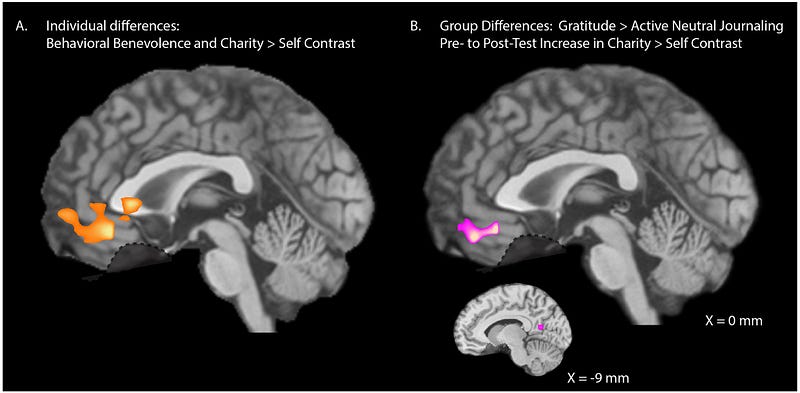
Psychologists led by Ulrich Mayr from the University of Oregon examined in 2017 whether gratitude training also leaves neuronal traces. To do so, they recorded differences in the brain activity of test persons when they received money for a charity or themselves. From this, a neural altruism measure could be calculated that was actually related to the participant's self-assessment of their gratitude and selflessness.
Mayr and his colleagues then asked themselves whether gratitude training would change this neural correlate for selfless thinking and acting. They randomly divided the test subjects into two groups. One group was to spend ten minutes each evening writing about the big and small experiences of the day or past diaries. The others were to write about those small and large experiences of the day or the past days for which they were grateful.
The result: The neuronal altruism measure in the lower medial prefrontal cortex (Image B. top) and a small part of the praecuneus (Image B. bottom) had increased more in the gratitude group than in the control group after the three-week training. The authors of the study conclude that gratitude is associated with increased altruism.
In other words, feeling shifts the brain’s reward system toward rewarding others rather than oneself.
Psychologist Dirk Lehr has made the observation: “Sometimes I get the impression that gratitude is viewed with skepticism in our individualistic achievement-oriented society. One would rather be the architect of one’s own happiness and not admit to oneself that others have also contributed to one’s success. Because in contrast to a feeling of appreciation or joy, gratitude involves appreciating the role of another. Perhaps this is why gratitude is also an antidote to loneliness and selfishness.”
Be Grateful.