
Black Women Are Reclaiming Their Identity Through ‘Covid Cuts’
Hair can be both a political statement and a statement of convenience
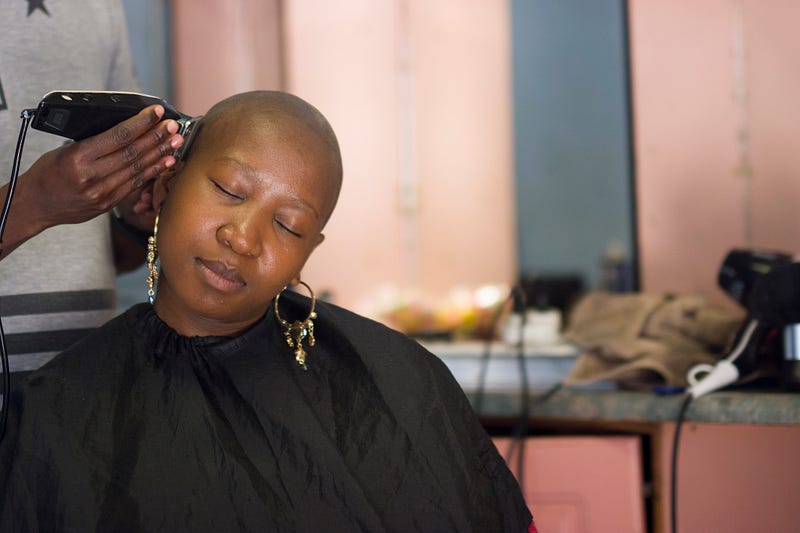
There’s a popular Coco Chanel quote: “A woman who cuts her hair is ready to change her life.” Oft repeated, but for good reason. A big chop can be a great way to announce to the universe that you’re ready for a life shift. But what does a big chop signify in times like these when life has shifted? For months now I’ve been observing my salon-dependent friends go through the pandemic, sharing their hair and beauty struggles online. Some have leaned into the times and learned to do their own braids or twists through online tutorials. Many have chosen to just big chop and rock a teeny weenie Afro instead. And now a trio of celebrities have made their big chop the main story.
Comedian Tiffany Haddish cut off her loc extensions and shaved her head on Instagram Live, explaining, “I cut all my hair off cause I want to see my scalp. I know my whole body. I know where every mole is, but I don’t know my scalp.” Respected journalist Melissa Harris Perry chopped off her hair as a deliberate symbol of fearlessness and cited civil rights legend Rep. John Lewis as part of her inspiration. “Rep. Lewis makes me want to be courageous again. So I started with something small but scary for me. I got rid of my hair. Then I sat down and I wrote words. And then I admitted to those I love what I hope to build even though I have no idea how I’ll do it. One step at a time, I’m going back to brave.” And Insecure actress and HBO comedian Yvonne Orji shared her cute new ’fro with an earnest Instagram post about finding joy. The accompanying photos show the range of her unfettered beauty.
As an observational trend, big chops and teeny weenie Afros are poppin’ right now. I’ve covered the natural hair scene for over a decade, and I’ve seen many celebrities embrace their natural hair and convert again as needed. But something about this moment feels different from times in which a big chop may have signified a more intentional personal or political statement. The pandemic has pushed natural hair into a collective new direction. We’re having a universal experience, where the lack of access to hair salons and beauty supply stores has revealed a window of opportunity. We’re in a place where we can truly question the way we have chosen to present ourselves to the world. We’re in a period where we have fewer places to go and fewer expectations weighing on us. We’re in a time where old, unrealistic standards of beauty may no longer apply. And we’re going through it together.
Celebrity stylist Felicia Leatherwood, who cut Orji’s hair, offered some perspective on what’s happening. “In Hollywood, [Black celebrities] wear wigs and weaves so often, many of these celebrities don’t know how to do their own hair,” Leatherwood says. “The pandemic forced people to be completely natural… Some people have always wanted to cut it off but couldn’t because of the demands for them to have a certain appearance. Other people just couldn’t deal with their hair and it was a good opportunity to just not deal with it. At the end of the day, it’s about convenience.”
For some, a Covid cut might be a statement of personal expression and freedom. But for others, a big chop right now may not really be that deep.
Convenience may be the ultimate appeal of short natural hair in a world contending with the coronavirus. When there are a litany of things to think about, it sounds like a relief to not have to add your hair to the list. For some, a Covid cut might be a statement of personal expression and freedom. A large measure of it is certainly rooted in our Black pride. But for others, a big chop right now may not really be that deep. A TWA might just be about convenience, a low maintenance way to ride out the quarantine until you can get back to a salon. And that’s okay. Do our hair decisions have to signify something all the time?
I had my first big chop at the age of three. A neighborhood bully braided my hair into the chains of a swing. My parents had to cut off my long plaits, and I started kindergarten with a TWA and a pair of hoop earrings. I was three when I first realized hair length was a signifier.
My second big chop was in college. The boy I spent all my time with — who wouldn’t ask me out until I showed interest in another guy — didn’t like it one bit. “You and this menopause haircut,” he scoffed, the first time he saw me with my cropped cut with the tapered back. I almost allowed that comment to jettison me back into thinking that long hair meant I was beautiful, or at least could be attractive to others. It took me years to interrogate, confront, and dismiss the Eurocentric standards of beauty I had been raised to preserve. It took me too long to see my own natural beauty, so seeing these celebrities chop off their hair and be free is inspiring to me now. I’m sure it’s also inspiring to so many others who have considered doing the same. As someone who has done it, if you’re considering trying a TWA and taking a Covid cut yourself, I say go for it and go brave. Our lives are changed for an indefinite time. If embracing a new look is a way for you to feel free and easy, why not do it? A TWA can be a way of reclaiming our identity, a way of reframing our beauty. But if you’re going to do it, make sure you do it for you.


