
Bitcoin
Bcashers Were Right About Everything: Tone Vays & Roger Ver on Segwit (2017)
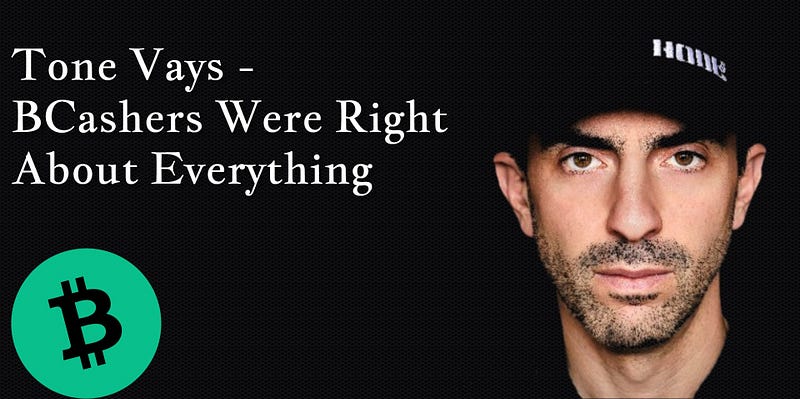
A compelling discussion took place two years after the scaling debate ended, which resulted in Blockstream taking control of Bitcoin developments.
During the discussion, Blockstream’s unofficial spokesperson, Tone Vays, promoted the benefits of Segwit to Roger Ver.
Tone Vays claimed that SegWit would resolve all scalability issues immediately, resulting in lower transaction fees and faster transaction times.
Segwit was a clever but inefficient code upgrade (soft fork) for Bitcoin (BTC) by Pieter Wuille that was activated in August 2017, days after the fork split the community into two (BTC and BCH).
In this video, we can explore a short discussion where we find Tone Vays making his usual feeble arguments while Roger Ver was underlying valid concerns about Bitcoin’s direction.
Subscribe (for free) to get email notifications whenever I publish:
SegWit Didn’t Solve Anything
The transcript of the discussion we watched in the video follows:
Tone Vays:
If SegWit (Segregated Witness) doesn’t solve this problem completely we can always hard fork later with a lot less contention. But give it a chance to solve all of Roger problems of scaling Bitcoin. SegWit has a chance to solve it on its own.
Roger Ver:
The problems that Segregated Witness solves aren’t ones that need to be solved urgently. The one that needs to be solved urgently right now is that people’s transactions are costing more money than ever before and are slower to confirm than ever before and are easier to double spend than ever before.
Tone Vays: It solves that!
Roger Ver: Segregated witness doesn’t solve that in the short term.
Tone Vays: Yes it does, immediately.
In Conclusion
Maybe Tone Vays didn’t have all the data at the time. Still the Bitcoin Cash community warned about what was going to happen.
At the end of the day, SegWit did not solve anything.
Bitcoin Cash proceeded with an 8MB block size limit increase (and later 32MB) by following the latest technological progress in hardware.
For price speculation, BTC outperformed Bitcoin Cash all this time since it sustained the brand name of Bitcoin while Bitcoin Cash had to start anew.
Yet, in metrics that matter to utility, Bitcoin Cash is unmatched without sacrificing decentralized properties like its borderless nature or censorship resistance.
A larger block size allows faster and cheaper transactions, which make Bitcoin Cash more appealing for everyday use than BTC.

Also Read:
Follow Me:
● read.cash ● noise.app ● Publish0x ● CashRain ● Medium ● X.com ● YouTube
👉Follow me on YouTube: @PanteraCrypto
Don’t forget to Subscribe and Like if you enjoyed this article!


