
Bayard Rustin, The Gay Black Civil Rights Icon
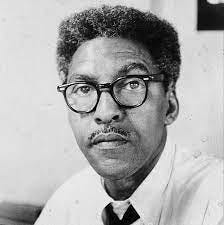
I guess the 1960’s was trending for me this week in the programs I consumed. And I guess it makes sense the turbulence of the 1960’s with the rampant racism, wars, gender and social movements and international turmoil, feels so readily familiar in 2023. I present to you my thoughts on the recent Netflix flick Rustin centering on the activist and in particular the organization of the 1963 March on Washington for Civil Rights.
I first heard the name Bayard Rustin when I was about 13 or so. Bayard Rustin is the name of a high school in NYC. Like so many high schools in New York City named after people, so few of us learn about the people behind the name. I wouldn’t learn more about him until later on when I was in high school and was looking for my own social historical linkage of Blackness and Queerness. Color me surprised to learn Bayard Rustin was not only an influential civil rights leader, but openly gay and Black back in the days when such things apparently were unheard of.
Bayard Rustin was born in 1912 to a Quaker family and raised by his grandparents. He said that he came out to his grandmother at a young age and she reportedly asked him, “ What should she do with that?”. Seemingly experiencing a level of permissiveness with regards to his sexual orientation, Bayard had a unique experience indeed for the time period.
Bayard’s grandmother was a member of the NAACP and was friends with W.E.B Du Bois and James Weldon Johnson. All of this set the foundation for the burgeoning young activist to be.
In 1932 Bayard went to Wilberforce University only to be expelled four years later for organizing a strike. From there he moved to Harlem, NYC and began attending City College of New York. While there he joined efforts working to appeal the case of the Scottsboro Boys, the nine young Black men accused of raping two white girls in Alabama. In the same time period , our man got involved with the Young Communist League in 1936, an organization he left once their stance on war changed. Rustin was a committed pacifist, courtesy of his Quaker roots.
Just have to add and will be doing more research, Rustin and his family were the first Black Quakers I have ever heard of. I am aware of Pennsylvania’s long and rich Quaker heritage and yet I did not imagine that many Black people converted or were brought up in the Quaker faith. Interesting.
A man of many stripes, Rustin was also a singer and happened to be in a choir of a Paul Robeson play.
The 1940’s found Rustin drawn into many different avenues of activist persuasion. He met A. Philip Randolph and A. J. Muste, leaders of the Brotherhood of Sleeping Car Porters and Fellowship of Reconciliation respectively. In 1941, they met with President Roosevelt and threatened to march on Washington to protest discrimination in the armed forces and employment.
Roosevelt took heed to the threat and Executive Order 8802 was signed by on June 25, 1941, to prohibit ethnic or racial discrimination in the nation’s defense industry, including in companies, unions, and federal agencies.
America moves slow and segregation remained a tenet of the armed forces until well after the 1960’s even though orders were issued throughout the 40’s and 50's.
Not one for rest or stingy with his activism, Rustin took up the cause of the Japanese Americans who were interned during World War 2.
Ever fearless, he was a pioneer of desegregating public transportation. In 1942, he boarded a Louisville, KY bus bound for Nashville and sat in the second row. An incident graphically depicted in the movie with a white woman who told her child, “ Don’t touch the Nigger”. For his troubles, Rustin was pulled off the bus and beaten to a pulp by the police who knocked out a number of his teeth.
Rustin was everywhere y’ all. It is just so crazy how much of his story has not really been that well known as many of the other big names.
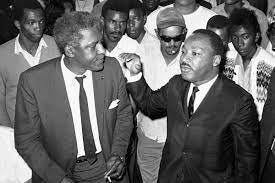
Rustin was behind and participated in the Freedom Rides that sought to really make Southern states follow the law. In 1946, the Supreme Court had ruled racial discrimination in interstate travel as illegal. And even as they did, this did not stop Southern states from arresting Black people who ran afoul of the common law and practice of segregation. Funny how this legacy hasn’t changed. The U.S. federal law says one thing and the Southern states say “fuck you Sam”.
In 1953, Rustin was arrested in Pasadena , California for engaging in lewd contact with two men in a car. His arrest would haunt his activist efforts for the remainder of his life. It made it easier for people to cancel him, to prevent him from sharing or participating in efforts to bring about change.
Sometime in the mid 50’s Rustin met Martin Luther King. And it was through Rustin who had traveled to India and met Ghandi and his advisors, that King developed a pacifist , non violent approach to protest.
In 1957, Rustin and King began organizing the Southern Christian Leadership Conference(SCLC). Many Black leaders were weary of Rustin’s involvement and following news of a civil rights march at the 1960 Democratic National Convention, A. Philip Randolph threatened to expose rumors of Rustin and King being involved romantically. King canceled the march and Rustin left SCLC.
Talk about crabs in a barrel and even Jesus had haters. Can you imagine men wanting to do good for the people but someone else jealous and wanting fame for themselves sabotaging efforts just to prevent improvement? Unchecked ego and envy is dangerous.
One thing that is so interesting to me is how important marches were to movements. I see it as a statement, as a forced confrontation in many respects. They were antagonistic and so provocative. I think in this day and age we don’t look at marches and protests the same way. And yet in this age before computers and even widespread tv usage, marches were powerful ,influential stances. Furthermore, post World War 2, Cold War era America, there was this pressure to present this gleaming image of America. Seeing peaceful, protesting Black folks demanding the full rights of their citizenship being spat upon, having dogs set upon, having their leaders shot in the head by civil servants whose taxes pay their salary doesn’t translate well. Reminds me of another nation that is trying to manipulate the media at all costs and failing rather terribly.
The Film
Rustin portrayed beautifully by Colman Domingo is still working in various desegregation efforts throughout the beginnings of the 1960’s. He has a white boyfriend Tom who is involved with many of the efforts of the movement. And he finds himself courting the advances of a young Black pastor who is involved in the NAACP. The film centers the lead up to the March on Washington, which was initially shut down as an idea by the NAACP. They thought it was too much and the idea of having 100,000 people march on Washington too monumental of a task.
We see the efforts of A. Philip Randolph and Ella Baker to try to get Rustin back in the movement efforts after he had been summarily dismissed in 1957.
Ain’t that something? They’ll dismiss a gay Black man when he’s deemed unsavory and demand his return when they want his skills.
We see the re-connection of Martin Luther King and Rustin whose charisma is something the best bro-mances are made of. I loved the depiction of their relationship. It’s not often we see the depiction of the less than certain side of MLK, the side of MLK that didn’t know everything, the side of MLK that needed help. And here was Rustin guiding and leading from behind the scenes.
The film touches briefly in points about the realities of being gay in such an era such as when Rustin and his younger lover Elias meet at a gay bar. A bar that would later get raided. Patrons would be arrested and their pictures posted in the newspapers. The law ,always and forever cruel ,was even more brutal back in the day. We stand on so many shoulders and backs .
Rustin’s sexuality was brought up as a moral default throughout many figures during this time period, both Black and white. People hurled , “ Homosexual” at others and it was supposed to be taken as a whole thought. It was used as a deficiency, a deviance, something that made one question your intelligence and sanity. The truth of the matter is that Rustin being gay and Black threatened the hegemony of systems that required conformity to survive. If a Black gay man can be a leader, then he threatens the pecking order that positions straight Black men as the head of the chain. Everyone wants to have the biggest dick, no pun intended.
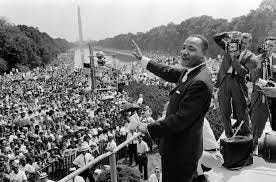
At the end of the day, they pull off what was thought to be impossible and over 250,000 people are estimated to have marched on Washington on August 28,1963. Towards the end of the film, a few civil rights leaders inform Rustin that they have been invited to speak at the Oval Office with the President. He refuses to join them and insists on cleaning up the debris left at the Mall. I took that moment as an acceptance albeit grudgingly of his position. Rustin was in a very precarious space. Even though his “ dirt” had been exposed and was well known, he still knew that it was enough for people to use as a distraction from the efforts for the movement. He knew that enemies to progress would use his sexuality as a moral clause to attack the integrity of his contemporaries. And like so many Black Queer people, he held his own, on his own, for his own sense of self respect.
And yet, forever a complicated being, Rustin’s politics and activism from the post Civil Rights era until his death in 1987 was controversial. He was reportedly critical of the Black pride movement, was a supporter of Israel, and was anti communist. The last part makes me chuckle a bit because in his youth , he was involved with the Communist party. He was also rather late to the Gay rights movement and only seemed to jump in towards the end of his life when he adopted his life partner Walter Nagele because they couldn’t get married which was a common practice for Gay men in the 1980’s for inheritance and proxy purposes.
Rustin died on August 24,1987, the same year as another great Black gay icon, James Baldwin. May these giants rest well for all of their hard, fought work and efforts to make the world a better place. They don’t make that same level of optimism and perseverance in this day and age.


