
Bastille Day in Toulouse
Do you really need a national excuse for a party?
Carcassonne is not one city, but two. There’s the modern town, with its train station and airport and supermarkets. And across the river, there’s the old town. Europe’s largest fortified medieval city, raising its battlements to the sky on a hill above the valley.
Never heard of it? Neither had we, until we lived close by in Quillan. But outside of Paris, Carcassonne is one of France’s most popular tourist attractions. And the narrow stone-flagged streets and crenelated walls make for a charming place to explore, even if many of the stores are given over to the usual tourist garbage.
Carcassonne is especially popular on Bastille Day, France’s national holiday. Crowds cluster along the banks of the river to watch fireworks lighting up the ancient walls as though the city is under siege. But we didn’t even think about Bastille Day until it was too late. By the time we started planning, there wasn’t a hotel room left in the town.
Instead, we went to Toulouse.
Like so many French cities, Toulouse is a Roman town. Invaders came from the South and stamped their mark on this bend of the river, carving straight streets into the soil and raising temples to the sky. The temples are gone, but there’s still something of that ancient orderliness to the town. Wherever they went, from London to Istanbul, the Romans built towns with good bones. And Toulouse’s bones are exquisite, especially in the fading light of the summer sun that brings out the subtle pink of the terracotta bricks. Especially on a holiday, when the people of the city are in a mood to celebrate. Especially on Bastille Day.
Men build in stone, and as long as the stones stand, we feel the lives of those that are gone all around us. But our lives are written on water, as fragile and inconsequential as sea foam. The people pass, and newcomers take their place, and the city shifts and transforms. But the city remains.
Toulouse is a southern city. And by afternoon, the sun had pushed its way through the early clouds to make the broad river glitter. The old stones groaned as they expanded, and the city smiled. The bells chimed from the famous basilica’s skeletal tower. Toulouse can be infinitely beguiling.
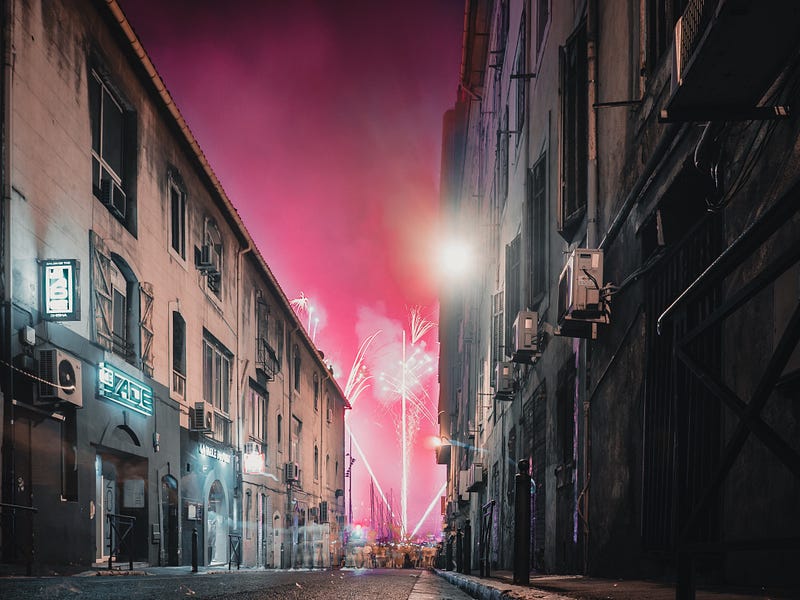
I’m not usually a fan of crowds. But as we made our way to the Prairie des Filtres, the grassy park on the banks of the Garonne, we could feel the excitement building. The crowd grew. Throngs of people lined both sides of the river, waiting for the show to begin. We made our way through a security checkpoint, holding open bags for hired guards to peer absently into. It’s an unfortunate fact in France these days that even pleasure has to be fenced off.
French patriotism isn’t like the American variety.
But then, very little is. Music blared from the stage, but it was made for dancing, not marching. Tricolores were in short supply. A holiday feeling lingered under the shade trees of the park, but there was nothing specifically jingoistic about it. Maybe that’s for the best. Toulouse has been the capital of a kingdom and of a distinct cultural region before France absorbed it. It’s seen legions come and go, and the rosy stones they left behind no longer remember who set them on top of one another. Nations pass. But people remain.
Our first site was poorly chosen. It was right by the river, with a view of the fireworks barge. But the shade provided by the bushes, through which the fading sun fell so beautifully, made it a de facto toilet for those unwilling to cross the park and use the facilities provided. “Pardon,” over and over again, as festival goers stepped over our legs and disappeared into the greenery. Better to pack up and find a new spot, hopefully close to the beer tent where the server complemented A’s French when she ordered us drinks. Bolstered by watered-down booze, we found a new spot further back from the water and settled in to wait for nightfall.
There were no cries of “Vive la France!” as I had been half-hoping. Like most Europeans, the French keep their love of their country close to their chest. It was a fun evening, but you could be forgiven for thinking it was any other holiday. On a perfect July night, do you really need a national excuse for a party?
Unwilling to piss in a bush, we chose instead to use the bathrooms when we needed them. And it was then, in the line outside the temporary toilet block, that out of nowhere, someone began to sing the Marseillaise, and then everyone did. While massive speakers pumped out powerful bass from the stage, the crowd sang a different song entirely.
As far as overt displays of patriotism go, it was brief. But its magic was in its spontaneity, unsullied by forced participation. The people of Toulouse sang their nation’s anthem because they wanted to, not because anyone was trying to make them or because they felt that they had to.
The fireworks, when they came, were impressive enough. But after that, they hardly mattered.

This story is published in Writers on the Run. If you’re interested in submitting your travel stories please visit our submission guidelines.