
Astrophysics
Basic shapes in our universe (# 35)

For thousands of years, scientists have discussed the foundations of our universe. There is no agreement. The Large Hadron Collider (LHC) is a machine that physicists hope will provide some answers. At the LHC in Switzerland, elementary particles (protons) are accelerated to close to the speed of light and then forced into head-on collisions with each other. The LHC creates images of what happens immediately after the collisions. One of the difficulties facing physicists is how to interpret these images. This article discusses some research associated with the issue of interpreting these images.
Feynman diagrams
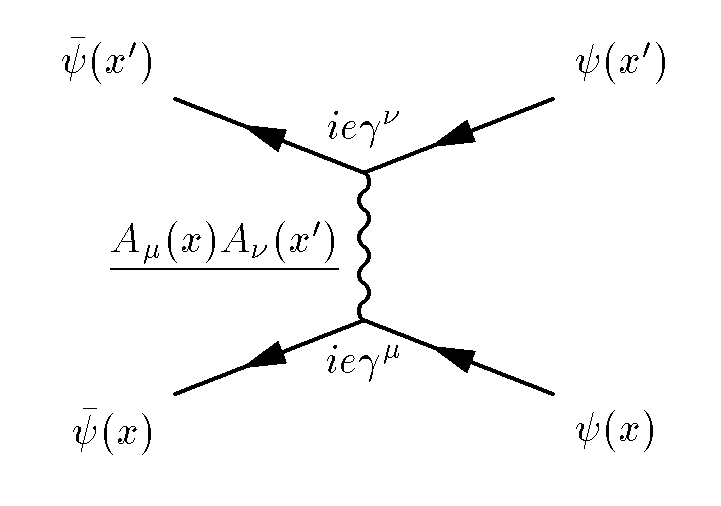
In the mid 20th century, Professor Richard Feynman invented diagrams that greatly simplified the process of solving equations describing collisions between elementary particles. For his insights, Feynman was awarded the Nobel Prize for physics in 1965. Solutions to the equations resulting from collisions in the LHC, however, require analysis of hundreds of Feynman diagrams.
‘Scattering amplitudes’ is the term used to represent the likelihood that a certain set of particles will turn into certain other particles upon colliding. Feynman sketched line drawings of all the ways a scattering process could occur and then summed the likelihoods of the different drawings.
Images taken of the collisions between protons in the LHC have to be interpreted by computers. The outcomes of the collisions can be described by mathematical equations but deriving solutions to these equations requires major computational effort.
Professor Nima Arkani-Hamed (NAH) of Princeton University argues he has identified mathematical objects that greatly simplify the process of finding a solution to the equations describing the outcomes of collisions between elementary particles. An amplituhedron is one such mathematical object. It has the explanatory power of more than 200 Feynman diagrams.
Amplituhedron
NAH discovered the ‘Amplituhedron’ after years of thinking about problems in physics, mathematics, and cosmology concluded that the current mainstream approach in modern physics to understanding reality must fail. His paper ‘The Amplituhedron’ which was written in 2013 with co-author Jaroslav Trnka led to some discussion in the popular press including the suggestion that the discovery hints at what the strange new world of physics might look like. More than seven years later, discussion of the amplituhedron remains largely within academia.
The novelty in the discovery of the amplituhedron is the way it links information about collisions between elementary particles with the volumes of shapes in an imaginary space. These shapes could be linked to Plato’s Theory of Forms (Theory of Ideas) where Plato argues that non-physical forms are the most accurate representation of reality. The discovery of the amplituhedron links modern physics with the ideas of ancient Greeks.
The discovery of the amplituhedron required bringing together various ideas in mathematics and physics. First, the amplituhedron is conceived in Anti-de Sitter (AdS) space. Second, the amplituhedron requires use of the mathematical theory of Grassmannians which is a concept used in various sub-disciplines of modern geometry. Technically, the Grassmannian set G(k, V) is the set of all k-dimensional linear subspaces in V. The amplituhedron is defined in a mathematical space known as the positive Grassmannian. The third idea involves use of Twistor Theory which was developed by Professor Roger Penrose in 1967. Penrose proposed that twistor space should be the basic arena for physics from which space-time itself should emerge.
After considerable effort, NAH hypothesized the existence of a multidimensional amplituhedron as an imaginary object in AdS space. The dimensions of an amplituhedron, such as length, width, and height, represent information about colliding elementary particles. The equation quantifying the amplituhedron’s volume describes the particles that emerge from the collision. This figure shows an example of an amplituhedron. It has the structure of a polyhedron i.e. it consists of a combination of many polyhedrons.
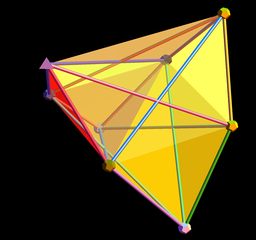

Based on NAH’s research, collisions between virtual particles in our universe can be interpreted in terms of shapes in AdS space. This conclusion is consistent with the idea that events in our universe could be described by events on the boundary of an AdS space where the AdS bulk space consists of polyhedrons. Furthermore, the outcome of collisions between protons can be considered as the outcome of mathematical computations.
[T]he discovery of the amplituhedron could cause … giving up space and time as fundamental constituents of nature and figuring out how the Big Bang and cosmological evolution of the universe arose out of pure geometry.
Is the Amplituhedron just mathematics?
NAH discovered the amplituhedron in his effort to understand collisions between elementary particles. As such, the amplituhedron is like a map of what happens but it is not the territory. Nevertheless, the map suggests the territory could be made out of geometry. The existence of the amplituhedron could be an example of how elementary geometry describes itself. The amplituhedron describes how newly created particles are to move. The newly created particles describe what shape the amplituhedron should take. The particles and the amplituhedron compute each other.
The question for this article is:
Could your brain be modeled by mathematics?
To view the headings of all the articles to be published in this series please click on https://michaeledalton.medium.com/orbiting-stars-and-origin-of-our-universe-338906930f51
To obtain a copy of the book ‘Orbiting Stars’ which contains the first drafts of all these articles, please visit https://www.amazon.com