Fair Money for All: Basic Income on the Blockchain

For most people money is something that just exists. In order to receive money, someone needs to be willing to spend this money on you. This conception of money might lead to the false assumption that money is “neutral” and does not have any properties that are worth discussing. The process of issuing new money is highly obfuscated and hidden in the balance sheets of central and private banks. In contrast, for cryptocurrencies this process has become crystal clear. Mining, presales and proof of burn are concepts that have been tried out.
However, to make a forecast which cryptocurrency will play the dominant role in the future is hard. There are many possible stable equilibria where one cryptocurrency is widely accepted and just for that reason others accept it as well. From a game theoretic perspective, currencies are coordination games. If everyone around you accepts a specific currency you will most likely do so as well. If no one does, you wouldn’t either.
In this ongoing cryptocurrency game, Bitcoin is currently the Schelling point for the simple reason that it was the first currency of this kind and currently therefore the biggest. Other than that, there is no good reason to join Bitcoin over an unlimited number of copies. In fact, currently a few million people are using Bitcoin. If a decent part of the world’s economy would start using Bitcoin as a currency, this would mean an incredible shift of wealth towards the early adopters. This is highly unlikely because it requires adoption of those who are not favored in any way by this wealth shift. This would only happen with a complete lack of alternatives: only if traditional fiat money widely were in acute danger of collapse and no other, more favorable crypto currencies were in place.
Putting aside for the moment that regulatory instances make this scenario highly unlikely, let’s imagine a few big companies like Amazon, Walmart and Apple would start a cryptocurrency together with similar rules to Bitcoin, like fixed supply and decentralized processing. The initial distribution, however, would be a mix of controlling most of the money themselves and distributing it to customers. This currency would immediately make Bitcoin irrelevant.
So the meta trend is that every entity would favor the use of a currency controlled by itself, or at least a currency that favors the entity during the initial distribution. If we continue this trend to the end, we could end up in a situation where every single person is issuing their own currency. A naïve approach where every person sets their own rules, would most likely fail in the meta game of competing coordination games due to higher complexity.
However, what will make coordination significantly easier is the ability of smart contracts to self restrict. Entities can control their own currency but they can restrict themselves in the set of allowed actions that will make it easier for others to “trust” in such a currency.
One concrete proposal for such a currency system is called “Circles”. The idea is that every single person can issue their own currency, however, this happens exclusively under globally fixed rules. These rules allow individuals to consciously issue new money in a distribution regime aiming for a stable ratio between newly issued coins and existing coins. In simpler terms, in the first year people could issue 1000 units per week and this number is increased by 5% year after year.
Now, all people have a comparable currency. The second important simplification that will make it possible to coordinate on such a system, is that it should be indeed used as a currency, not as equity in this person — the fact that one hour of work for person A has a higher value, shall not be represented by a higher value of their personal currency, instead A would simply charge more units an hour.
This allows another big simplification that could turn this currency system into a world currency (system). People who know each other can agree to set a fixed exchange rate between their currencies of 1:1. They would mutually agree to each other’s existence. They form a “Circle” of two persons and within this “Circle” both currencies can be seen as equal.
This concept allows transitive exchange transactions along “Circles” and thereby create a spending network that effectively functions as a big “Circle”. If a set of people is at least somewhat densely connected to each other, all their currencies have the same value and can be seen as one. For instance, if A has an 1:1 relationship with B and B with C, A can still pay C with C-coins by exchanging A-coins to B-coins and B-coins to C-coins.
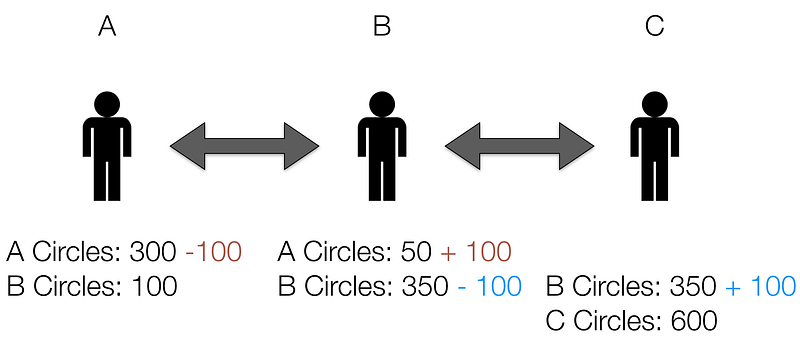
The result would be a global cryptocurrency where every participant has a good reason to use it (because they get free tokens) but with a fully decentralized mechanism of joining this currency.
This concept borrows from the idea of a universal basic income to answer the question of a fair, initial currency distribution. Of course this concept is an experiment or a long shot. However, Ethereum makes it as easy as never before to start such a social experiment. You can find a more technical description of the Circles concept here and a forum here.
—
I’m Martin Köppelmann decentralization Engineer and co-founder of the Gnosis prediction market at ConsenSys. All opinions are mine, and not necessarily those of ConsenSys.