
Basic Income and the Robot Apocalypse
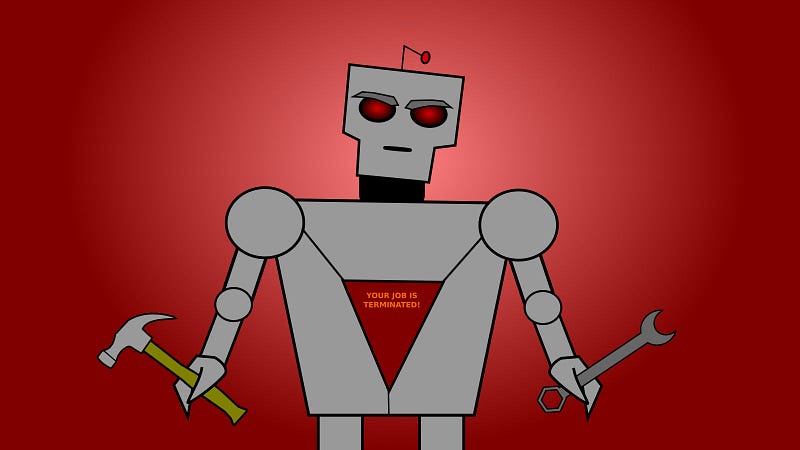
In recent years, a lot of interest in Basic Income seems to have been generated as a result of the perceived threat of a ‘robot apocalypse’ — not an apocalypse of AI-enabled robots literally enslaving us through some sort of military takeover, but a robot jobs apocalypse.
The fear is that robots will soon take over so many jobs that there will be a massive surge in unemployment levels — and a Basic Income system will then be essential to prevent mass poverty, discontent, chaos, revolt and the potential disintegration of our entire society.
In a sense, I’m grateful for this fear, because it does seem to have helped generate interest in Basic Income — and I’m a very keen supporter and promoter of Basic Income.
But on the other hand: I don’t promote Basic Income as being necessary to combat the robot apocalypse and I’m concerned that the focus on the potential of a robot apocalypse might possibly do more harm that good.
My chief concern is that if Basic Income is promoted on the basis of misleading or exaggerated claims, this could seriously harm the credibility of the overall campaign for a Basic Income.
Whilst it is almost certainly true that many jobs currently undertaken by humans will be taken over by robots, computers or other machines within the foreseeable future, that’s not the same thing at all as there being mass unemployment as a result.
To put things in perspective, the ‘robot takeover’ of jobs has been underway for the last 300 years or so — since machines started helping with the harvest and the early waterwheel-powered factories of the industrial revolution were built.
Today, production lines that might once have required thousands of workers, are now sometimes manned by machinery that can be operated and maintained by only a handful of humans.
And yet, despite this, there’s little sign of the sorts of apocalyptical automation-induced mass unemployment that many people have feared.
There are probably two main reasons for this:
1. To put a robot or other machine on the production line requires scientists, inventors, designers, engineers, programmers, salespeople, operators and maintenance people.
2. As some jobs are taken over by machines, we invent new products and services and new jobs and new tasks for people to do. When people are no longer required to work on farms or in factories, they become available to write apps for your phone, manicure your nails or staff the bowling alley.
So far, we’ve not had a major structural problem in terms of any inability to dream up new products and services that people can be employed to provide.
Now, it would be wrong to thoughtlessly assume that just because we’ve so far found new work for people whose jobs have been taken over by machines, that we’ll necessarily always be able to do that.
Maybe there will come a time when we struggle to find jobs for people to do. And there are people who will argue that the new wave of technology makes things different from before. They may argue, for example, that advances in Artificial Intelligence will lead to a sudden spurt in robots taking over jobs and a sudden increase in unemployment.
Or perhaps we’ll some day approach a time when we run out of new goods and services to demand — and what work there is may be very unevenly distributed.
Markets, however, have ways of coping with changes that result from new technology and we don’t really have convincing evidence yet that the next step in the robot takeover will be drastically different from previous steps. So far we’ve coped. And we’ll probably cope with the next stage too.
We should remember, of course, that at any one time, there are many individuals who are struggling because they’ve been made redundant due to automation and have yet to find a suitable new job. But across the economy as a whole, new jobs do emerge to take over from the ones that are gone.
Please be clear that I’m not attempting to dismiss people’s concerns about a potential ‘robot apocalypse.’ It is entirely possible that there will be very considerable transitional problems, at some stage, as we move to a more automated economy. At the moment, however, there doesn’t seem to be a compelling case that we actually need to introduce Basic Income because of an imminent robot apocalypse.
Far more convincing, I believe, are the many positive reasons to have a Basic Income system.
Basic Income offers huge potential for greater financial security, less stress, more freedom, less bureaucracy, less waste, improved education and training opportunities, improved work incentives, a better negotiating position for workers, more fairness for carers, better support for families, higher productively and greater happiness. The list goes on and on.
And that’s why I much prefer to argue that we should have a Basic Income system, not because we need one, not because we’re forced to have one, but because the advantages of introducing a Basic Income system are so extensive and so important that we’d be stupid not to!