
Barthes: The Texture Of The Photographic Gaze
The passing grip on/of a photograph.
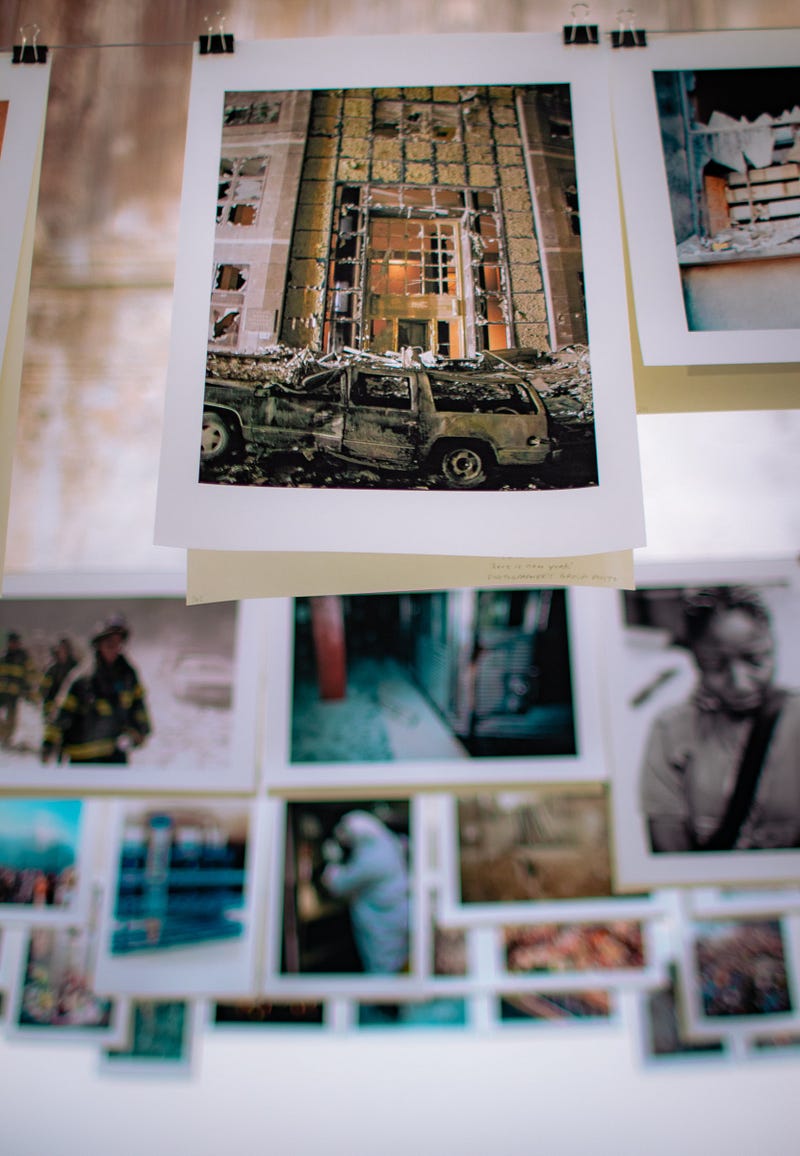
And I realized then, with an amazement I have not been able to lessen since: ‘I am looking at eyes that looked at the Emperor.’ — Barthes, Camera Lucida, 3
So. The picture (of oneself) when you are looking at it, is the experience of yourself through the other’s eyes: I am looking through eyes that saw me. There are two photographs in my house that always grab my attention, that feature subjects that draw me in (that they contain me in them, at least, because it’s me shown, displayed, is not the reason they capture me).
One of them is of me from more than a decade ago; the event, the location of the photograph is uncertain, in my memory. I think I know where it is, but I cannot be sure, although it is at least certain that I was there. My hair is bleach blonde, with a cut I believe I gave myself prior to going to Florida; this would have been the early years of my cutting hair/learning to cut hair. I have on a black button-down shirt, rolled up to the elbows, revealing the rose tattooed on my right forearm. I am crouched down in pinstriped dress pants, balancing on the balls of my feet. A lit cigarette is held between my fingers, & between my knees, you can see the package of cigarettes on the ground. My eyes are closed, or squinting: I am laughing. In the background, it is hard to identify too much. Clearly, I am the focal point. (Of this picture, my wife has said it represents the me that she married, the laughing, smiling figure from the past; I may try to recover that, but, with the “noeme” of the photograph as “that-has-been” (Barthes), I can never be certain of anything else so much as that was a moment: that was a me. & someone saw.)
The other photograph is of my wife & I on our wedding evening, less than a decade ago. We were married on the first snow that year, in early November. I am in a suit, a suit I still own but do not fit in/cannot wear any longer. My hair is dark. We are both smiling, my left arm wrapped around her waist. My wife looks absolutely stunning in her dress, white, strapless: I had flat-ironed her hair for her. We are standing on the front steps of our house, the house we got married in. Behind us, you can see the snow falling.
These photographs grab me: but I cannot assume them: that is, I (the “I” who writes of them, who reflects on them) am not them, cannot be them, will not even ever become them.
Alas, however hard I look, I discover nothing: if I enlarge, I see nothing but the grain of the paper: I undo the image for the sake of its substance; and if I do not enlarge, if I content myself with scrutinizing, I obtain this sole knowledge, long since possessed at first glance: that this indeed has been — Barthes, 100
These pictures which seize me, which offer details which either myself or someone else wished to preserve, have only the power to seize me in light of this past that I was. I cannot unlearn anything that is in these pictures; they do not offer themselves as instances to be denied; they don’t even offer themselves as something to be confirmed. There’s no “proof” required with a photograph. Though it may not be “truth” that prompted them, there is a sense which the documenting of a time has led us to the moment photographed, whether serendipitous (the me crouched down, smoking), or intentional (the wedding photo). But there is nothing new. I do not scan these pictures to determine something I/we have lost or because-we-are-no-longer in that particular space: we have moved across every orientation we can possibly possess: even (especially?) the moment immediately following the photograph being taken.
In fact,
I cannot penetrate cannot reach into the Photograph. I can only sweep it with my glance, like a smooth surface. — Barthes, 106
This is (partly) because
The photograph is literally an emanation of the referent. From a real body, which was there, proceed radiations which ultimately touch me, who am here; the duration of the transmission is insignificant; the photograph of the missing being, as Sontag says, will touch me like the delayed rays of a star. A sort of umbilical cord links the body of the photographed thing to my gaze: light, though impalpable, is here a carnal medium, a skin I share with anyone who has been photographed. — Barthes, 80–1
There is no transformation, though, in such a touch: only preservation; preservation because (in spite of?) every orientation (space &/or time) shifts immediately the next moment but nothing happens to that preserved object; nothing can substantially change this thing which makes your glance, your gaze slides over this object, “smooth surface” as it is.
Nothing is added to these photographs. I cannot put jeans on that picture of me, crouched down, anymore than I can style my wife’s hair as an up-do. To be sure, a photo can be added-to (superimposed upon), but this changes the photograph’s relationship to the Photograph’s noeme: if the photograph has been added-to, it changes the sense that there is something real being shown: a real record; added-to, it has become an invention. Changes to this record changes its relationship to Record: a photograph that doesn’t follow the Photograph’s noeme experiences a trend towards the way a painting is apprehended. As Barthes writes early on,
By nature, the Photograph (for convenience sake, let us accept this universal, which for the moment refers only to the tireless repetition of contingency) has something tautological about it: a pipe, here, is always and intractably a pipe. — 5
Strictly speaking, there is nothing in the photograph that requires interpretation; if one looks at a photograph from a different age, one can ask what items are included, if one doesn’t recognize all the objects, types of clothing, etc. Barthes says,
It is precisely in this arrest of interpretation that the Photograph’s certainty resides: I exhaust myself realizing that this-has-been — 107
But then it is a matter of following up with history, but not with asserting that, for instance, the rotary phone is anything like (i.e., commensurate with) the smartphone so ubiquitous today. The two devices do not occupy a spectrum; or: if they do, it is in the manner of vestigial qualities. Without interpretation: we have a texture of “textureless-ness” that the photograph displays. It grips, can hold on to us, but it doesn’t call upon us to enter into it in any way; we do not, because we cannot, assume the person of the photograph.
Since every photograph is contingent (and thereby outside of meaning), Photography cannot signify (aim at a generality) except by assuming a mask. — Barthes, 34
The photograph’s hold is the hold of a memory.
The photograph, like the painting or like other plastic arts, does share at least one structure with them:
Now once I feel myself observed by the lens, everything changes: I constitute myself in the process of ‘posing,’ I instantaneously make another body for myself, I transform myself in advance into an image. This transformation is an active one: I feel that the Photograph creates my body or mortifies it, according to its caprice — Barthes, 10–1, emphasis mine
Technically, I suppose this means I can assume the photograph’s object; but this is only before the picture has been taken. But in this light, the difference, perhaps, between the two photographs I have been referencing, the pose with me smoking isn’t really assumed. I don’t know that I’ve ever knowingly posed by closing my eyes (don’t some people experience a horror of this?). While the shape of the figures, with respect to the photographer, of the wedding picture clearly evokes this condition. The difference between knowing & not knowing that one will be photographed.
But once that picture has been captured, no transformation occurs:
I can put this another way. Here again is the Winter Garden Photograph [of Barthes’ mother as a child]. I am alone with it, in front of it. The circle is closed, there is no escape. I suffer, motionless. Cruel, sterile deficiency: I cannot transform I cannot let my gaze drift; no culture will help me utter this suffering which I experience entirely of the level of the image’s finitude (this is why, despite its codes, I cannot read a photograph): the Photograph — my Photograph — is without culture: when it is painful, nothing in it can transform my grief into mourning. — Barthes, 90
Finally, I can end this reading, this tension in the photographs in no better way than as Barthes, himself, ends Camera Lucida:
Such are the two ways of the Photograph. The choice is mine: to subject its spectacle to the civilized code of perfect illusions, or to confront in it the wakening of intractable reality. — 119
Entrance into the photographs that captivate me is by no means secure; I am fascinated by the objects (cf. Barthes, “punctum”) in these pictures, but there are plenty more than I do not retain any special feeling towards (as Barthes also claims; it is not a sort of general fascination with the P/photograph, but specific ones). It’s an interesting thing to consider, especially when one grows up with far more exposure to photographs than, say, paintings: perhaps, the things that grip us in them are merely the things we, in particular, want to remember.
J.D. Harms 2020