
Banksy, Pranksy, and the Limits of NFTs
A failed hack shows the vulnerabilities of the NFT marketplace.
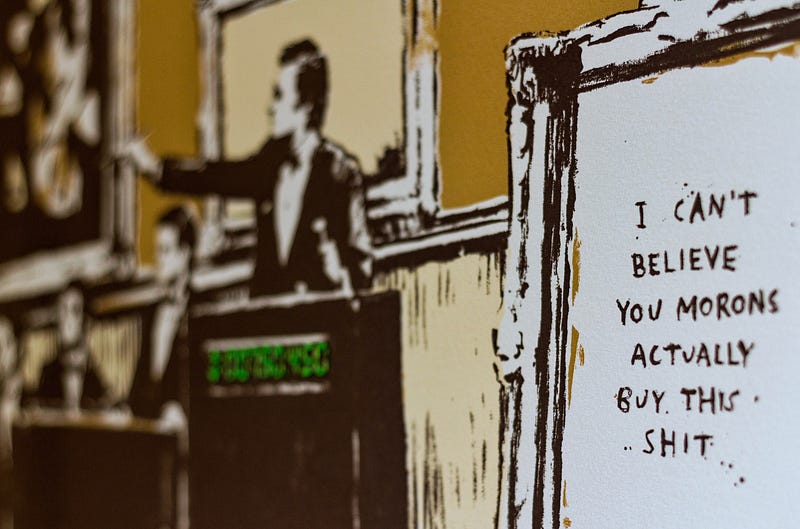
“Modern art is a disaster area,” Banksy once said. “Never in the field of human history has so much been used by so many to say so little.”
And in his hidden, professional life, Banksy has stood by this statement by upending the art world. He has offered prints of his work for free. He sold a painting through Sotheby’s for $1.4 million, only to shred it immediately — a kind of performance art in its own rite that only made the piece more valuable. He has made his art in war zones, his familiar stencils appearing on the walls of the Gaza Strip. He has created exhibits for his work, even though much of it continues to be illegal.
Because he has so often taken the industry to task on his own terms, no one blinked an eye at the offer of his first NFT through his official website. He had always pushed the boundaries in choosing to monetize (and not monetize) his work, so why not dip a toe into the world of smart contracts?
However, soon after Pranksy (a Banksy fan and the holder of a parody Twitter account) purchased an NFT for over $300,000 on the OpenSea marketplace, the NFT page vanished from Banksy’s website. Banksy’s spokesperson told the BBC that the artist hadn’t “created any NFT artworks.” The scammer, perhaps running scared, soon refunded the stolen funds.
This latest blockchain scam highlights the perils of investing in NFTs — a marketplace where contractual agreements bind buyers to sellers whose identities cannot be verified, for works of art they cannot touch. Even for a genre as shrouded in secrecy as street art, there are costs to flying blind.
NFTs (non-fungible tokens) are digital assets, such as drawings or songs, preserved on a blockchain. At first glance, NFTs patch existing holes in the digital marketplace. If a platform dies, consumers retain ownership rights in their NFTs. NFTs also offer a promising solution to creatives who suffer from rampant copyright infringement, blatant theft, and a loss of control over their artistic work in the digital realm.
Heavyweight auction houses like Christie’s and Sotheby’s have leapt on board. Often seen as gatekeepers to the art world, these old guard behemoths value NFTs because they are so easily authenticated and protect buyers from forgeries. NFTs also offer a modern way forward for an industry too often seen as elitist, inaccessible, and so privileged as to be — in the famous words of Banksy — “the trophy cabinet of a few millionaires.”
Any individual can sell an NFT, building a lucrative business model and a following without the permission of the art world. Creatives can use NFTs to take back ownership of previously exploited works. Investors can build collections of digital assets, the blockchain protecting their valuation over time better than a climate-controlled room can cradle a painting.
For street artists, NFTs impart the seduction of permanence. Graffiti has always survived at the mercy of the elements. Whether killed by a rival street artist or whitewashed by a police state, its existence hangs on the impulses of those who walk by a wet wall and decide whether to let its etchings last. For better or worse, street art only lasts when we let it be.
Banksy, perhaps the world’s most renowned street artist, acts as a model for emerging artists looking to make a living from graffiti. His Pest Control Office effectively authenticates his works. His willingness to offer his work at a low price point (if not for free) endears him to the general public. In his political speech, he satirizes society and lets us in on the joke. Banksy has transformed illegal works once consigned to an public gallery to investments for private consumers.
But in managing this new reality, we’ve seen his struggles to protect his work as well. Banksy lost his trademark case before the European Union Intellectual Property Office (EUIPO). The EUIPO used his famous monkey image’s existence in the public sphere in its rationale for denying trademark protection. The panel had also earlier indicated the challenges posed by an individual with a secret identity seeking copyright protection. Though Banksy hasn’t yet tokenized his work as an NFT, his loss shows that NFTs may offer protections for creators that existing laws do not.
Yet, where the NFT blockchain gives greater ownership protection, it also takes away. Many artists have claimed to have been impersonated. Stolen art appears on ownership platforms, requiring creators to perform the due diligence necessary to find their work and then to persuade the platform to take it down. And once a sale is executed, it is final.
Tom Robinson, from cryptocurrency analysis company Elliptic, described the sham Banksy sale on OpenSea: “OpenSea is the eBay of NFTs — it allows anyone to sell digital art that they own, or have created themselves. Once a bid has been placed, the seller can accept and the cryptocurrency is irreversibly transferred.”
As with past innovation, the technological advances appear to have outpaced the regulation that would govern it — leaving platforms wide open for fraudulent, predatory behavior. Recently, a rulemaking petition to the SEC requested further clarity on NFTs. Questions abound as to whether NFTs should be treated as securities or commodities, and how fully investors will be protected.
From the standpoint of street artists, the NFT might present a familiar outsider, boundary-pushing allure. NFTs certainly allow artists to protect their ownership, monetize their work, and hide their true identities. But still. A digital asset, unlike a painting in a private collection that could be loaned to a museum, seems like the ultimate trophy. Moreover, it’s hard to imagine art more divorced from a street-side public gallery than a privately-owned digital asset.
While the art world appears eager to embrace technological advances, we’re left to wonder if anything is lost in the rush to digitize creation. Soon, an avid art collector might inhabit a space with white walls, content with a virtual chain of ownership to safeguard blossoming investments. But will that be enough for the rest of us?
Street art would seem to be particularly difficult to siphon off from public engagement. Even an image of destroyed graffiti, while fortunately not lost to the ether, cannot have the same resonance as taking in the real thing. No digital asset can capture the feeling of waiting for a bus, catching sight of an hastily-constructed image that wasn’t there yesterday (that might not be there tomorrow), and feeling the fleeting aliveness of being wrenched from your routine. It might be late in the day, but you’re awake now. Having seen it, you’re seen too: each presence validates the other.
NFTs provide unmatched ownership rights for digital assets, but they beg the implicit question: is the point of making art making the sale? We are still waiting on solutions for protecting the more fragile aspirations of creativity. The ones that have no price point.