
Banksy and The Future of Street Art: Trespass or Treasure?
The writing on the wall may mean that it’s time to decriminalize graffiti.
The footage is grainy and blurred, with a quality that recalls the bulky televisions of the early noughties. Only a sliver of his face, a pale half-moon encompassing wild tufts of brown hair and thick eyebrows, is visible. His dark eyes are exposed and deep-set. They fall flat, though, trained as they are away from the camera. He speaks with a thick accent. He seems nice enough. He might even be smiling, but the dark t-shirt covering his face is so effective that even modern facial recognition software likely can’t parse apart his features. He is forgettable, blending in even while being interviewed alone. He is determined to remain anonymous. The bits of spliced video footage might be lost to history were it not for the sight of this unknown man contributing to such recognizable work. In the video, he is working on a baby whose alphabet blocks spell out: KILL MORE. He is also stenciling a black bug to the wall, part of a known Banksy piece. The stenciling itself as recognizable as a friend’s handwriting. Though critics already doubt that the footage could be him, the titillating promise of an answer has propelled many to ask the question again. No matter that it has been asked so many times before.
Could this be Banksy?
Banksy has performed an inimitable sleight-of-hand: he has maintained his anonymity in a world obsessed with celebrity. In an era where people tweet their breakfast cereal, post daily records of their OOTDs, and proudly upload images of their fetuses — quantifying experiences by likes and shares — identity is so much more than a name with a birth certificate attached to it. It is a thing to be branded. Banksy cuts against the current in hiding his true identity, in part because turning his back on acclaim is anti-establishment and counter-cultural. Conversely, it’s very much on-brand for Banksy to not want you to know his name. He also must preserve his anonymity for more banal, practical reasons; the kind of art he makes is patently illegal. His medium, graffiti to some and street art to others, is as intertwined with his mystery as the spray paint staining his unregistered fingerprint. He makes satirical, instantly-identifiable street art, and that art — made furtively, under the cover of darkness — only heightens the mystery that makes us want more.
The impulse to mark our spaces, to tag the walls that shelter us with a kind of proof of life, is as primal as our yearning for immortality itself. The word ‘graffiti’ has its roots in the Italian word ‘graffio,’ meaning ‘a scratch.’ The first documented cave drawings, the ancestors of modern-day graffiti, are known colloquially as The Cave of Hands. Discovered in Santa Cruz, Argentina, they are estimated to have been created between 13,000 and 9,000 B.C. Beyond cave drawings, history is rife with examples of vandalism. Legs of an ancient Egyptian statue, Colossus of Memnon (c. 1350 BCE), are covered with graffiti by wealthy Roman travelers dating beyond 1,000 years after the its creation. Preserved in the ruins of the ancient city of Pompeii is scatalogical graffiti. Archaeologists work to preserve this graffiti as much as they do more legitimate works of art, recognizing its inherent cultural value as insight into another time. There is a delight, too, in discovering that these people were so like us: in their impulsiveness, in their curses, in their satire. Graffiti might be the great equalizer, reminding us that anyone can make a mark and leave a message.
However universal the urge to write on walls, the modern response to graffiti has been somewhat less forgiving. More recent iterations of graffiti art found infamy in the subway trains of New York City in the 1960s. In 1972, Mayor John Lindsay declared a ‘War on Graffiti’ in 1972. Hundreds of millions of dollars were spent to preserve the appearance of the subway cars that did not work well, rather than investing in an overhaul of its crumbling infrastructure. The crackdown on graffiti artists unfolded in conjunction with harsh, often racially biased, policing tactics such as gang databases and zero tolerance policies. The stated purpose of these policies was to make a violent city safe, while also making a dirty, tagged-up city, clean. New York City’s Citywide Vandals Task Force, created in the heyday of the flurry of countless graffiti artist arrests, continues to the day. The association of graffiti with gang violence, poverty, and lawlessness lives on potently as well. Since the seventies, the significance of graffiti art cannot be explored without an omnipresent consideration of its illegality. Just as graffiti artists work under constant threat of arrest, the viewer who enjoys it becomes somewhat complicit in this rule-breaking. By definition, graffiti requires people to deface property that does not belong to them, with little thought given to those who will come along later to clean it all up.
Many artists work subversively, challenging assumptions and breaking new ground with their work, but graffiti’s more nefarious connotations are legitimate. Gang members use tags to mark territory, to intimidate, and to harass those who would challenge their control. Bombed-out walls can create a climate of fear. These markings, boundaries delineated by bombed-out walls and shoes swaying from telephone wires, too often lead to turf wars and an attendant body count. Tags are no longer two-dimensional when there are real victims and real communities terrorized by violence. Separate and apart from gang violence, there are documented instances of beatings and stabbing by graffiti artists themselves, as they work to secure the integrity of their art. It shouldn’t come as any surprise, then, that graffiti lowers property values. Its lingering presence hints of lawlessness, a lack of policing, and a lack community involvement. Once arrested, vandals can expect a rap sheet, community service work, and a substantial penalty. Ironically, some judges also suggest that these artistic yearnings be channeled towards art classes — and this at a time when the arts are being unceremoniously cut from public schools to make way for further standardized testing. Graffiti stems from deep, systemic poverty, then, as much as it does cave drawings. Its presence speaks to a disregard for existing laws and social mores, but also to an artistic impulse that has no outlet, to an urge to be noticed by people who would just as soon look away. If graffiti is a craving for recognition, logic follows that it would be claimed so fiercely by those whom society treats as invisible.
At base, graffiti is a message. And as with any message, context matters. A wall tagged by a gang member resonates differently than one etched with a political slogan. The Israeli West Bank security barrier, always a draw for street artists, is coated with graffiti. In 2005, Banksy created an image there depicting small children with a bucket and shovels. Criticism followed that the image was too lovely for its medium. In 2017, Banksy added a sheepish “Er… Sorry” to the wall in commemoration of the Balfour Declaration. Recently, Banksy even recently established “The Walled Off Hotel,” dedicated to offering access to the wall to tourists of its political art. Though his establishment has faced criticism from some Palestinians who view it as “occupation tourism,” history has shown that people will get close enough to decipher the messages left for them. During the Berlin Wall’s reign of terror, from 1961 to 1989, expatriates and impassioned West German citizens painted the western side of the wall with political art. With the help of the children of US servicemen, who were more familiar with American graffiti culture, the Berlin wall’s artful western side soon stood in stark contrast to its sterile eastern counterpart. It was the one action that those who had freedom could take for those who did not: they could leave a record of their fury. Now, the East Side Gallery is a section of the Berlin Wall that has been reincarnated as a freedom memorial. We see whispers of graffiti now where we need it most. While Hong Kong has generally never taken to graffiti, except for advertisements and commercial work, recent protesters of a controversial extradition bill allowing suspects to be sent to China have taken their movement to city walls. The original “Lennon Wall” is a beautiful piece of politically-charged graffiti in Prague, weaving together Beatles’ lyrics with various political sentiments. Recently, “Lennon Walls” covered in protest post-it notes have popped up all over Hong Kong. They are no less powerful for their impermanence. Fighting has erupted when anti-bill campaigners try to take them down. Famed Chinese artist Ai Weiwei, in supporting the Hong Kong protests, stated that, “Freedom of expression is the most important weapon to combat authoritarianism. Authoritarians simply have no imagination, and without that, they have no future.” Under the shadow of authoritarian regime, graffiti feels less like vandalism and more like a battle cry.
Banksy’s work also reflects the particular political, economic, and societal challenges of his country. While the United Kingdom certainly isn’t a totalitarian state, it is a constitutional monarchy with entrenched inequality. The UK recently elected a new prime minster with the support of just .13% of its citizens. Since 2014, social mobility — the ability of individuals to move between social classes — has flatlined. The current greatest predictor of professional success in Britain isn’t educational or employment opportunities, but birthright. We cannot know the specifics of Banksy’s personal background, but we knew that he came of age with a motley crew of graffiti artists in a depressed area of Bristol. Bristol is a colorful city with a complex history. Its merchant class amassed wealth through shipbuilding, maritime trade, and by playing an integral role in the slave trade. Perhaps, the genesis of its vibrant counterculture stems from an effort to understand this sordid history. In the eighties, the Barton Hill district was an edgier area with a criminal underbelly. Banksy reportedly told another graffiti artist, Felix Braun, that he made his initial approach to the area with anxiety as his “dad was badly beaten up there as a kid.” He soon found his footing as a freehand artist with Bristol’s DryBreadZ Crew. His early work was never without social commentary. Murals like Take The Money And Run and Cat and Dog challenge authority figures, elevate the anti-hero, and advocate for graffiti as street art. In Gorilla with Pink Mask, we see his playfulness, a coy, peekaboo taunting that walks in lockstep with the medium itself. Always, Banksy reminds us that he broke the law and got away with it. He’s careful to let us in on the joke, as aware as we are that we’ll look the other way. From the beginning, when Banksy left a message, he did so with the youthful arrogance of one who knew it would be read.
While the first graffiti art can be traced to New York City in the seventies, the first graffiti in the United Kingdom came to Notting Hill via American street artist, Futura. Britons quickly took to street art, though its style was different. Most bombed-out walls were layered with political slogans, each piece loaded with characteristic dry British humor. The graffiti artists’ words mattered as much, if not more, than the street artistry. Banksy’s work follows the longstanding British graffiti tradition of not simply tagging something, but saying something. We saw Banksy’s leftist leanings early on with The Mild, Mild West, a cheeky mural of a teddy bear firing a Molotov cocktail back at the riot police. This image referenced a local crackdown on unlicensed raves that led to riot police attacking partygoers. Banksy painted the piece during the day, with the tacit support of the local community. Similarly, Banksy’s iconic In Tesco We Trust, in which children pledge allegiance backwards to a plastic Tesco bag, has been interpreted as a commentary on the dangers of capitalism and plastic pollution. Even covered with plexiglass, it has since been vandalized and tagged by King Robbo, a late graffiti artist. His work, One Nation Under CCTV, shows a police officer watching the child painting the phrase; the city council ordered it removed. His works are as recognizable for their trademark stenciling as they are the for their anti-establishment sentiment. Many of them are also no longer with us, though The Mild, Mild West has survived multiple attempts to destroy it. Ironically, Banksy’s work is a greater draw for up-and-coming graffiti artists looking to tag, for vandals looking to destroy, for city councils looking to make an example out of urban scrawl. Graffiti is always at risk of disappearing, and not just by city council order. At best, graffiti artists can only cross their fingers and hope that their message had a chance to resonate. The lifecycle of the art form is one of resignation, as new graffiti is layered on top of the old or walls are whitewashed back to a blank canvas. Still, their transience begs the question as to the heft of a political message that cannot last.
In Bristol however, people loved Banksy’s 1998 work of a tank so much that they put a frame around it. When Banksy’s Seasons Greetings image appeared on a garage wall in Wales, the property owner wasted no time cordoning it off, employing guards, and covering it with plexiglass. One wonders about the impulse to protect something that is by its nature ephemeral. Presumably, some hope to sell Banksy’s work for its fair market value, but many hurry to preserve Banksy’s murals even without a financial stake in them. It is this connection that people feel to Banksy’s work that cuts in favor of it being considered artwork. And perhaps part of that connection is down to his willingness to speak on our behalf. His work, always created at great personal risk, invariably stands for some greater ideal. Citizens around the world take extraordinary measures to preserve and restore graffiti not simply for its beauty, but because it allows them to stand in solidarity with an artist. Unlike other art forms, graffiti requires an effort on the part of the viewer to exist. Citizens become active participants in each mural’s lifespan, either advocating hard for its significance or its nuisance. Advocates for street art make a compelling premise: art which has no legal right to exist should nonetheless be protected. It’s so subversive a sentiment that it mimics the graffiti itself, allowing the supporter to pretend for a moment that he or she is aligned with the artist. Because if you can keep Banksy’s street art alive, maybe you’re as counter-cultural, anti-establishment, leftwing, and woke as he is — doing your best to further his message so that it might spread. But, of course, that’s not true. There’s only one person here who truly bears any risk, and we don’t yet know his name.
In both the United States and the United Kingdom, graffiti is illegal. Consent is determinative; if a property owner consents to the graffiti, it’s no longer an illegal act. Intent matters, too; if property is vandalized by accident, it’s still illegal but less punishable. Under both legal systems, the rights of the property owner trump those of the street artist, even if the work happens to raise property values, and sentencing is proportionate to the damage caused. In the United Kingdom, under the Criminal Damage Act of 1971, offenders will be hit with fines and can be imprisoned anywhere between 3 months and 10 years. There is also the Anti-social Behaviour Act 2003 which empowers local councils to clean up graffiti and penalize offenders with fines. Some have argued that graffiti artists in the United Kingdom suffer particularly harsh sentences, often resulting in prison time. In the UK, graffiti artists working in tandem can also be charged as co-conspirators or as part of a crime syndicate. The result of such a strict interpretation of the law is that graffiti artists serve time alongside more hardened criminals, and that prison time itself has been glorified within the graffiti community. Occasionally, local councils defer to their citizens on the value of a given mural. In Bristol, the city council determined that Banksy’s Well Hung Lover could remain following “overwhelming support” from the public, though they cautioned that their decision should be not be construed as their support for further graffiti. Still, this situation demonstrates that harsh penalties may be mitigated by an artist’s notoriety and public support. Importantly, nuisance issues arise if the street art is allowed to remain. Seasons Greetings attracted thousands of tourists to the point where the Welsh government took control of managing access to the piece. It was ultimately sold for six figures, though not without headaches. There are practical logistical difficulties when countless gawkers are drawn to your place of business, one of the many side effects of making art in a space that was never intended as an art gallery.
In the United States, specific penalties for graffiti vary by the jurisdiction. Vandalism can lead to criminal sanctions, such as jail time, alongside fines, community service, and education. Regardless of the penalty, as in the United Kingdom, the offender is expected to make things right by fixing the damage. Additionally, both countries strictly regulate graffiti-making supplies, alternatively regulating the way it’s not, displayed, and/or not allowing it to be sold to minors. Increasingly in the United States however, graffiti artists are taking to the courts to seek out copyright protection for their work. Pursuant to 17 U.S. Code Section 102(a), copyright is granted to “original works of authorship fixed in any tangible medium of expression.” H&M sought to use graffiti in a public park by artist Jason ‘REVOK’ Williams as the backdrop for a fashion shoot; Williams argued that he should have had prior approval and took legal action. Ultimately, H&M voluntarily dismissed their case following public backlash. In another seminal case for graffiti artists, they were awarded $6.7 million in damages after a property owner erased their murals; a judge ruled that they were sufficiently artistic to warrant copyright protection. The jury found that the property owner had violated the Visual Artists Rights Act (V.A.R.A.) which has been utilized to protect public art of “recognized stature,” even if it exists on somebody else’s property. Accordingly, some now argue that property owners do not have copyright protection of illegal work created on their property, and that copyright protection should remain with the artist. In an attempt to prevent the unauthorized reproduction of his work, Banksy himself sued an Italian exhibition for trademark infringement — and won on the issue of unauthorized merchandise. Having once declared that “copyright is for losers,” Banksy appears to have evolved to a point where he wants rights to his creations. With museums, art dealers, and the general public increasingly recognizing graffiti as an art form, the law could very well evolve right along with him.
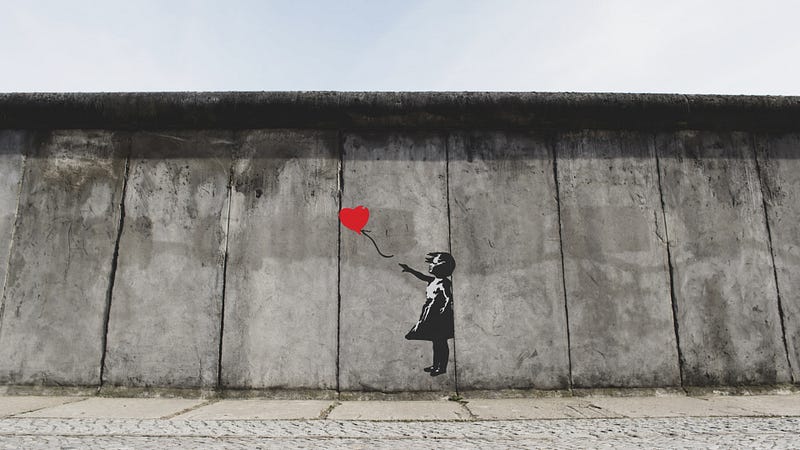
The law has no bearing, however, on an invisible man. Banksy can only be held liable for illegal acts created under his pseudonym if he is unmasked. And so far, he’s a lot like that Teflon-coated kid you knew in high school who never got caught. In 2004, Banksy created Princess Diana pound notes. After some of the spoof currency was thrown into the crowd at the Notting Hill and Reading Festival, people tried to purchase items with them as real currency. They’re now worth a small fortune. More recently, Banksy shredded Girl With Balloon just after it was sold at auction for $1.4 million. Art experts now believe that the piece has doubled in value, from a new standpoint as a conceptual piece. This is referred to colloquially as the ‘Banksy Effect’. His art has raised global interest in street art and substantially increased its market value. And perhaps a more important feat than even the asking price for his work is the fact that Banksy is beloved in his home country. In a nationwide poll, Banksy was voted Britain’s all time favorite painter and the only living artist to break into the top ten.
But where there is an artist atop a pedestal, there are always critics — respected voices in the art world, anonymous trolls, and even fellow street artists — ready to knock him off. Alongside the global recognition of the “Banksy effect” are claims that he has sold out. In his ascent to a street artist of worldwide renown, he has not only amassed wealth — taking active part in the capitalist machine that he so ardently vilifies, he has also gone legit. These days, much of Banksy’s creations are in fact legal. Over the years, Banksy has transcended his earliest etchings to expand into other genres. Banksy designed the cover for Blur’s album, Think Tank, supporting a vocal anti-war band while also going commercial. He also created a documentary, Exit Through the Gift Shop, which was nominated for the Academy Award for Best Documentary Feature. He wrote a book, Wall and Piece, that compiles photographs of his best work. His work has appeared on “free walls,” like the Leake Street Tunnel, that are government-sanctioned spaces for creating street art. Most recently, Banksy created a stab-proof vest with a Union Jack flag that Stormzy wore in a performance at Glastonbury. Though he used fashion to make a political statement by highlighting the epidemic of knife crime terrorizing London, Banksy also created a wearable piece of art: a true fashion statement. Major fashion houses have appropriated street art for years, both as clothing and as backdrops for shoots. Banksy could certainly follow suit someday with a foray into the fashion industry. With each effort to branch out of his street art niche, he creates future legal opportunities for himself. He has also provided a playbook of sorts for up-and-coming street artists who make it. Banksy is proof that they are not resigned to stay in the streets where they began, that they are not limited by their hidden identities.
We only stand a chance of Banksy voluntarily identifying himself if graffiti is legalized. Many of the arguments surrounding the decriminalization of street art are similar to those of marijuana and prostitution. It’s expensive to clean up and wastes resources to seek out offenders. It has existed since we were ancient cave dwellers and will always exist. And, as cities are increasingly gentrified, it is difficult to reconcile criminalizing an art form that has solid cultural value. In this vein, Melbourne conducted research and now authorizes larger murals, while outlawing tags. Following the death of a 16-year-old street artist by police and city-wide protests, Bogota decriminalized street art in 2011. It has since become an attraction for street artists around the world, boosting tourism with bus tours and serving as powerful political commentary. Brazil also decriminalized street art in 2009, following a shift in cultural attitudes. In Rio de Janeiro, street art flows freely through the entire city, no matter property value; it is not seen as a symptom of lawlessness, but of community. As Rio de Janeiro artist Quito claimed, the decriminalization of street art is truly “an agreement between the population and the city.”
Even as graffiti is increasingly recognized as an art form, decriminalizing street art in most areas of the world would require a publicity campaign. The government and citizens would need to agree on the contours of the art form and the acceptability of behavior that could accompany it. Law enforcement officials and anti-graffiti advocates often point to the Broken Windows Theory of policing. The Broken Windows Theory ascribes to the idea that visual signs of decay — such as graffiti, prostitution, or drug paraphernalia — can encourage lawlessness. Basically, if you crack down on lesser crime, maybe the big crime won’t happen. Though the validity of the field study underpinning the theory is questionable, recent events have indicated that there might be a larger point to cleaning tags from a wall. The Lennon Wall in Prague, at once a bastion of street art and a symbol of communism’s failure, will soon be monitored by surveillance video. Access to the graffiti itself will be regulated as well. Apparently, the wall has attracted drunk international tourists. People are spraying unauthorized areas, even trees, and littering. Similarly, Bristol — epicenter of all things Banksy — has recently initiated a pilot project to clean up graffiti tags in an effort to alleviate community “anxiety”. The initiative provides residents with free paint to erase graffiti on their own; they will also launch a portal, allowing residents to upload images of tags to aid authorities in prosecution later. It remains to be seen whether an art form rooted in illegality can be deemed legitimate, and whether art in a public space can ever demand a code of conduct.
Further, can sanctioned street art remain street art? Graffiti has always been marked by its speed. It goes up quickly and efficiently; it is often destroyed or disappears at the same breakneck pace. It doesn’t last. It is a breathing thing that lives and dies. One wonders if a mural painted leisurely, with community support, and during daylight hours can have the same gravitational pull. Banksy himself reportedly discovered his signature stenciling style while hiding from the British Transport Police. He noticed the stenciled plate at the bottom of a fuel tank. He liked the “political edge” to stenciling, but there are practical benefits to the use of a stencil — it’s effective and it’s fast. Significantly, he came up with his idea, his signature style, under threat. Most of the most recognizable street art around the world was similarly created with feet held to the fire. Graffiti might be a different animal entirely without the burst of adrenaline that gives it life.
One artist called Alvarez described the thrill of it: “You tag this wall with spray real fast . . . And nobody catches you, and then another crew sees what you’ve done and tries to tag over you. . . It’s a rush.” In reporting out of Bogota, known as a Mecca of legalized graffiti, another graffiti artist said people would be most impressed if someone could tag the presidential palace. In a rare 2003 interview, Banksy spoke of street art as others would an addiction: “The art to it is not getting picked up for it, and that’s the biggest buzz at the end of the day . . . The feeling you get when you sit home on the sofa art the end of that, having a fag and thinking there’s no way they’re going to rumble me, it’s amazing, better than sex, better than drugs, the buzz.” Those of us good kids — ever rule-following and law-abiding — can only surmise that it might be less satisfying for a street artist to make art that is, well, legal. Maybe gaining credibility in one world dilutes it in another. Maybe some earnest, rollicking messiness is lost when access to a sterile gallery is gained. Maybe even Banksy will someday have no need of a pseudonym, when he looks back over his shoulder only to find that no one is chasing him. And maybe he’ll miss it.