
Ballroom Bullies: No, I Really Don’t Wanna Dance With You!
About pushy men trying to get women onto the dance floor
My father, my father-in-law, my grandfather, my uncle. My ex-boyfriend, older randos, and lately, even younger men — oh, pardon me, “ballroom dancers” — with a dominant streak.
All have one thing in common: In a ballroom, with music appropriate for classic partner dances like Waltz, Disco Fox, or Foxtrott, their testosterone is bubbling over.
The only thing to do then: Hunt. Grab an unsuspecting female to demonstrate their skills in “leading” and “peacocking” on the dance floor.
If she looks insecure and shy like me, even better!
Those ballroom bullies don’t listen to a woman telling them she doesn’t wanna dance. Instead, they nag, embarrass her with macho talk, and just pull her on the dance floor. Where the throwing around begins.
Never visiting those festivities ever again, where family, friends, as well as ballroom bullies, mingling is not an option. Neither is me just being less sensitive — because I’m not the problem here.
And yes, being forced to dance is problematic for so many reasons. Let me share my experiences with you and try to explain.
My kind of ballroom might be different from yours – that should be ok!
It‘s quite simple: Not everything you like to watch, you necessarily wish to do yourself. And apples should not be compared with pears.
To watch (consensual) ballroom dancing can be quite nice – there are even TV series like “Dancing with the Stars” featuring elegant couples swooshing around on the dance floor.
However, I don’t want to learn and try the same, and I‘m not even that fond of classic dances myself.
Honestly, I’m more interested in the underground and drag ballroom scene, as known from NY in the 1970s, RuPaul‘s drag race, or lately, the series Pose. They celebrate individuality, quirkiness, creativity, body and sex positivity, gender fluidity, and camp instead of rigid couple rules. Hey, that’s just me – you do you!
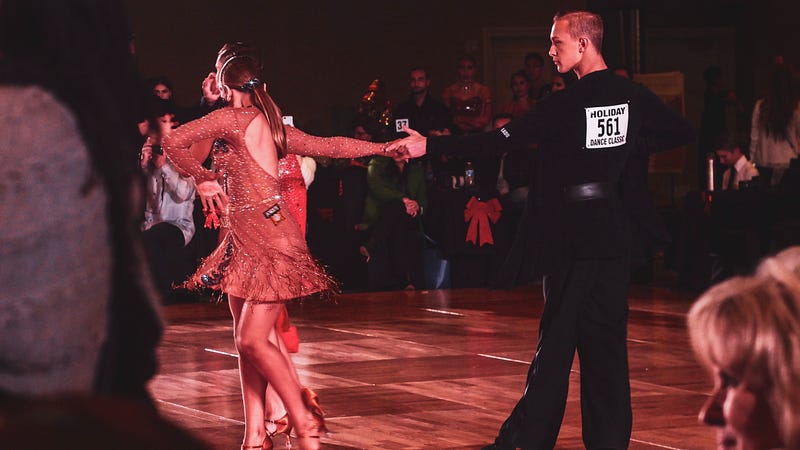
Last weekend, my niece and her boyfriend — a professional ballroom couple — did a dance number for the family party crowd.
It was amazing to observe: the elegant movements, the flow, and the two becoming one swirling tornado. All the other men got nervous, though.
After the family pros had finished, I tried to fend off my father-in-law – unsuccessfully. He just had to waltz me around to prove “you could do that too” and “just follow my lead.”
Everybody was watching me getting manhandled. I was super embarrassed. My arm hurt. I have a neurological condition; it’s invisible under clothes, but he was well aware of it.
Afterwards, he “threatened” my next birthday present was going to be a classic ballroom dance course (no! for the 1000th time! no!) and I was left to swat away the other preying dance dudes’ grabbing hands.
My sister-in-law had the same problem with my father. We both have a lot in common: Although we would agree to do a slow shuffle dance with our significant others, we are not into ballroom dancing.
Punk rock, pogo, and mosh pits are what we prefer. Wild and crazed movement along to music, freely jumping around to tunes, not caring how it looks, but how it feels.
And maybe, she and I are too polite to say “No” to ballroom bullies with a strong voice. Or rather, shouting it. Again. And again.
Forcing women to (couple) dance: What it really is
Maybe you think, whoah, calm down, woman. It’s just classic chivalry and a compliment if a man asks you for a dance. Not a problem!
Maybe you are right. But if a man doesn’t accept “No, thank you” and is getting pushy, he isn’t any better than cat-callers on the street or males confusing a dressed-up, sexy female for an unspoken invitation to touch.
For starters, it’s rude!
Not surprisingly, there are handbooks about ballroom etiquette. They inform us to take care of oral and body hygiene before approaching potential dance partners, but also how to handle rejection when asking for a dance.
Some probably medieval guidebooks honestly recommend: “It’s rude to decline an invitation.” ROFL.
Cry me a river, it’s even more rude not to accept a “No” and to continue begging, nagging and pulling a woman — like a toddler would do to Mum if she refused to buy sweets in the supermarket.
Gender stereotyping par excellence
Traditional ballroom dancing is a display of conservative gender roles. The man demonstrates so-called masculinity by being the leading force, commanding the flow of his own and his partner’s movements.
By contrast, the woman, a picture-book perfect example of femininity, lets herself sink into his secure embrace and demurely looks aside.
I cannot count anymore how often males encouraged me and other females to “just follow their lead” — or strengthened their grip and complained when our submissiveness was not deemed to be enough.
Which might explain why I don’t like ballroom dancing:
I don’t like to be lead, like a horse put in leash and holster. I’m a wild mare, not here to be tamed by you. Live with it.

Too much unwanted body contact
Classic couple ballroom dancing requires lots of touching: To waltz, for example, intertwining hands and being held at the waist is the bare minimum to “lead” a woman.
And dances like tango or samba require even more body parts touching… and sometimes grinding. Yikes. Guess what:
I don’t like being touched that way. About 99.9% of guys should keep their paws to themselves. Especially if their fingers tend to slip to my bum — as happened with a family friend who pretended not to notice.
As the word “couple” implies, dancing is quite a personal affair. I’m the one choosing whom to have that with, to what extent, and how.
I might like to share an intimate, platonic moment by slow-shuffling with a good friend.
Or a lovely dance-hug-smooch combination with Hubby. Otherwise, I’ll say no — and very much appreciate it if this decision is acknowledged.
Belittling and embarrassing
The “Come on girl, let me show you” attitude is extremely condescending.
Every time a man pulled me to the dancefloor, I could see the competitive glimmer in his eyes — another trait described as “masculine” in old-fashioned gender studies.
He wanted to show off to the audience how well he could do – no matter which partner he had to “tame.”
A scene like in a black-and-white movie. Me, the coquettish damsel in distress – oh no, please, I can’t! Him the strong, persistent hero who doesn’t accept anything other than Yes, and just takes what he wants. And me — giving in.
Well, it’s not a movie. No means no, and being “convinced” to dance anyway by using words and force makes you look like a fool.

In the past, my mistake has been that I used to play along.
To avoid making a scene, since I felt already embarrassed from everybody looking at me.
Witnessing my desperate feet stumbling around on the dance floor while my unwanted dance partner pushed and pulled and twirled, me trying to keep up and avoiding the glee in his eyes.
Well, fuck this.
Next time, there will be a scene. Me leaving that socially ingrained tendency to de-escalate behind and clearly say no, louder than the music playing. No subtle body language or gestures anymore. The refused man will probably roll his eyes since this spoil-sport refused his offer.
My mission will be to learn the subtle art of not giving a fuck anymore.
How could women feel more comfortable in ballrooms & clubs?
Unfortunately, I am not alone in my experiences of men — family, friends, and strangers — being too pushy in ballrooms.
Apart from my female friends, who reported similar stories, other women express online how men in clubs reacted with insults, if their invitations to dance were refused.
And in the 2016 study “When women do not want it” over 75% of female bargoers said they had to face undesired advances and touching, too — and which strategies they used to get out of those situations.

From ballrooms and clubs as male spaces…
Frequently, women going out are feeling harassed frequently by men, and not vice versa.
Ergo, we can define ballrooms and clubs as male spaces. All too often, this kind of behavior is tolerated or played down by witnesses, ballroom and club staff.
And additionally, men seem to learn that flirting necessarily involves pursuing women, especially those “playing hard to get” (by saying no), and (not so) accidental touching.
“When I go to a club, I have come to expect a certain invasion of my personal space, a certain entitlement to my company or pleasant conversation, to not to be left alone even when I send every possible sign that I’d like nothing more. (…) The club has a gender: masculine, by default, but also by construction.“ (Sophia Seawell, feminist)
Romanticized harassment of women by men is even a popular theme in dance choreographies, of her being torn between rejection and desire (see the video above — its older, but just watch dancing series with tango, modern dance & co, and you will stumble across the same message).
Is it like porn movies, creating wrong expectations in real (dance) life?!
… to women-friendly safe spaces
In my opinion, the ballroom regulations and etiquette guides could use an update — and many men should be obligated to study those revised rules. Which are, to be honest, just common sense.
Oh, wouldn’t our dancing life be easier if everybody accepted this:
No means no.
I can’t believe we still have to stress this. It’s as simple as that. You can ask somebody for a dance but take a possible rejection seriously — and leave without getting upset. Neither grill her for her reasons — it doesn’t matter why she said no — nor be more persistent.
Don’t confuse dancing for teaching.
Unless your dance partner explicitly asks for advice, do not try to teach her on the dance floor or force your skills upon her. If she wanted a dance lesson, she would have booked one. Be pleased that she agreed to dance with you in the first place — for fun’s sake.
Males leading females is not the only option.
Indeed modern ballroom regulations state that gender roles are over — it’s lead and follow, not male and female. Thus, women can lead just as fine as men. Moreover, some dancers teach gender-neutral ways where both people lead, which is especially important for people who survived abuse. So men, brace yourself for some new discussions on the dance floor.
Broaden your definition of “dancing”.
Dancing is so much more than just the schmoozy couple thing. You can dance together and still be your own person without anybody needing to be in the lead. Try hip hop, for example, and dance-offs where people show individuality.
Maybe, next time, I will ask somebody not “for” a dance, but to join me in dance. It’s not a couple thing, after all. It’s an expression of individuality.


