
Bacteria producing energy… also from your guts
Harnessing the electricity produced from even your bacteria
Microbes and fungi have been underestimated for centuries. Recently, people are exploring their potential beyond the traditional clinical applications. Some scientists have encoded a short movie into bacteria, while others are powering battery cells with them.
It is not far fetched, that in the future we will become more conscious on recycling, and use more biodegradable materials. In this view, internet of things might become bacteria internet of things. On the way to do so, first we need to develop materials that do not only nurture the microbes, but also efficiently harvest the electricity or other resources they make, and control these in practical manners. Moreover, we will need efficient ways to encode and sequence bacteria DNA to truly use them in information technology.
In this article I avoid talking how you can encode information (as videos or texts) into bacteria. Since this topic requires long discussions on its own, and I focus on the energy part. First in general terms, then focusing on the energy we might have in our guts.
This year, some researchers of the Karlsruhe institute of technology (Germany) published “Cultivation of Exoelectrogenic Bacteria in Conductive DNA Nanocomposite Hydrogels Yields a Programmable Biohybrid Materials System”, where they described programmable “biohybrid” systems, which can conduct electricity produced by bacteria. Those bacteria are called
exoelectrogenic bacteria.
The most known exoelectrognic bacteria are the Shewanella oneidensis. The special aspect of those bacteria is that electricity can move on top of their own membrane, and we are talking about their own electricity. The observation is not new, but its practical development has been hampered by the fact that no existing material was supporting the reproduction of those bacteria, or the control of them efficiently. The novel approach from the group of Prof. Christof M. Niemeyer in Karlsruhe is to use a porous hydrogel composed of carbon nanotubes and silica nanoparticles, interlinked by DNA strands “programming” the electrical activity. This represents the supporting scaffold where the exoelectrogenic bacteria can proliferate assuming they also have basic elements promoting nutrition and growth.
The funky scaffold efficiently conducted the electrons produced by the bacteria to an electrode. Others have also proposed carbon dots cells to create scaffolds for Shewanella oneidensis.
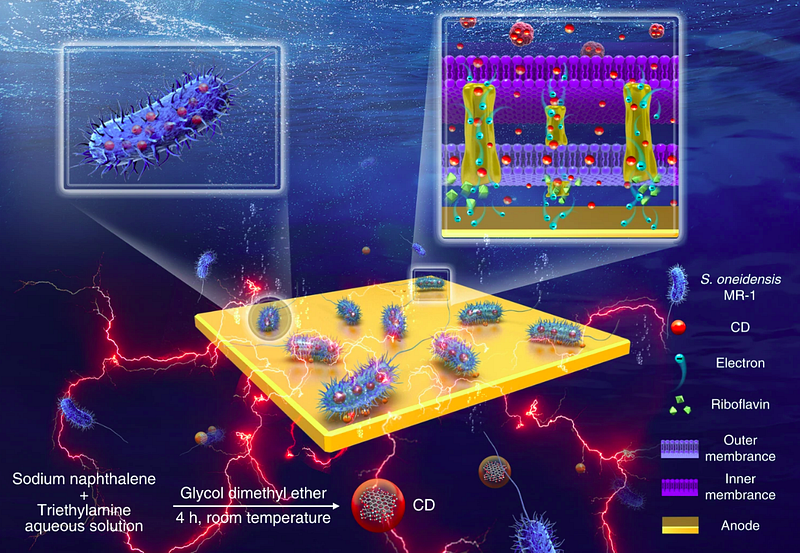
Now let’s move to the ecosystem in our guts. Guts are fascinating human structures with incredible connections to the nervous system, and with relevant roles for the immune system. Unfortunately, we probably don’t have butterflies as the common knowledge suggests, but we have certainly “electrifying things”. Shewanella have been found in the intestine of some animals but not specifically in humans. Nevertheless, other exoelectrogenic bacteria — like the Listeria monocytogenes — have been found in humans.
To be fully clear, L. monocytogenens are not part of the natural gut ecosystem in humans. They can be introduced during the eating process, and can cause food poisoning. Indeed, we call this infection listeriosis.
The mechanism of electricity generation from bacteria is similar to our breathing process, in the sense that they do it to remove electrons produced during metabolism and support the production of energy. This might be particularly pronounced in the gut, as this electricity-generating process is probably a “back-up system” used in low-oxygen conditions (the gut). It appears that our guts might provide sufficient scaffolding to them, likewise the synthetic ones described above.
It is unlikely that we will harness electrical power from the gut of human beings, unless we imagine a distopian future Matrix-style. Nevertheless, those bacteria allow us to study their genes and therefore to understand better which protein is responsible of the exoeletrogenesis. Opening up new way to future technologies.
We can design bacteria-based energy-generating technologies, or organic battery cells where those live, resolving the waste of toxic materials from currently used batteries. Lastly, it is fascinating to imagine that we literally have an entire ecosystem producing energy in our belly.


References:
Hu, Y., Rehnlund, D., Klein, E., Gescher, J., & Niemeyer, C. M. (2020). Cultivation of Exoelectrogenic Bacteria in Conductive DNA Nanocomposite Hydrogels Yields a Programmable Biohybrid Materials System. ACS Applied Materials & Interfaces, 12(13), 14806–14813.
Yang, C., Aslan, H., Zhang, P., Zhu, S., Xiao, Y., Chen, L., … & Wang, L. (2020). Carbon dots-fed Shewanella oneidensis MR-1 for bioelectricity enhancement. Nature Communications, 11(1), 1–11.
Light, S. H., Su, L., Rivera-Lugo, R., Cornejo, J. A., Louie, A., Iavarone, A. T., … & Portnoy, D. A. (2018). A flavin-based extracellular electron transfer mechanism in diverse Gram-positive bacteria. Nature, 562(7725), 140–144.