
Backtesting Hull Moving Average (HMA) Algo-Trading: NVDA Price vs Volume Buy/Sell Signals & Expected Returns

- The objective of this post is to effectively backtest two Nvidia (NASDAQ: NVDA) algo-trading strategies based on the Hull Moving Average (HMA) trading indicator.
- According to Zacks, NVDA is a top growth stock for the long-term. NVDA is a #2 (Buy) on the Zacks Rank, with a VGM Score of B. NVDA has a Growth Style Score of A, forecasting year-over-year earnings growth of 84.7% for the current fiscal year. With a solid Zacks Rank and top-tier Growth and VGM Style Scores, NVDA should be on investors’ short list.
- Our current goal is to compare expected returns generated by HMA NVDA historical price vs volume crossover signals, being referred to as Strategies A and B, respectively.
- While many traders focus solely on trading strategies that utilize price data only (Strategy A), we will delve into the importance of volume analysis and explore how Strategy B can provide insights into potential market trends and strength.
Price-Volume HMA Crossover Strategies
- Conventionally, the HMA crossover strategy involves using two different HMA timeframes, a shorter period and a longer period, to generate trading signals when they cross each other.
- The key idea is to generate buy and sell signals based on the interaction between the two HMA lines. As with other moving average indicators, when the price/volume crosses above the HMA line from below, it is considered a buy signal. Conversely, when the price/volume crosses below the HMA line from above, it is a sell signal.
- Generally, the HMA strategy reduces noise in the data and provides clearer buy or sell signals when used alongside other technical indicators like oscillators or trend lines.
- Unlike other moving averages that rely solely on closing prices, Strategy A takes into account high and low prices as well. This additional information helps smooth out volatility and provides a more comprehensive view of market dynamics.
- In the proposed technical analysis, Strategies A and B are combined specifically to support investors that incorporate price-volume relationships into their trading decisions.
Let’s explore nuts & bolts of the HMA algo-trading strategies, covering everything from their implementation in Python to backtesting NVDA HMA price vs volume entry/exit positions and expected cumulative returns of Strategies A and B.
Downloading Stock Data
- Importing libraries and reading the NVDA historical stock data 2022–2024
import datetime as dt
import pandas as pd
import numpy as np
import matplotlib.pyplot as plt

plt.style.use('fivethirtyeight')
plt.rcParams['figure.figsize'] = (20,10)

def download_stock_data(ticker,timestamp_start,timestamp_end):
    url=f"https://query1.finance.yahoo.com/v7/finance/download/{ticker}?period1={timestamp_start}&period2={timestamp_end}&interval\
=1d&events=history&includeAdjustedClose=true"
    df = pd.read_csv(url)
    return df

datetime_start=dt.datetime(2022, 1, 1, 7, 35, 51)
datetime_end=dt.datetime.today()

# Convert to timestamp:
timestamp_start=int(datetime_start.timestamp())
timestamp_end=int(datetime_end.timestamp())

ticker='NVDA'

df = download_stock_data(ticker,timestamp_start,timestamp_end)
df = df.set_index('Date')
df.tail()
           Open       High       Low        Close     Adj Close   Volume
Date
2024-05-13 904.780029 909.979980 885.289978 903.989990 903.989990 28968000
2024-05-14 895.989990 916.510010 889.340027 913.559998 913.559998 29650700
2024-05-15 924.719971 948.619995 915.989990 946.299988 946.299988 41773500
2024-05-16 949.099976 958.190002 941.030029 943.590027 943.590027 32395200
2024-05-17 943.690002 947.400024 918.059998 924.789978 924.789978 34651900
Plotting SMA20 vs HMA20
- Calculating and plotting 20-day HMA vs SMA for Adj Close price
def hma(period):
 wma_1 = df['Adj Close'].rolling(period//2).apply(lambda x: \
 np.sum(x * np.arange(1, period//2+1)) / np.sum(np.arange(1, period//2+1)), raw=True)
 wma_2 = df['Adj Close'].rolling(period).apply(lambda x: \
 np.sum(x * np.arange(1, period+1)) / np.sum(np.arange(1, period+1)), raw=True)
 diff = 2 * wma_1 - wma_2
 hma = diff.rolling(int(np.sqrt(period))).mean()
 return hma
period = 20
df['hma'] = hma(period)
df['SMA20'] = df['Adj Close'].rolling(period).mean()
figsize = (10,6)
df[['Adj Close','hma','SMA20']].plot(figsize=figsize)
plt.title('Hull Moving Average {0} days'.format(period))
plt.show()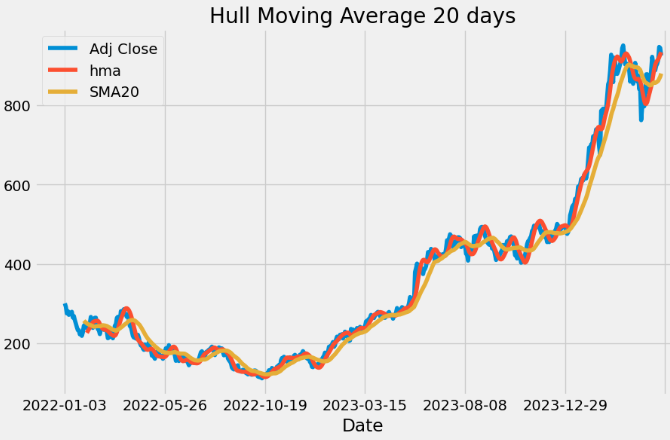
Plotting HMA Short/Long Lines
- Calculating and plotting short (20-day) and long (30-day) HMA lines
df['hma_short']=hma(20)
df['hma_long']=hma(30)
figsize = (12,6)
df[['Adj Close','hma_short','hma_long']].plot(figsize=figsize)
plt.title('Hull Moving Average')
plt.show()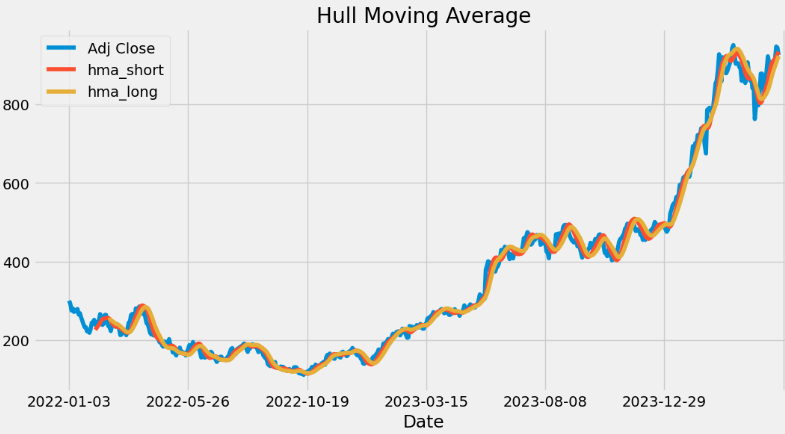
Comparing HMA Volume vs Period
- Invoking the volume to calculate the weighted average
def hma_volume(period):
 wma_1 = df['nominal'].rolling(period//2).sum()/df['Volume'].rolling(period//2).sum()
 wma_2 = df['nominal'].rolling(period).sum()/df['Volume'].rolling(period).sum()
 diff = 2 * wma_1 - wma_2
 hma = diff.rolling(int(np.sqrt(period))).mean()
 return hma
df['nominal'] = df['Adj Close'] * df['Volume']
period = 20
df['hma_volume']=hma_volume(period)
figsize=(12,8)
fig, (ax0,ax1) = plt.subplots(nrows=2, sharex=True, subplot_kw=dict(frameon=True),figsize=figsize)
df[['Adj Close','hma_volume','hma']].plot(ax=ax0)
ax0.set_title('HMA Volume vs HMA period')
df[['Volume']].plot(ax=ax1)
ax1.set_title('Hull Moving Average')
plt.show()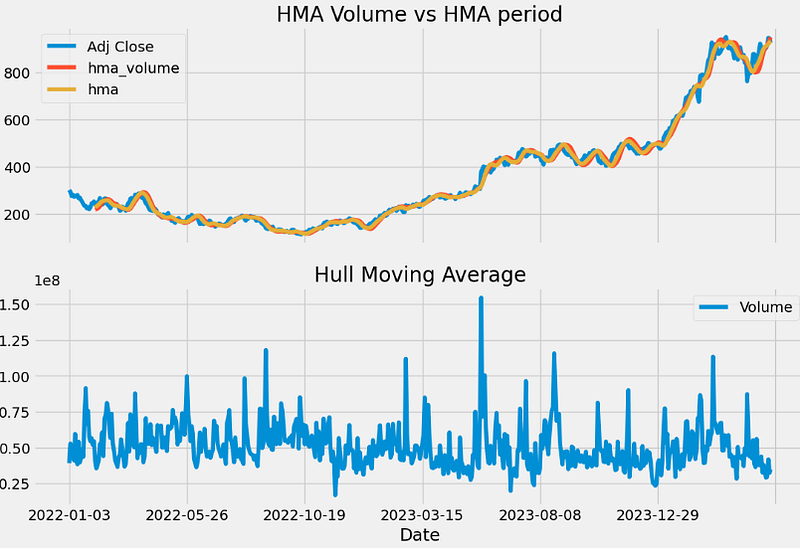
Backtesting Strategy A
- Calculating trading signals and cumulative returns (CR) of Strategy A
#SIGNAL
df['hma_short']=hma(20)
df['hma_long']=hma(30)
df['signal'] = np.where(df['hma_short'] > df['hma_long'],1,-1)

#RETURN
df['signal_shifted']=df['signal'].shift()

## Calculate the returns on the days we trigger a signal
df['returns'] = df['Adj Close'].pct_change()

## Calculate the strategy returns
df['strategy_returns'] = df['signal_shifted'] * df['returns']

## Calculate the cumulative returns
df1=df.dropna()
df1['cumulative_returns'] = (1 + df1['strategy_returns']).cumprod()

#PLOT
figsize=(12,8)
fig, (ax0,ax1) = plt.subplots(nrows=2, sharex=True, subplot_kw=dict(frameon=True),figsize=figsize)
df[['Adj Close','hma_long','hma_short']].plot(ax=ax0)
ax0.set_title("HMA: Short vs Long")

df[['signal']].plot(ax=ax1,style='-.',alpha=0.4)
ax1.legend()
ax1.set_title("HMA - Signals")
plt.show()

df1['cumulative_returns'].plot(figsize=(10,4))
plt.title("Cumulative Return")
plt.show()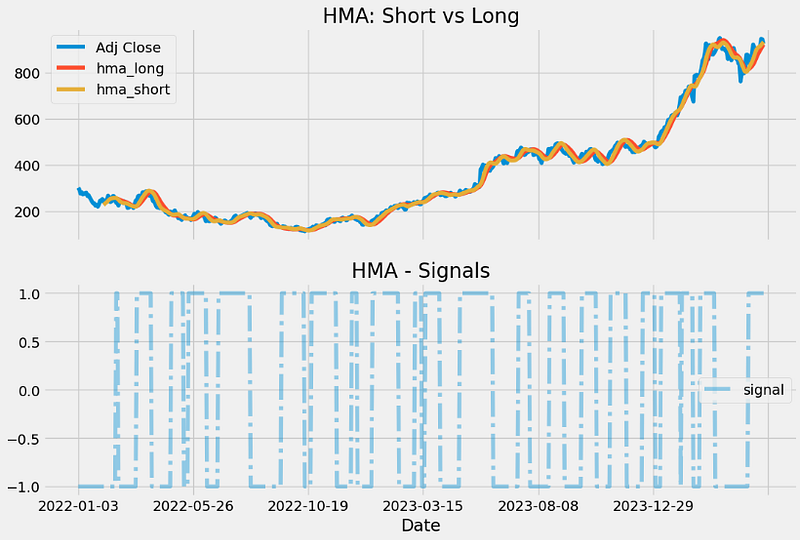
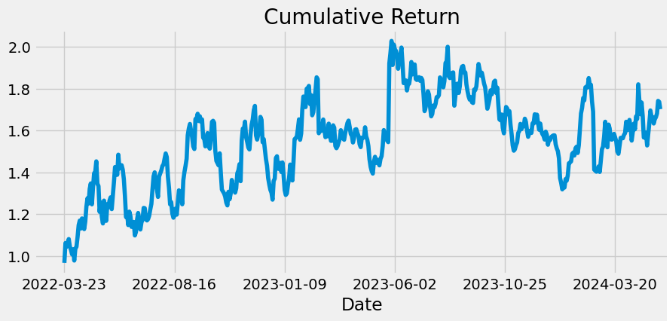
- Printing the latest value of CR
df1['cumulative_returns'].tail()[-1]

1.7016343263088096
Backtesting Strategy B
- Calculating trading signals and cumulative returns (CR) of Strategy B
#SIGNAL
df['hma_volume_short']=hma_volume(20)
df['hma_volume_long']=hma_volume(30)
df['signal'] = np.where(df['hma_volume_short'] > df['hma_volume_long'],1,-1)

#RETURN
df['returns'] = df['Adj Close'].pct_change()

## Calculate the strategy returns
df['strategy_returns'] = df['signal'].shift() * df['returns']

## Calculate the cumulative returns
df2=df.dropna()
df2['cumulative_returns_volume'] = (1 + df2['strategy_returns']).cumprod()

# PLOT
figsize=(12,8)
fig, (ax0,ax1) = plt.subplots(nrows=2, sharex=True, subplot_kw=dict(frameon=True),figsize=figsize)
df[['Adj Close','hma_volume_short','hma_volume_long']].plot(ax=ax0)
df[['signal']].plot(ax=ax1,style='-.',alpha=0.4)
ax0.set_title("HMA - Volume: Short vs Long")
ax1.legend()
plt.title("HMA - Signals")
plt.show()

figs = (10,4)
df2['cumulative_returns_volume'].plot(figsize = figs)
plt.title("Cumulative Return")
plt.show()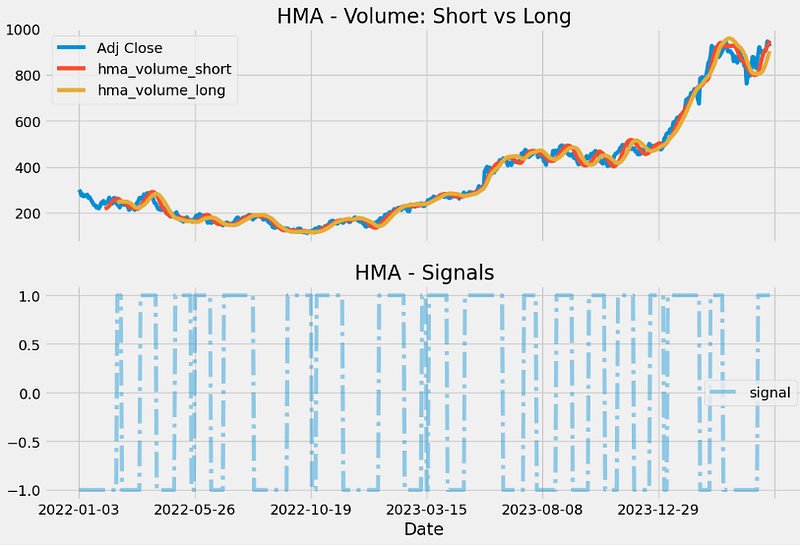
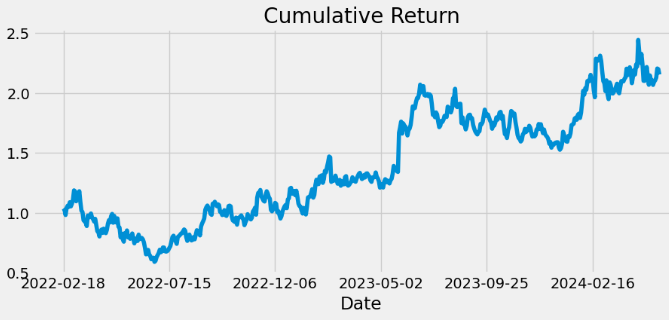
- Printing the latest value of CR
df2['cumulative_returns_volume'].tail()[-1]

2.1535115868707386
Trading Signals of Strategies A and B
- Comparing trading signals of Strategies A and B
df['signal'] = np.where(df['hma_short'] > df['hma_long'],1,-1)
df['signal_volume'] = np.where(df['hma_volume_short'] > df['hma_volume_long'],1,-1)
figsize=(12,8)
df[['signal','signal_volume']].plot(figsize=figsize)
plt.show()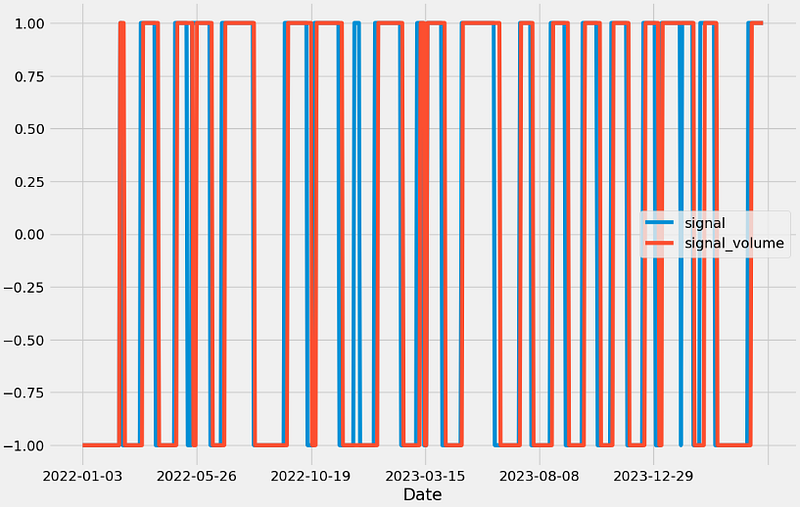
Backtesting Buy & Hold Strategy
- Calculating expected returns of the NVDA Buy/Hold passive strategy
# Selecting libraries
import yfinance as yf
import pandas as pd
import numpy as np

benchmark='NVDA'
def get_benchmark(start_date, investment_value):
    spy=yf.download(benchmark, start=start_date)['Adj Close']
    benchmark1 = pd.DataFrame(np.diff(spy)).rename(columns = {0:'benchmark_returns'})

    investment_value = investment_value
    number_of_stocks = floor(investment_value/spy[0])
    benchmark_investment_ret = []

    for i in range(len(benchmark1['benchmark_returns'])):
        returns = number_of_stocks*benchmark1['benchmark_returns'][i]
        benchmark_investment_ret.append(returns)

    benchmark_investment_ret_df = pd.DataFrame(benchmark_investment_ret).rename(columns = {0:'investment_returns'})
    return benchmark_investment_ret_df

benchmark1 = get_benchmark('2022-01-01', 10000)

investment_value = 10000
total_benchmark_investment_ret = round(sum(benchmark1['investment_returns']), 2)
benchmark_profit_percentage = floor((total_benchmark_investment_ret/investment_value)*100)
print(cl('Buy/Hold Profit by investing $10k in NVDA: {}'.format(total_benchmark_investment_ret), attrs = ['bold']))
print(cl('Buy/Hold Profit percentage : {}%'.format(benchmark_profit_percentage), attrs = ['bold']))

Buy/Hold Profit by investing $10k in NVDA: 20592.3
Buy/Hold Profit percentage : 205%
Backtesting S&P 500 Benchmark
- Calculating expected returns of the ^GSPC benchmark
benchmark='^GSPC'
def get_benchmark(start_date, investment_value):
    spy=yf.download(benchmark, start=start_date)['Adj Close']
    benchmark1 = pd.DataFrame(np.diff(spy)).rename(columns = {0:'benchmark_returns'})

    investment_value = investment_value
    number_of_stocks = floor(investment_value/spy[0])
    benchmark_investment_ret = []

    for i in range(len(benchmark1['benchmark_returns'])):
        returns = number_of_stocks*benchmark1['benchmark_returns'][i]
        benchmark_investment_ret.append(returns)

    benchmark_investment_ret_df = pd.DataFrame(benchmark_investment_ret).rename(columns = {0:'investment_returns'})
    return benchmark_investment_ret_df

benchmark1 = get_benchmark('2022-01-01', 10000)

investment_value = 10000
total_benchmark_investment_ret = round(sum(benchmark1['investment_returns']), 2)
benchmark_profit_percentage = floor((total_benchmark_investment_ret/investment_value)*100)
print(cl('Benchmark Profit by investing $10k in ^GSPC: {}'.format(total_benchmark_investment_ret), attrs = ['bold']))
print(cl('Benchmark Profit percentage : {}%'.format(benchmark_profit_percentage), attrs = ['bold']))

Benchmark Profit by investing $10k in ^GSPC: 1013.42
Benchmark Profit percentage : 10%
Conclusions
- Our HMA backtesting results can be summarized in terms of 2Y NVDA ROI % on 2024–05–17 as follows:
- Strategy A: 170
- Strategy B: 215
- Buy/Hold: 205
- ^GSPC: 10
- We can see that Strategy B yields the highest win rate.
- All three strategies outperform the S&P 500 from 2022–01–01 to 2024–05–17.
Credits
References
- Hull Moving Average (HMA) Using Python
- Mean Reversion Trading Strategy Using Python
- Advanced Trading Techniques: Mastering the Hull Moving Average
- Nikhil-Adithyan/Algorithmic-Trading-with-Python
Explore More
- A Market-Neutral Strategy
- A Comprehensive Analysis of Best Trading Technical Indicators w/ TA-Lib — Tesla ‘23
- NVIDIA Returns-Drawdowns MVA & RNN Mean Reversal Trading
- NVIDIA Rolling Volatility: GARCH & XGBoost
- IQR-Based Log Price Volatility Ranking of Top 19 Blue Chips
- Plotly Dash TA Stock Market App
- Data Visualization in Python — 1. Stock Technical Indicators


