
Backstage of a new service designed for Leroy Merlin France
Back in May 2017 my wife and I had moved from Brazil to France. On my very first days here, my goal was to design a new service within the company and do that using all the good practices of an agile and user-centric project. In this post, I’ll share with you guys some stuff about this journey. : )
Until late 2018, I was working at the Innovation Department at Leroy Merlin France, where I’m proud to say that I’ve had the “go for it” to conduct this project in this way without all the traditional “corporate bs” of huge companies.
The service created: Last-minute home services How does it work? Quite simple, in fact.
- Are you locked outside your house?
- Do you have a water leak in your apartment?
- Electrical breakdown?
- Problem on your heating system?
A qualified and reliable professional will arrive at your house in less than 2h, for an affordable price!
Quality, trust, agility, and transparency
Were the missing values for this niche in the French market. There were several professionals available, but there was as well a great level of unsatisfied customers. For example, the professionals were either late either they didn’t show at all. We had as well a hand full of fake websites where customers paid for a service that just… didn’t exist. : (
In August/17, when we started the project, the first thing to do was fast research to see which companies were working on this matter. We’ve chosen 2 out of 15 and invited them for a meeting.
David e Golias: Allies instead of enemies.
The typical marriage where the huge brand full of Clients needs the quality and agility of a small and ready-to-go company on the run of conquering a good amount of Clients.
Instead of starting from scratch, what would slow us down a lot, we’ve decided on having a partnership with those 2 start-ups, that were already working in this niche for quite a bit of time, and in our evaluation were the best ranked on the values I’ve mentioned above.
The deal was simple: We would bring Clients, with all the trust and legitimacy around our brand and our partners would bring all the excellence to perform the services for those people.
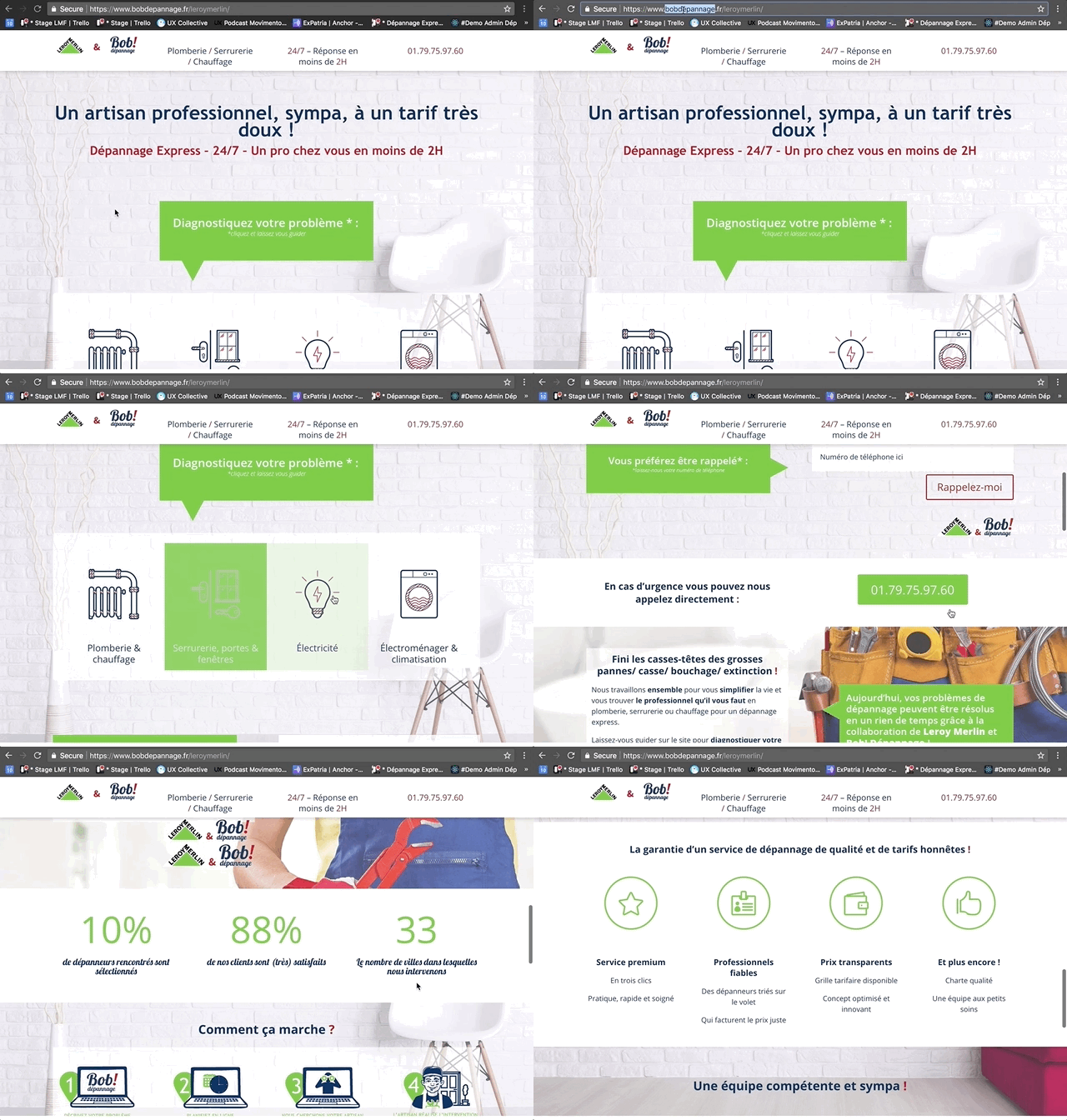
In September/17 we’ve launched our very first sketch of the service, the simplest possible way.
Each start-up created one landing page “/Leroymerlin” on their own website, we’ve taught the staff of the store and after just 30 days between our first handshake, the service was deployed.
Quality + Trust
After 2 months, middle November/17, we had an analysis of customer's behavior and the performance of our partners. We've learned that one of the two companies was exactly what we were looking for as a partner.
At that time, we did a few interviews with Clients to understand a bit more about their journey to find, chose and hire who would provide their home-service. It goes without saying that the internet was the shortest path to find someone qualified.
We were then on our way to our second challenge: would it work at a “Uber-like” model?
Fast forward for the future (may/18): Facebook’s market place expands to service” :
“More people ask for recommendations related to home services on Facebook in the U.S. than any other topic,” said Bowen Pan, Product Manager at Facebook”
…ok, we’re back in 2017, end of December.
We’ve started to design our own website instead of a landing page on our partner's domain.
It’s the very first version, a result of a design sprint, came up to life. The important thing here was that we’ve evolved from “partner.fr/leroymerlin” to our own address within the main website of our brand: “depannage.leroymerlin.fr”. It was a way to tell customers “hey, we’re Leroy Merlin and this is an official service” rather than “Leroy Merlin trust this service”
The user flow was simple :

Bellow, one example in the video of the flow at the time :
Merry Christmas, Happy new year’s eve… hello January/18! : )
With that model + a satisfaction rate of 99% versus a digital conversion of… 0% we’ve learned one important thing :
The trust-transfer between our brand to our partner were relevant on physical world. On digital side, we were just a sad waste of people’s precious time. 😿
Customers were going on our website, they found the right service and when on the partner’s checkout flow they gave up…
Design sprint sketching hypothesis to solve this problem, The internet is powerful though, without even one line of code we’ve come up with a new workflow, and all we had to do to deploy it was:
- create Typeform account + form
- create Zapier account + connect with our Typeform, slack and e-mail
- modify the link that sent customers for the partner’s checkout flow in order to send them to the Typeform (in our first MVP, this was the only thing we could dynamically change on the back-end without needing a dev)
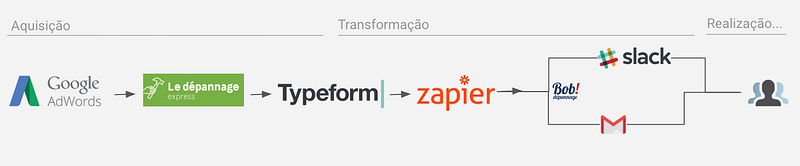
We’ve tested out this refinement in one service, after no time we had the first conversion, and another…. and another. We’ve switched this approach on the entire site. The outcome?

99% satisfaction rate : kept | 0% conversion rate : surpassed
After this test, we’ve increased by 250% the number of service orders online. Surpassing the number of orders from physical stores.
A small video with the user flow:
Goodbye complex “no conversion” flow. Hello, complex operational flow. I’ll explain myself… Usually, when you solve a problem there’s a good chance of throwing other problems into play.
So far, the distribution of service orders on our partners' side was automatic, which means that every time a demand arrived, the system could automatically attribute it to one cluster of professionals available to provide the service in the right region, as soon as possible. With this new flow, we’ve added one human not-scalable layer in the flow: A.K.A Telephone. We needed one active employee to answer customers in less than 2 minutes, 24/7.
And, talking about trust, it wasn’t yet the ideal. People were still going out of the main website to a new interface, in a different domain in order to complete their request…
The good thing to know, at that moment we already had a great capacity of collecting data from tools like Google Analytics, Hotjar, Speed Curve and such… we’ve started to experiment several incremental innovations through a/b tests. The goal was to enhance the user experience on the website. On the operational side, we’ve canceled all ads between 11 pm and 7 am to allow our partner’s staff to rest given we didn’t have late-night orders.
At the beginning of march/18, we’ve launched a more stable version, that looked like this :
Cool, customers didn't have any more to go out of our website to order.
After one month, we’ve realized that such experience had still a great rupture.
Payment + invoice
So far, (April/18) all payment processes were made with cash, check — it's still used in France — or wire-transfer. The invoice, sent by the professional after a few days.
Some customers wasn’t that confortable : “How so? I hire Leroy, I get a pro from Bob and the invoice is plombier.com? Weird !”
Besides, it was difficult for us to measure several metrics from the moment customers order the service until the service is over and customers satisfied.
We deep dive into what was the most complete part of this project since the handshake with our partners in this “Phygital” service.

Which brings us to the flow released on July/2018 :
The project continues at full throttle, and new problems are being solved. After 2 weeks of deploying the online payment, we’ve launched the service evaluation feature.
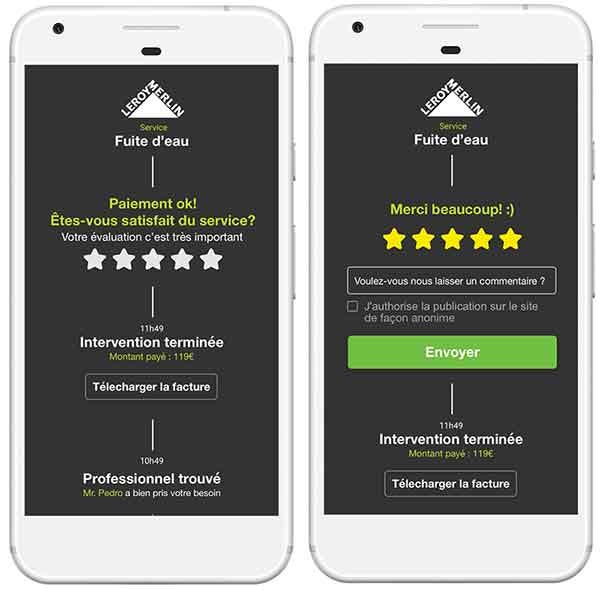
We’re now 1 year after its inception, focused on filling the main gaps that we still have in the overall experience. It goes from optimizing the acquisition channels until our partner’s experience.
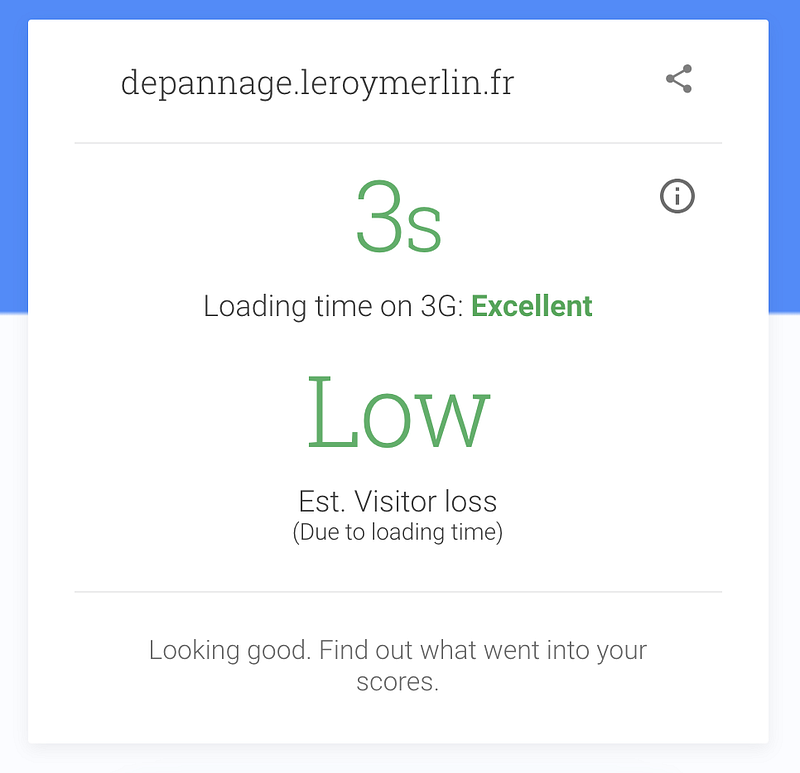
In another article, I’ll address the Tech stack behind this project, I’ll leave for you a spoiler bellow with our page load time
So… how was it to create a new service, in a new country for a huge company?
It was and it is being awesome. : )
Something really interesting in this journey was seeing how “underground” (in a good way, please) was my approach to several corporate matters. This is a subject for another article where I’ll share how we can work-around a corporate system without having to hide things, lie or deceive people.
Another very important detail, if you speak french, you will notice several grammar errors on those videos and screenshots available here. It’s really hard to design interfaces in a language that you do not master, this is also a subject for another article. We did several fixes along the way and double-check before deploying anything. But still, several mistakes went through but they were fixed in time.
Mistakes are such an incredible resource towards evolution as long as you can do two things with it: fix it fast and learn from it.
Thank you very much for reading so far, and we’ll see you in my next article! : )
A huge thanks to jonathan jalouzot, Fabien and Kamau from Eleven Labs on this project.