
Backspin: Mary J. Blige — What’s the 411? (1992)
The day the paradigm shifted. (92.5/100)
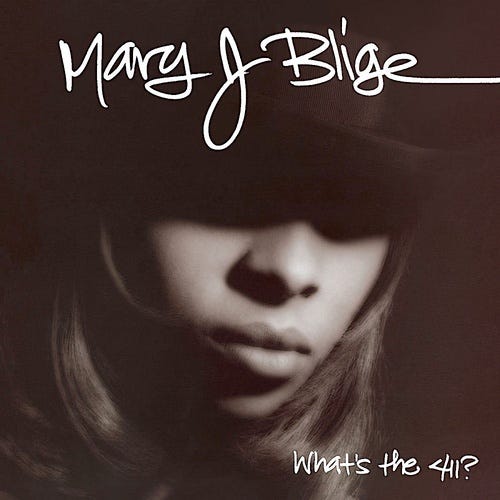
Mary J. Blige might be the most important musical artist of the ’90s. Unlike her most notable rivals for the distinction, she didn’t have to die to achieve it. Instead, she breathed life into a stagnating legacy genre and expanded our very conception of what its burgeoning successor could be.
What’s the 411? didn’t just signal a paradigm shift in urban music, it was the paradigm shift. Blige’s seismic debut is the moment hip-hop turned its mama out, engulfing R&B in its street seasoned aesthetic. It positioned hip-hop squarely in the center of the urban music orbit where R&B had reigned supreme for decades, realigning the solar system around its herculean gravitational pull.
Blige is an R&B singer; more precisely, a soul singer. But she’s a hip-hop artist. Her emotive rasps pulsate with the defiant grit of New York streets, not dirt roads and juke joints. Rather than floating atop lush arrangements, her vocals bounce in concert with the propulsive rhythms of breakbeats. Her preferred attire of baggy jeans, boots, and jerseys spit in the face of the diva glamor that had defined R&B queens from the Motown era through the champagne soul of the ‘80s.
When “You Remind Me,” Blige’s debut single, hit clubs and airwaves in spring of ’92 via the Strictly Business soundtrack, hip-hop heads heard ourselves in an R&B song for the first time. This wasn’t our parents’ R&B. The shimmering keyboards behind Blige’s unvarnished vocals during the extended intro felt weightless, slowly elevating like the euphoria of young love itself.
When the beat dropped along with the instantly hummable chorus, it felt at once fresh and familiar. Were those the eccentrically stuttered drums from Biz Markie’s “Biz Dance Part One” grounding the etherial synths on the cold concrete of blacktops and subway platforms? Hip-hop had been sampling R&B since its embryonic stages, and the old heads wouldn’t let us hear the end of it. Now R&B was sampling hip-hop? In true b-boy fashion, Mary’s unlikely summer anthem was spinning musical orthodoxy on its head.
When What’s the 411? hit shelves at the end of July, it landed as the summer’s most anticipated release, both among hip-hop heads and younger R&B devotees. While the Luther Vandross crowd wasn’t as enthusiastic, neither were they openly hostile as they had been at the onset of the late ’80s New Jack Swing era.
“Leave a Message,” the album’s now quaint intro on which a series of hip-hop luminaries from DJ Red Alert to Heavy D leave effusive answering machine messages for music’s fastest rising star, leans into Mary’s standing as hip-hop’s favorite chaunteuse. It seamlessly transitions into the extended soul vamp that revs up “Reminisce,” the album’s sensuous third single.
Built atop the propulsive synth bassline of MC Lyte’s “Stop, Look, Listen” and the punctuative keyboard stab from 7th Wonder’s “Daisy Lady,” a DJ favorite since the park jam days, “Reminisce” keeps its feet firmly planted in the fertile soil of hip-hop. Yet, from the mid-tempo bounce of Dave “Jam” Hall’s production to Mary’s measured vocals, the songs draws its power from it’s deliberateness. Mary luxuriates in the ethereal synths and dramatic open spaces, imbuing the song a maturity rarely felt in New Jack Swing hits, even as its paean to love past brings a youthful innocence to the tried and true R&B trope.
Where “Reminisce” draws its emotional resonance through restraint, “Real Love” flips the coin on its head, viscerally connecting through reckless abandon. The instantly recognizable stutter-step of the drums from Audio Two’s “Top Billin’” retains every bit of its party rocking power, while a jubilant keyboard riff, courtesy of co-producer Mark C. Rooney, builds momentum. Mary rides the beat with the rhythmic precision of an MC, but the writing by the song’s other producer Mark Morales (aka Prince Markie Dee of Fat Boys fame) charts an emotional journey in the mold of vintage soul burners.
We ride with Mary through the adrenaline rush of infatuation and the tumult of heartbreak en route to battle tested resilience that only strengthens her underlying belief in love and ultimately herself:
So I try my best and pray to God he’ll send me someone real To caress me and to guide me towards a love my heart can feel Now I know I can be faithful, I can be your all and all I’ll give you good lovin’ through the summertime, winter, spring and fall
Thematically, it’s a precursor to the growth-through-pain motif that underscores many of Mary’s most iconic songs. Tonally, it’s perhaps the most innocently optimistic she has ever been on a record.
What’s the 411?’s middle section slows the pace for Mary to dive deeper into the soul side of her repertoire. An impassioned re-make of Rufus’s Chaka Khan helmed creeper classic “Sweet Thing” provides a welcomed breather. Morales and Rooney wisely avoid the impulse to re-invent the wheel. Their imagining retains the dreamy warmth and leisurely tempo of the original.
But where Khan’s vocals ache with resignation, Mary’s sear with desperation, as if fighting to extend a fleeting moment of elicit passion into infinity. The addition of an anvil-heavy drum break from Barry White’s “I’m Gonna Love You Just a Little More Baby” accentuates Mary’s urgency, while giving the track just enough knock to boom in your jeep.
“Love No Limit” offers a jazzy jaunt of romantic bliss aimed straight at the grown and sexy and those aspiring to be. Mary unveils a lower register and a playful skat-inspired delivery on the first verse, before belting out the second with pure soul power.
In contrast, “I Don’t Want To Do Anything” delivers a torch ballad for a new generation of lovers. Clocking in at nearly 6 minutes of gloriously overwrought vocal sparring from Mary and her then real life partner, Jodeci’s K-Ci Hailey, it feels like “Fire and Desire” for the post New Jack Swing age.
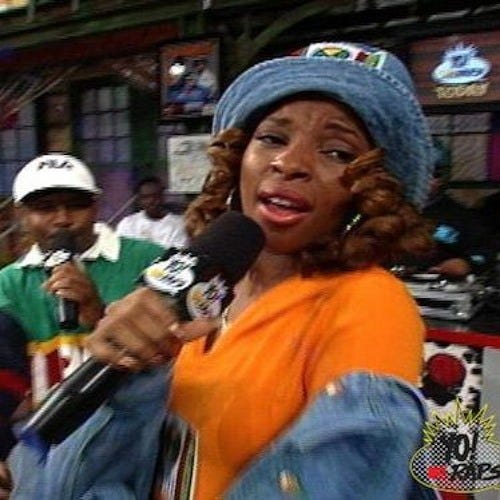
It’s a testament to the pair’s volcanic chemistry, as well as the freedom of urban radio in its waning days of local ownership, that the duet received massive airplay despite never getting an official release as a single. Almost unimaginable in the post corporate consolidation world (thank the 1996 Telecommunications Act), nearly every track on What’s the 411? received some form of radio play, even the deepest of album cuts.
Ambient slow burner “Slow Down” became a late night staple, helping to modernize the Quiet Storm format with its soaring synths and slapping snares. “My Love” scored the occasional mix show spin, it’s easy bounce and imminently hummable melody making it the perfect warm up track for the afternoon portion of the cookout. Even the title track, in which Mary solidifies her hip-hop cred going rhyme for rhyme with Grand Puba, scored daytime rotation with it’s battle-of-the-sexes repartee. Despite Puba’s rakish charisma, Mary holds her own with the bars:
I don’t have no time for no ‘Wham-bam-thank-you-ma’am’ Gas me up, get me drunk, hit the skins and scram The same ol’ s*** you pulled last week on Pam I’m not havin’ that, no, I’m not havin’ that You gotta do a lot more, and that’s just how it be I’m Mary Blige and you just ain’t runnin’ up in me I need a man whose lookin’ out with some security So come correct with some respect, and then we will see So if you with it, then drop the seven digits And I might just give you a call If you ain’t wit’ it, then don’t waste your time at all
The only track I don’t recall ever hearing on the radio is the Biz Markie sampling “Changes I’ve Been Going Through,” which is perhaps the album’s purest banger outside of “Real Love”.
What’s the 411? may well be the most transformative R&B album since Marvin Gaye’s What’s Going On. Just as Marvin’s 1971 opus ushered in an era of auteurist prog soul signaling the sunset of the assembly line polish of the classic ’60s Motown sound, Mary’s missive stomped out the bourgeois elegance of ’80s champagne soul with beat heavy bounce and blunt emotional rawness.
Within a year of Mary’s debut, Janet was cooing sweet nothings over James Brown loops and Mariah was belting atop the “Blind Alley” sample popularized by Big Daddy Kane. Urban contemporary radio downshifted its target demographic from 25–54 to 18–34, opening the floodgates for a bevy of Renaissance era hip-hop artists to crack daytime rotations and become cultural icons. None other than New York’s future king, Biggie Smalls, would introduce himself to the masses via a blistering feature on the “Real Love” remix.
What’s the 411?’s wunderkind executive producer, Sean “Puffy” Combs, astutely branded Mary J. Blige “The Queen of Hip-Hop Soul”. While the moniker captured the multitudes of Mary, it also missed the point. Mary didn’t birth a new genre so much as evolve a legacy genre, adapting it to the rhythms and rhetoric of the time. Simultaneously, she broadened the reach of the burgeoning culture, illustrating that hip-hop could produce musical styles beyond just rap.
That’s a paradigm shift of truly royal proportions.
By the Numbers
Production: 9.5 Lyrics (how the words are put together): 7.5 Delivery & Flow: 9 Content (Substance): 7.5 Cohesiveness: 9.5 Consistency: 10 Originality: 9.5 Listenability: 10 Impact/Influence: 10 Longevity: 10
Total — 92.5
Related
Next
Previous
SEE ALL..
Backspin is a look back at the albums that shaped and defined hip-hop. It explores what made them resonate, the impact they had on the culture, and where they fit in today’s ever-expanding hip-hop canon.