
Backspin: Kool G. Rap & DJ Polo — Live and Let Die (1992)
The ultimate “rapper’s rapper” triangulated a blueprint for an era of New York crime rhymes. (85/100)
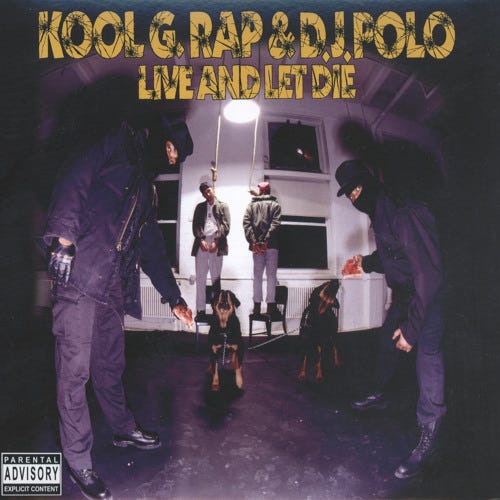
You may not have been bumping Live and Let Die in 1992. The third album from the Kool Genius of Rap and his erstwhile DJ barely registered on the charts, and was later pulled from distribution due to its controversial cover. But if you cut your teeth on mid-90s New York hip-hop, your favorite rapper was likely listening closely.
Kool G. Rap’s standing as the ultimate “rapper’s rapper,” a devastatingly deft spitter of meticulously syncopated multisyllabic missives, positioned him perfectly to be the first New York heavyweight to incorporate the innovations of other regions into his repertoire without losing street cred at home. Live and Let Die stands as an early example of hip-hop’s triangulation, combining stylistic hallmarks of the West and South with the lyrically dense MCing acumen upon which New York had long prided itself.
The copious bodycount and omnipresence of frequent Ice Cube collaborator Sir Jinx behind the boards makes it tempting to view Live and Let Die as G. Rap’s take on West Coast gangsta rap. In actuality, it’s far more adaptation than imitation. The intro establishes a distinctly New York milieu. A voiceover, delivered over the regal trumpet from “The Godfather Waltz,” imagines the city of 8 million stories as:
A place of opportunity and success, where most men discover their wildest dreams… But in some places, you be careful crossing the street.
“On the Run” delivers the first of many vividly rendered stories of aspiration, desperation, and cold blooded brutality from the other side of the street. Unlike the prototypical West Coast gangsta tale of corner boys and drive-bys, the cult classic is anchored in the upper reaches of New York’s long mythologized organized crime scene.
Where gangsta rap icons told stories, G. Rap builds an entire world and worldview. Shadowy bosses control an underground economy in which he’s simply a conduit, moving money and contraband from one family to another. Half a million dollars in hand and frustration at heart, G. Rap decides to make a bold play to realize his own American dream and takes off with the cash. The final two verses are rendered with a novelist’s penchant for pacing and suspense as G. Rap and his lady maneuver the city, gunning down mobsters in a high stakes play for their own piece of the pie.
While “On the Run” rides pensive jazz inflected production to ominously cinematic effect, Sir Jinx serves up a bubbling caldron of cascading horns and elongated electro-funk chords evoking blood simple intoxication on the title track. Where Ice Cube leverages the open spaces of similar soundscapes on Death Certificate, G. Rap packs his rhymes tight with staccato syllables. His lyrical barrages mimic the bustle of New York itself as he expounds on nature and nurture breeding the zero sum mentality behind the brutality on his side of the street.
Cause I grew up in the fast lane See, my pops ran the numbers and my moms held the blackjack games Now I’m able to leave the cradle I don’t remember the dinners, only the kilos on my kitchen table Sittin’ right beside a pistol And I’m watchin’ my pops pick up bricks made out of crystal While he was countin’ the green I seen nothin but strainers, containers, scales and rocks on a triple beam People was too afraid to stick him up Because he had the most notorious brothers to come and pick him up When I reached ten years old I never recalled seein’ any more money and drugs in the household Cause now pops was on his feet And to keep us from gettin’ hurt, he kept his dirt in the street And if he tried to attack Your family’s wearin’ black Because he just got your death put on a contract Another sucker to rub Even my mother’s walkin’ around packin’ a .357 snub And many cops dropped dead I seen a man pull out a pistol and blow off an undercover’s head Cause it’s hard to get by And that’s why, when you’re young in the streets You gotta live and let die
“Crime Pays” digs down another layer, laying bare the machinations of the capitalist machine that keep the streets waring while the suits in skyscrapers profit. If the title track is a nod to the West, “Crime Pays” offers a head tilt to the south with Jinx unleashing the gut bucket juke joint funk of the Bar-Kays’ “Jiving ‘Round” for a relentless mid-tempo grind. G. Rap matches it with an avuncular delivery reminiscent Scarface’s blues drenched inflections on amphetamines.
Unlike his later disciples, G. Rap doesn’t stick to a single persona across the entirety of the tracklist. Yet, “Train Robbery” feels like the culmination of the album’s inaugural song suite. With the world, its ethos, and its attitude firmly established, we accompany a trio of stick-up kids on a cold blooded subway caper.
The story’s immaculate detail is matched by its unrepentant nihilism. There’s no lesson, remorse, or larger social commentary. Nor is it cartoonishly over-the-top in the way of post-Ice Cube N.W.A’s gangsta fantasies. It’s simply a dispassionately rendered, disturbingly evocative recounting of a petty crime that quickly escalates to murder and rape, because that’s simply the world in which we live. In hindsight, it feels like an inflection point in the coarsening of hip-hop, opening the Pandora’s box of jarring brutality that ultimately coalesced into tracks like Biggie’s “Gimme the Loot”.
“Straight Jacket” takes an even darker turn, putting us in the passenger seat for the murderous marauding of a psychopath. While clearly inspired by Scarface’s “Diary of a Madman,” it’s the first notable instance of an East Coast artist incorporating mental illness into a first person narrative, and an early precursor to the New York gothic aesthetic that would inform RZA’s Gravediggaz and other standard bearers of the mid-90s horrorcore movement.
Sonically, “Edge of Sanity” explicitly evokes a horror movie, though the narrative is actually more grounded. G. Rap methodically walks us through the compounding struggles that gradually corrode the mental state of a seemingly average man until he’s capable of the horrific. It’s one of G. Rap’s best performance’s on the album, as he slows his delivery and minimizes his verbiage to truly let each line breathe in the eerie atmosphere of the production.
Best of all is the classic single, “Ill Street Blues”. Perhaps its the ragtime bounce of the Trakmasterz piano tinged production that puts a spritely spring in his step, but G. Rap seasons his machine gun flow with a wicked whimsey that breathes life into his typically well crafted crime story. The onomatopoeic climax practically dares you not to try to rap along as G. Rap bucks three shots out the window behind a recently dispatched adversary.
You know the evil that men do, hell is where the men go We snatched him by his hands and feet and threw him out the window Up, up, and away, cause I don’t play, clown Buck, buck, buck, take that with you on the way down
Ironically, Kool G Rap’s occasional master turns serves to highlight his one shortcoming as an MC on many of the other tracks. G. Rap is a rapper in the purest sense. He’s an exacting writer and a precise spitter of multi-syllabic rhymes. He’s not a performer in the manner of many of the West’s top gangsta rappers, who don’t simply deliver rhymes, but embody characters while acting out the narratives. It’s no coincidence that many of the most successful gangsta rappers ultimately became movies stars.
When the writing is first rate, G. Rap’s stories are involving enough to cover for the performance deficiencies. But when he phones in generic gun talk on tracks like “#1 With a Bullet” (despite a clinic in flow from G. Rap and Big Daddy Kane) and “Nuff Said,” the album loses steam. Similarly, rehashes of past favorites like “F*** U Man” (a “Talk Like Sex” sequel) and “Still Wanted Dead Or Alive” feel like filler, lacking the punch of the originals and muddying what started out as a tight concept record.
While the personality deficit and lack of availability likely contributed to the album’s failure to catch on among fans, its impact on the next generation of New York MCs has grown apparent with time. Be it Nas’s unwavering eye for the lurid details of urban decay, Biggie’s mastery of the macabre, or the outsider’s dogged pursuit of a dream eternally deferred that drove Raekwon and Ghostface’s Only Built for Cuban Linx, Live and Let Die is dominant in the DNA of the ensuing mid-90s Renaissance era. Upon first meeting, Big Pun took a knee and kissed the ring of Kool G. Rap, whom the Terror Squad capo routinely credited for his own rapid fire flow.
The magnitude of its importance may not have been obvious at the time. But G. Rap’s willingness, as a New York O.G. with unimpeachable street and microphone bona fides, to embrace innovations from the West and South gave fellow New York artists the freedom to adapt to the changing zeitgeists.
The relentless blues drenched closer, “Two to the Head,” perfectly synthesizes the album’s modus operandi. In a then unprecedented summit, Kool G. Rap shares the mic with Ice Cube, Scarface, and Face’s fellow Geto Boy, Bushwick Bill. The posse cut personifies the oncoming boundary busting of hip-hop in real time, with each MC absorbing the super powers of the others and growing stronger for it. Face and Cube display a heightened emphasis on crispness and syllabic precision in the mold of G. Rap. The Kool Genius, in turn, adopts Cube’s performative flair and Face’s mastery of mood and atmosphere.
The fact that Kool G. Rap’s most notable students ultimately surpassed the teacher doesn’t detract from the teacher’s acumen. In retrospect, it further elevates the breadth of Live and Let Die’s vision and the microphone mastery that made Kool G. Rap your favorite rapper’s favorite rapper.
By the Numbers
Production: 8.5 Lyrics (how the words are put together): 10 Delivery & Flow: 9.5 Content (Substance): 8.5 Cohesiveness:7.5 Consistency: 8 Originality: 9.5 Listenability: 8 Impact/Influence: 9.5 Longevity: 6
Total — 85
Next
Previous
SEE ALL
Backspin is a look back at the albums that shaped and defined hip-hop. It explores what made them resonate, the impact they had on the culture, and where they fit in today’s ever-expanding hip-hop canon.