
Backspin: Jay-Z — Vol.2… Hard Knock Life (1998)
With a genre in disarray, Jay-Z seized the throne with hip-hop’s most calculated classic. (86/100)
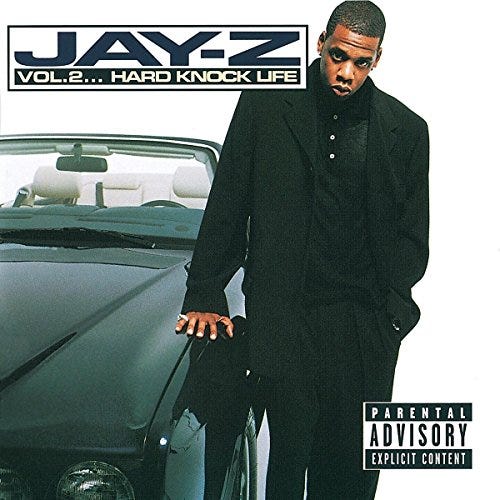
Jay-Z is hip-hop’s most strategic legend, and Vol. 2… Hard Knock Life may well be its most strategic classic. While not his greatest album or most beloved, it’s the project that best embodies him, defined by meticulous calculation and measured balance of competing elements.
In 1998, hip-hop was adrift. Still reeling from the murders of its two biggest icons, Tupac Shakur and The Notorious B.I.G., rap music was moving more CDs than ever, but lacked a clear direction. Puff Daddy’s shiny suit era was in full swing, churning out jiggy dance floor anthems to keep the east coast Harlem shaking. The sunset of the west coast’s G-Funk era, it’s gangsta fairytales suddenly rendered a little too real, made way for a southern invasion of irresistible bounce, but little lyrical weight. A genre historically driven by larger-than-life stars found itself facing a sky of dwarfs. Vol. 2 is Jay-Z’s carefully modulated play to assume hip-hop’s vacant throne and position himself as the standard bearer; the captain at the reins, steering the genre into a new millennium.
Intently aware he was competing against two outsized ghosts as well as a cadre of hungry newcomers, Jay-Z immediately set out to differentiate himself as the seasoned OG, while also creating a sense of urgency. “Intro — Hand It Down” opens with a skit teasing the rapper’s pending retirement and plans to bequeath the mic to protege Memphis Bleek. The premise connects Jay-Z to the ’90s Renaissance era of B.I.G. and Pac, while simultaneously foreshadowing that era’s official end. Bleek’s verse, clearly penned by Jay, fails to establish him as a worthy heir. But as a device to further buttress Jay’s mythology, it serves its purpose. Who but a boss deploys an underling to anchor their album opener?
The anticipation immediately pays off with “Hard Knock Life (Ghetto Anthem),” the now iconic single which lives up to its title on all fronts. The track encapsulate all the elements the album sets out to juggle. Mark the 45 King’s dusty, bass heavy production provides the album’s only true “boom-bap” moment. It’s paired with a hook sampled straight from the broadway musical, Annie. Instead of a jarring juxtaposition, the combination actually feels organic, the 45 King making Annie feel grimy, while unashamedly leaning into the conceit of catchy hooks and traditional song structure that we’ll need to accept to embrace the album.
Jay-Z slows his formerly rapid-fire flow to a conversational crawl, making it more accessible to casual fans without sacrificing the sophistication of the rhyme schemes and syllabic patterns. Lyrically, he sticks close to the underworld philosophizing that defined his 1996 debut, Reasonable Doubt. Where that cult favorite was almost claustrophobically introspective, “Hard Knock Life” reflects outward, positioning Jay-Z as a voice for the ghetto; a beacon of light for those clawing and scratching for a slice of the proverbial pie. He brazenly announces his plans to reach the top of the world, but his success will be ours:
From standin’ on the corners, boppin’ To drivin’ some of the hottest cars New York has ever seen For droppin’ some of the hottest verses rap has ever heard From the dope spot, with the smoked Glock Fleein’ the murder scene, you know me well From nightmares of a lonely cell, my only hell But since when y’all n****s know me to fail? F*** naw Where all my n****s with the rubber grips? Bust shots And if you with me, mama, rub on your t**s, and what-not I’m from the school of the hard knocks, you must not Let outsiders violate our blocks, and my plot Let’s stick up the world and split it fifty/fifty Let’s take the dough and stay real jiggy, uh-huh And sip the Cris’ and get pissy-pissy Flow infinitely like the memory of my n**** Biggie (baby!) You know it’s hell when I come through The life and times of Shawn Carter, n****, volume two Ya’ll n****s, get ready
In three concise verses, “Hard Knock Life” soars where 1997’s In My Lifetime, Vol. 1 stumbled, positioning Jay-Z directly in the lyrical lineage of Biggie while also laying out the vision board for his own GOAT narrative.
A pair of oft-forgotten album cuts follow. “If I Should Die” and “Ride or Die” have aged surprisingly well considering the production is very much of its awkwardly transitional moment, when programmed drums and digital instrumentation were just beginning to supplant increasingly pricey samples as hip-hop’s sonic backbone.
The latter provides an early glimpse of the slick-tongued swag that would eventually make Jay-Z the king of the subliminal dis, as he slyly dismembers Ma$e, for whom he had recently ghostwritten, without ever uttering the shiny suited rapper’s name. The former is grounded in the sobering subtext of Biggie and Pac’s murders, giving Jay’s meditations on his own mortality and legacy added weight:
If I should die I’d tell Big they’re still hearin’ his songs Run into Pac ask him where we went wrong Tell him life is miserable when you’re dealin’ in the physical form Is everything that’s invisible gone? I need to know, will I still feel pain or will it be ironic? Will I chill in the flames for all the ills in my brain? Can I reveal the game to all the hustlers trapped in the race? And if so, can I leave this place? Can I puff cigars and drink Cristal? If this is heaven to me, is this considered heavenly?
“N**** What, N**** Who (Originators 99)” kicks off the album’s core with a clinic in flow. Over a mesmerizingly stuttering Timbaland track, Jay and his mentor, Jaz-O, triumphantly reclaim the double-time style they pioneered in the early 90s from the southern and mid western rappers who later rode it to the top of the charts. It marks one of the first Timbaland beats featured by a major hip-hop artist outside the production wunderkind’s immediate circle, an early example of Jay-Z’s uncanny ability to harness oncoming waves as they’re beginning to crest and reap the rewards when they break.
A young Swizz Beatz serves up another futuristic flourish on “Money, Cash, Hoes.” A descending keyboard riff, interpolated from the video game Golden Axe, slices through a monstrous bassline to create a soundscape as fitting of a 21st Century apocalypse as 1AM at the club. Jay-Z cannily channels the energy to further define the “hustler” persona that’s been taking shape throughout the album, splitting the difference between the Bad Boy inspired “playas” and the Death Row-esque “gangstas” that defined the better part of the decade.
The hustler exists at the intersection of the playa’s luxurious lifestyle and the street ethos of the gangsta, using a more cerebral approach to make power moves. Jay embodied the persona since Reasonable Doubt, but here he brands it, synthesizing the lifestyle into a three word hook, ripe for chants by tipsy club goers and vicarious thrill seeking frat boys alike. His unerring self awareness heads off haters at the pass:
I know they gonna criticize the hook on this song Like I give a f***, I’m just a crook on this song
“A Week Ago” gives the ethos color. A narrative masterclass, it uses the story of two hustlers divided when one breaks the code by turning snitch to illustrate the nuanced machinations of the game. If not the album’s best track, it’s certainly the most organic. Jay is firmly in his bag dropping OG wisdom over a meditative mid-tempo beat. The regionally agnostic sound coupled with the inclusion of Oakland street vet Too $hort on the hook underscore Jay-Z’s determination to transcend geographic tropes, but the content is the closest Vol. 2 comes to Reasonable Doubt’s vivid vignettes.
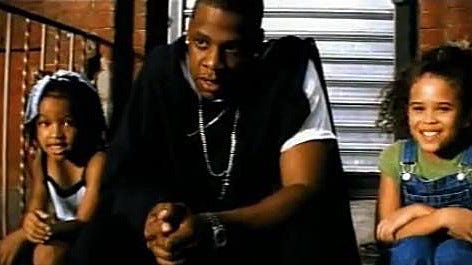
“Coming of Age (Da Sequel)” reunites Jay and Bleek’s characters from its ’96 predecessor for a tumultuous new chapter in which the impatient protege comes for his mentor’s spot. Swizz Beatz’s synthesized bassline and digital keys effectively convey the rapidly changing times that produce short self-lives in the drug and music rackets. In true hustler form, Jay-Z backs the cocky young gun down with poise and savvy rather than gangsta bravado, demonstrating that in the rap game, as in the song, he is more than equipped to run the on coming era.
“Can I Get a…,” already a massive hit at the time of Vol 2.’s release, rounds out the album’s center. While the hypnotic bounce of the beat remains irresistible, inclusion of the original version over the re-worked radio edit is the album’s only glaring strategic misstep. With listeners conditioned to expect the the clean version’s ear worm call-and-response “can I get a what, what?” chorus, the album version’s misogynistic vitriol feels tonally dissonant.
With all the other bases covered in his play for rap’s vacant throne, Jay-Z assembles a murders’ row of similarly positioned MCs for a bout of lyrical pugilism on “Reservoir Dogs.” The Lox, Sauce Money, and Beanie Sigel all eat on the Erick Sermon track, but Jay-Z devours it, leaving nary a crumb. Flexing his most aggressive delivery, he flips and contorts his flow, weaving seamlessly in and out of pockets of the Isaac Hayes sample that Black Moses himself probably didn’t know existed. It’s a brief but potent reminder that behind all the commercial cunning and brand management, Jay-Z was, is, and always will be a master on the mic.
Five hit singles and five platinum plaques later, it’s safe to say that Vol. 2… Hard Knock Life succeeded resoundingly in its aims to “stretch the game out, etch your name out, put Jigga on top.” From it’s release in the fall of ’98 to his eventual (and short-lived) retirement at the end of The Black Album’s chart run in 2004, no rapper dominated the charts, airwaves, and culture with the consistency of Jay-Z.
While his hustler persona and audience triangulation strategies are still imitated today, the reverence for Vol. 2 has dissipated over time. Despite remaining his best seller and containing two of his most iconic hits (“Hard Knock Life” and “Can I Get a…”), it’s rarely mentioned in discussions of definitive Jay-Z albums, let alone hip-hop’s great long-players.
I suspect the strategic approach responsible for its success is also what now keeps listeners at arms’ length. In avoiding regional identifiers and golden era tropes, the production can feel polished to the point of sterility. The efficiency with which all topical and tonal boxes are checked carries the clinical calculation of corporate product rather than heartfelt art. Even when Jay-Z bares his soul in bars, the reveals seem measured, giving just enough to humanize him, but not enough to truly expose him.
Vol. 2 isn’t the best Jay-Z album, but it is the most important. Without the brand it built, he likely wouldn’t have had the status to return soulful soundscapes to hip-hop with 2001’s The Blueprint (or been relevant in 2001 at all), or deliver The Black Album as a mic drop magnum opus. Without the foundation it laid, New York may not have had a place in the re-configured hip-hop landscape of the 2000s. It is after all, the project that introduced Ja Rule and Murder Inc. to the rap world, helped elevate Swizz Beatz to super producer status, and made it okay for New York artists to enlist dirty south producers like Timbaland to help broaden their reach.
Even if didn’t quite manage to transcend its time, it did define the time; an era of overlooked importance as hip-hop recalibrated before our very eyes. It takes a master strategist to not only navigate such uncharted terrain, but emerge at the top of the mountain.
By the Numbers
Production: 8 Lyrics (how the words are put together): 9.5 Delivery & Flow: 9 Content (Substance): 8.5 Cohesiveness: 8.5 Consistency: 8 Originality: 8 Listenability: 8 Impact/Influence: 9.5 Longevity: 9
Total — 86
Next
Previous
Backspin is a look back at the albums that shaped and defined hip-hop. It explores what made them resonate, the impact they had on the culture, and where they fit in today’s ever-expanding hip-hop canon.


