
Backspin: Cypress Hill — Cypress Hill (1991)
Behind the smoke, Cypress Hill delivered a hit of gritty surrealism. (86/100)
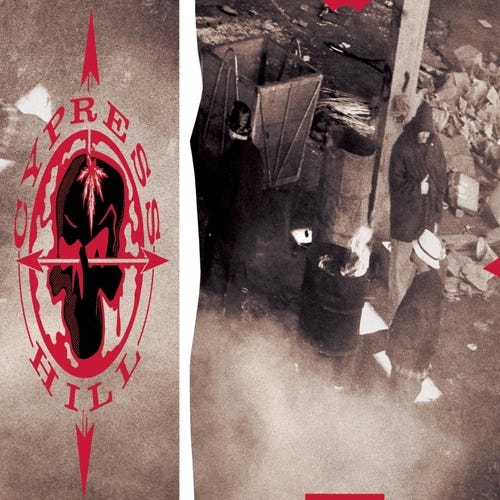
Delving back into early ’90s hip-hop is like opening a time capsule. In retrospect, 1990–92 was a transitionary period - a towering suspension bridge connecting the late ’80s Golden Era to the mid ’90s Renaissance. Inside the capsule, you’ll find a dizzying array of bold stylistic excursions that were omnipresent in the moment (chiggy-check the stigitty-style of digitty-Das EFX), but ultimately a pitstop rather than the final destination.
Cypress Hill’s 1991 debut is one of the more memorable pitstops. Like the roadside diner you stumbled upon on your “gap year” road trip, the pie hits just as hard as it did back then. And not just because of that Cohiba sized spliff you may have smoked before saddling up to the counter…
I tried in vain to get through the introduction to a Cypress Hill retrospective without a weed reference. Alas their decades as hip-hop’s unofficial ambassadors to the High Times crowd has come to define their legacy, overshadowing the unique brand of gritty surrealism that made their debut such a singular offering.
Press play on Cypress Hill, and you’re immediately greeted by the sound of a police dispatch reporting suspects “seen climbing out of both windows, male Hispanic and a possible male Black.” The alert is quickly overpowered by a dusty drum loop and piercing guitar sample that feel like the blues on angel dust. It sets an atmosphere of a horror movie filtered through a fun house. The dizzying dissonance only deepens when B-Real’s nasal countertenor cuts through the mix with a playful rebuke of crooked police. His sing-song delivery belies the scathing commentary of the lyrics, making it feel as though we’re wading through the world’s most sinister cartoon.
Cypress Hill quickly pivot from prey to predators on the album’s two iconic singles. “How I Could Just Kill a Man” lets the nihilism truly marinate. DJ Muggs once against unleashes high pitched wails atop heavy bass to create sonic tension. It’s resolved by a cathartic call and response chorus utilizing the yin and yang vocal chemistry of B-Real and Sen-Dog. The track continues to flesh out the album’s dystopian dreamscape with a double beat switch leading into the third verse, taking us from a pensive horn loop to whimsical organ riff. As B-Real issues icy threats atop a sound more at home on a carousel than a hip-hop song, the streets he’s depicting suddenly feel like a carnival of anarchy.
That carnival grows even more mesmerizing with the “Duke of Earl” sample that opens “Hand On the Pump,” twisting Gene Chandler’s playful vocal into a psychedelic accompaniment to the bassline (or is it the other way around?). B-Real’s cartoon voice makes his threats all the more menacing, as if the streets are a children’s game with no winners where everybody meets the finish line sooner than later. He sounds like a demon rising from the deepest part of the id as he spits:
Well I’m an alley cat, some say a dirty rat On my side is my gat, see I’m all of that Spittin’ out buckshots, boy I’m gonna wet’cha Run and hide, but I’m still comin’ to get’cha Thinkin’ like a peace smoke, comin’ on a homicide You talkin’ s***, tryna take me for a ride I’m not a bad guy, but I’m the funky feel Finger on the trigger when my hand’s up on a steel Lettin’ out a bullet, this is goin’ boo-ya You’re stuck in my hood, so what ya gonna do now? Bein’ the hunted one is no fun Here I come son, yo I think ya better run Better run more, and move a little faster Second of thought and I’m comin’ to blast ya
The sing-song hook introduces the weed component with which the group would eventually become synonymous. Here, it remains as subtext; a flourish of detail to flesh out the scene of murderous merriment (“Sawed-off shotgun, hand on the pump/left hand on a 40, puffin’ on a blunt!”).
On “Light Another,” Mary Jane makes her way to the forefront, but purely as metaphor. In arguably the album’s most creative lyrical display, B-Real imagines himself as the herbal stimuli, intoxicating listeners via his music.
Cypress Hill doesn’t deliver a true smokers’ anthem until the 10th track, but “Stoned Is the Way of the Walk” delivers a head rush worthy of the purest medicinal. Muggs slows the tempo to an off-kilter amble, topping the bassy rumble of Grant Green’s “Down Here On the Ground” with a slightly atonal horn riff to musically mimic the haze of a high. For his part, B-Real keeps the colorful caricature to a minimum. Riding the cascading beat with intense precision, he shows more reverence to his herbal companion than he has shown for anything else on the album, including (or especially) life itself:
Kick it like a steel toe, real slow hits from the bong Make me feel like Cheech, and I’m kickin’ it wit’ Chong Just like Cheech and Chong frontin’ with “Ice Cream” Cypress Hill is here to give you a nice dream Speak it like a rolla’, and you know it’s rolled tightly I’m like the funky beat, so, why ya tryin’ ta fight me?
Marijuana has been a part of hip-hop since the beginning. That wasn’t the smell of incense wafting into NYC high rise windows from late ’70s park jams. But until Cypress Hill, it had remained largely on the periphery, with many MCs publicly shunning it as a detriment to breath control. Once Cypress Hill proudly lit up, it went around like VD. Within a year and a half, Dr. Dre had gone from bragging the he didn’t “smoke weed or sess” to naming his album after LA’s high potency chronic bud.
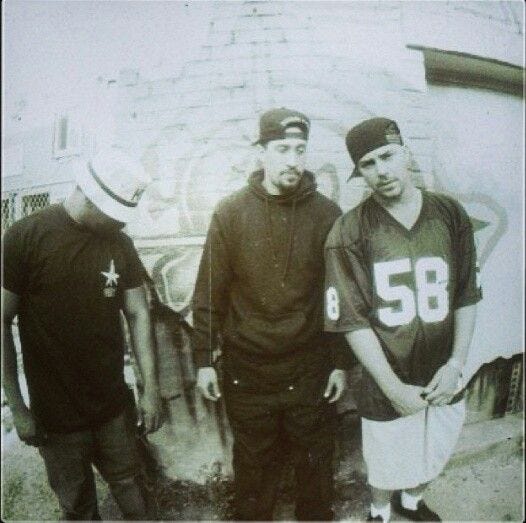
Similarly, B-Real and Sen Dog’s proud celebration of their Latin American heritage pushed the contributions of Latinos to the forefront after years of going largely overlooked despite being integral to the culture from its inception. “Latin Lingo,” a Sen Dog fronted flex of bi-lingual braggadocio, is a celebration of the cross cultural seasoning that has long given hip-hop its vibrancy. Muggs’ bubbling percussion closes the circle of Sen’s Afro-Latino heritage with a beat channeling African rhythms as filtered through the South American outposts of the Middle Passage. “Tres Equis” features B-Real rocking entirely in Spanish over John Roberts’ “Sophisticated Funk,” itself a gumbo of diaspora sounds.
It’s not hard to imagine a world in which Cypress Hill ushered in the next sound of gangsta rap, bristling with brutal surrealism rather than the funkafied hedonism mainstreamed by N.W.A’s Efil4zaggin earlier in the year. But Cali’s infamous weed turned Dr. Dre out and, 16 months later, The Chronic refined the Efil4zaggin sound to create a sonic template so warm and sumptuous that it quickly enveloped an entire coast for the better part of the decade. Ironically, the Cypress Hill sound carried a greater influence on the East Coast, where Muggs’ dusty excursions into tonal dissonance could be seen as the conduit from Public Enemy’s wall of sound to Wu-Tang’s 36 chambers.
Still, Cypress Hill’s long term impact outstrips most of their class of ‘91 peers, with Latino rappers from Fat Joe and Big Pun’s Terror Squad collective to multi-media sensation Cardi B having achieved stardom in subsequent decades. And you’d be hard pressed to get past the third track on any hip-hop album from the last quarter century without at least a passing weed reference.
Cypress Hill themselves remain at the forefront of the intersection between the hip-hop and marijuana communities, proof positive that they made the smart decision by leaning into the weed world once it embraced them. It’s hard not to wonder what might have been had they continued down the path of gritty street surrealism paved by Cypress Hill. But the fact that they didn’t makes their debut a truly singular entry in the time capsule to an equally singular moment.
By the Numbers
Production: 9 Lyrics (how the words are put together): 8.5 Delivery & Flow: 9 Content (Substance): 8 Cohesiveness: 9 Consistency: 8 Originality: 10 Listenability: 8.5 Impact/Influence: 9 Longevity: 7
Total — 86
Next
Previous
SEE ALL
Backspin is a look back at the albums that shaped and defined hip-hop. It explores what made them resonate, the impact they had on the culture, and where they fit in today’s ever-expanding hip-hop canon.